Tucson protesters urge no vote on Prop. 421 and TEP deal
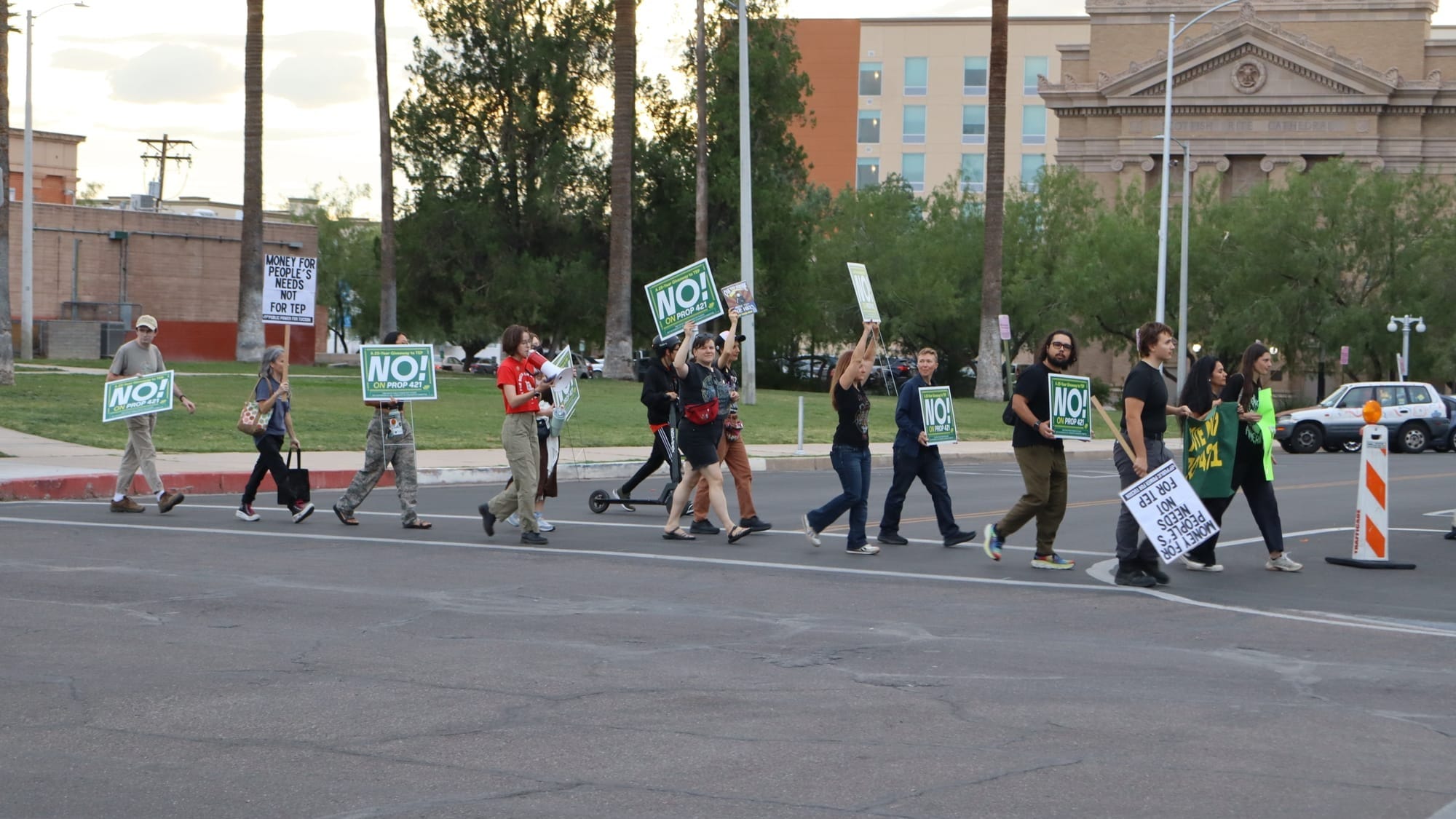
Protesters marched to TEP’s downtown Tucson office Oct. 21 urging a no vote on Prop. 421 and a shift to public power ahead of the Nov. 3 election.
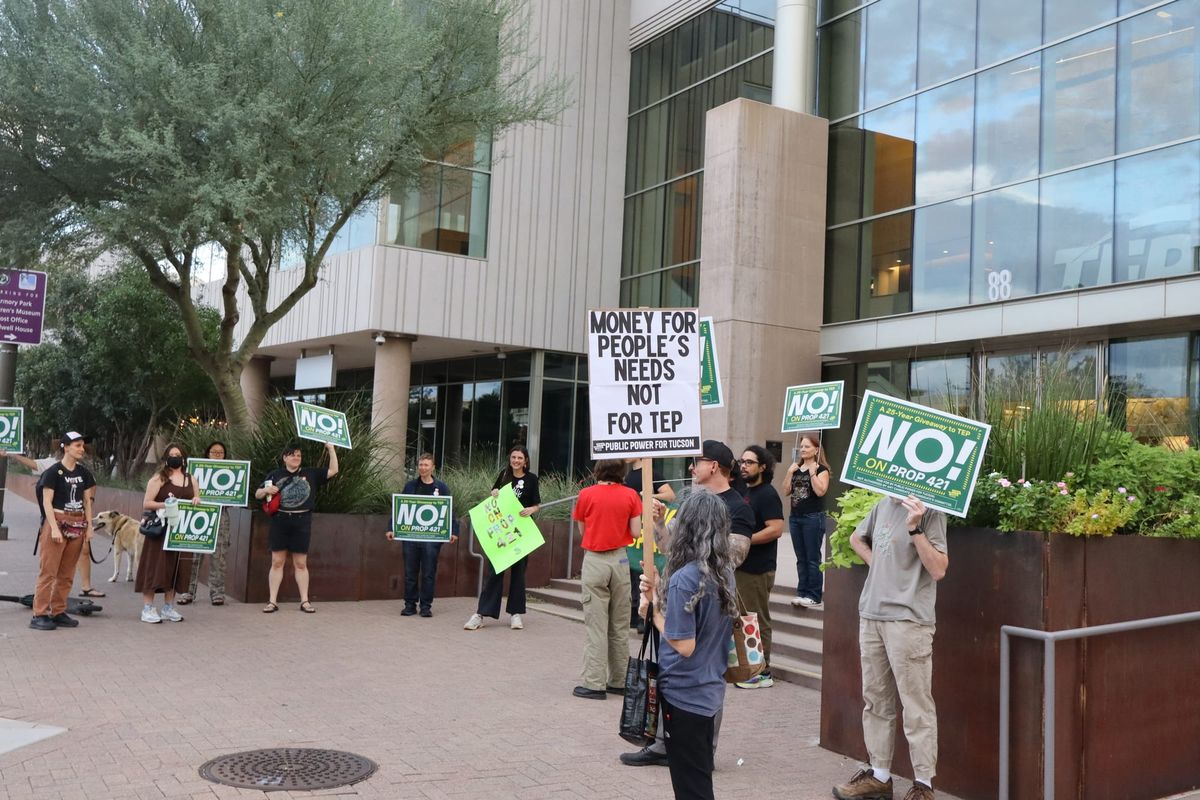
Protesters who marched to Tucson Electric Power’s downtown office Oct. 21 say a no vote on Proposition 421 would keep the city from committing to TEP for 25 years and open the door to public power.
Prop. 421 would renew TEP’s 25-year franchise agreement with the city and put into effect a related energy collaboration agreement. Voters will decide in the Nov. 3 election.
Starting at Armory Park, protesters spoke with voters and heard from speakers before walking down 6th Avenue to TEP’s office, carrying signs and chanting slogans critical of the utility’s ongoing rate case and environmental practices.
They called a vote in favor of Prop. 421 a “referendum on TEP.”
“Through voting no on Proposition 421, we will finally be able to force the city council to look into the public power option and to stop further collaboration with TEP,” said Desiree Nguyen, a member of the Public Power for Tucson and the Party for Socialism and Liberation who helped organize the protest.
Organizers have been campaigning for public power, saying a people-driven process would provide greater benefits than an investor-owned utility like TEP, including lower rates and fewer power outages.
They also said public power could use surplus profit for things like health care and education instead of repaying investors and shareholders. They compared those promises with the rate increase of about 13% that TEP is seeking from the Arizona Corporation Commission.
The energy collaboration agreement would provide $2 million a year in TEP funds for infrastructure and sustainability projects, rising 2% annually, for about $64 million over 25 years. Protesters said TEP’s practices harm the environment in ways public power would not, such as moving to renewable energy faster instead of shifting from coal to natural gas, as TEP plans to do by 2030.
We're a nationally recognized newsroom, but we're still a nonprofit that runs on community support. Help us keep telling Tucson's stories.
Protesters also linked TEP to Project Blue, a proposed data center they say would damage the environment as a result of TEP’s business practices. The Arizona Corporation Commission approved a 10-year energy service agreement between TEP and the data center in December, and Attorney General Kris Mayes has sued to force a rehearing.
TEP can’t deny power to anyone in its service area, but protesters said a public utility would give residents more say in where power goes on the grid.
“We would have the final say in decision-making, in processing, in being able to decide where our electricity is going towards, such as going towards our low-income neighborhoods instead of being siphoned to a data center,” Nguyen said. “Much like how the public utility of Tucson Water defeated the initial proposal for Project Blue. Project Blue could still be defeated, could still not be destroying our land if TEP, if our electrical grid, were a public utility.”
TEP officials say Prop. 421 renews “common-sense rules” on the utility’s access to the city’s right-of-way as part of the franchise agreement renewal, which would free the company to respond to outages faster.
The existing Tucson-TEP franchise agreement is set to expire in April 2027 and includes a 2.25% franchise fee on customer bills.
Public Power Tucson said that campaign finance reports show that TEP’s political action committee, TEP for Tucson, has spent nearly $4 million over the course of its campaign to garner support for Prop. 421, including almost $3 million on online and TV advertisements, $780,000 on campaign mailers and $14,160 on 59 campaign arguments for the official Tucson voter guide.
TEP said Prop. 421 would not raise customer energy rates and that rates would not fall if voters reject it. Any increase would come from a separate rate case before the Arizona Corporation Commission. Commissioners will vote after hearings before an administrative law judge.
TEP said it filed the request to recover costs from $1.7 billion in investments over the last five years. The utility also said inflation has raised its material and labor costs by 15%, more than the increase it is requesting.
Ian Stash is University of Arizona alum and freelance journalist in Tucson. Contact him at ianjgs16@gmail.com.
Tucson Spotlight is a community-based newsroom that provides paid opportunities for students and rising journalists in Southern Arizona. Please consider supporting our work with a tax-deductible donation.