Tucson violent crime spikes as temperatures rise, data shows
Tucson violent crime rose nearly 18% during the hottest months of 2025, according to Tucson Police Department data, as researchers and local death records point to a consistent link between rising temperatures and increased aggression.
When temperatures climb past 110°F in Tucson, the heat does more than make people sweat. Researchers say it also makes them angrier, and local crime and death records back that up.
Seasonal depression, also known as Seasonal Affective Disorder, typically peaks in winter, but a less common form emerges in spring and summer, according to the National Institute of Mental Health.
The study also found that summer-pattern SAD can bring additional symptoms including trouble sleeping, poor appetite and weight loss, restlessness and agitation, and anxiety and violent or aggressive behavior.
One expert said the link between heat and violent crime comes down to basic physiology.
"There are hypotheses grounded in physiology (predicting that) heat makes us irritable and it reduces sleep," said Brian Mayer, a professor in the University of Arizona's School of Sociology. "As warmer temperatures reduce our body's ability to rest and be calm, scientists hypothesize that it might also make us more aggressive."
Not everyone responds to heat the same way. Some people seek it out for swimming, tanning and outdoor sports, while others struggle with its effects.
Tucson Spotlight is free for every reader because donors make it possible. Join them.
But Mayer said the connection goes beyond individual physiology.
"There are other factors beyond just individuals and our impulse control, or lack thereof. Warmer temperatures drive us to be outside more and in different patterns," Mayer said. "Here in Tucson, we want to be outside in the early and late hours when there's less light, creating greater opportunity for violent interactions. That thinking is a little outdated today, but events like 1977's 'Summer of Sam' tell that story well."
The summer of 1977 in New York City became a byword for urban unraveling. Serial killer David Berkowitz terrorized the city while it contended with abandoned buildings, waves of arson, a 25-hour blackout in which 3,000 people were arrested, and a blistering heat wave that only increased the tension as Berkowitz's attacks on couples in parked cars and on sidewalks pushed public fear toward panic.
Berkowitz killed six people and wounded eleven others over more than a year, but it was that sweltering summer, the one that gave the era its name, that Mayer says illustrates his point: heat doesn't cause violence so much as it raises the temperature on everything else that already does.
Mayer said the pattern goes deeper than just who's outside and when.
Gun violence follows a seasonal pattern, with June, July and August consistently recording the highest number of mass shootings over the past decade, according to the Gun Violence Archive, as reported by the Associated Press. The Fourth of July ranks among the deadliest days of the year, while December through March see the lowest totals.
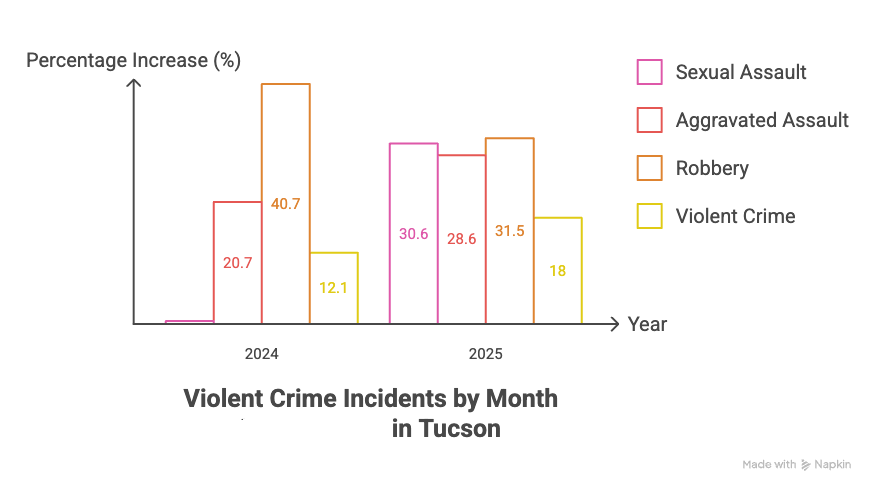
The pattern held across two consecutive years of Tucson Police Department data. In 2024, TPD recorded 12.1% more violent crime incidents during the five hottest months of the year than the five coolest, with robbery up 40.7% and aggravated assault up 20.7%.
In 2025, the overall gap widened to 18%, with aggravated assault jumping 28.6%, robbery 31.5% and sexual assault 30.6%.
In both years, homicide was the lone exception, with slightly more incidents recorded in cooler months than hot ones.
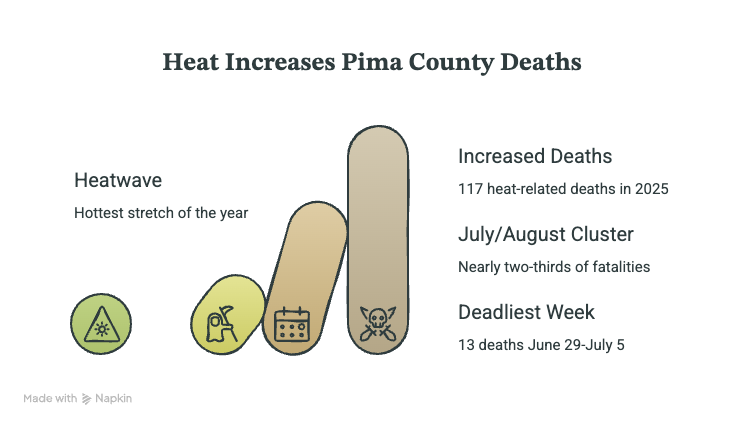
The heat's toll shows up in the morgue, too. The Pima County Office of the Medical Examiner recorded 117 heat-related deaths in 2025, a 9% increase from the prior year, at a rate of 10.7 per 100,000 residents.
The deaths clustered in the hottest stretch of the year: July and August alone accounted for nearly two-thirds of all heat-related fatalities, with 37 and 38 deaths respectively, and the deadliest single week was June 29 through July 5, when 13 people died. Notably, only 24% of those deaths were caused directly by environmental heat exposure.
The majority involved heat as a contributing factor, amplifying underlying conditions like chronic illness or drug use, which accounted for 32% of heat-related deaths on its own.
"I think it's important to consider the interaction between pre-existing structural vulnerabilities that make some spaces more likely to experience increases in heat and the effects heat has on everyone's bodies," Mayer said.
Christy Russell is a journalism major at the University of Arizona and Tucson Spotlight intern. Contact her at crussell68@arizona.edu.
Tucson Spotlight is a community-based newsroom that provides paid opportunities for students and rising journalists in Southern Arizona. Please consider supporting our work with a tax-deductible donation.