Rio Nuevo board tackles safety, downtown growth projects
Rio Nuevo's board addressed downtown safety measures and a board member's resignation while advancing retail expansion projects in Tucson.

The Rio Nuevo Board of Directors met July 29 for the first time since a board member's abrupt resignation and last month's downtown shooting, addressing both while continuing to push forward retail expansion projects across downtown Tucson.
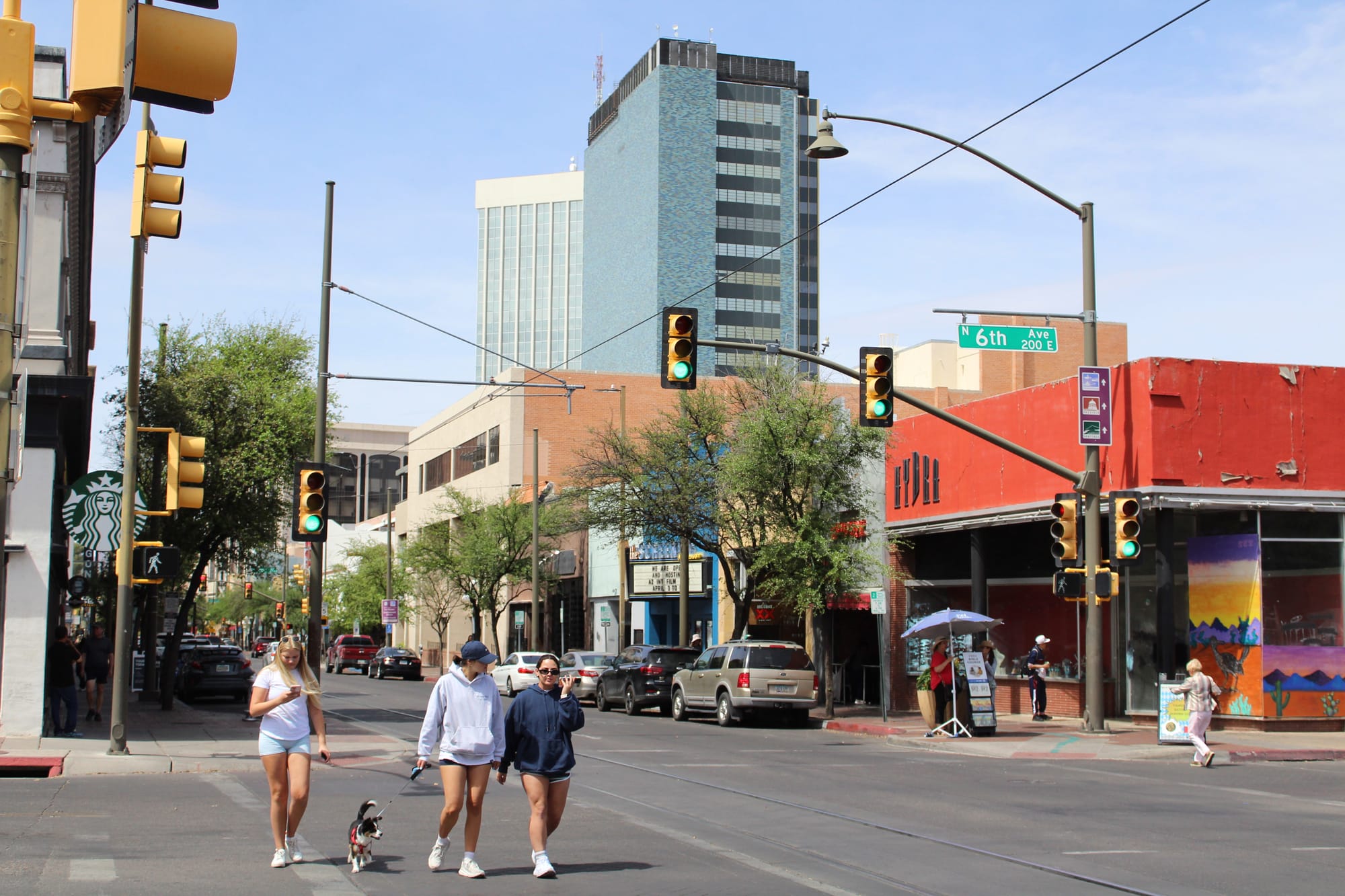
Downtown Tucson Partnership President and CEO Crystal Moore walked the board through steps to improve downtown safety, including better management of the nighttime economy, increased public safety visibility and coordinated scheduling of city employees such as Safety Ambassadors, downtown district police officers and off-duty police.
The most controversial of these steps has been the adoption of Patron Scan ID scanners by businesses participating in the Together Tucson safety initiative. The scanners collect the first and last name, date of birth and ZIP code of all IDs scanned and add it to a database for a period of 24 hours to 21 days, depending on operator discretion. When violators are banned from any establishment participating in the program, the ban automatically transfers to all other participating locations.
Board Chair Fletcher McCusker said the $55,000 program has already faced backlash online, with community members expressing privacy concerns.
Moore defended the scanners, saying they actually collect less data than the old, outdated system that Together Tucson had previously used.
"Your phone is probably generating more information on the output than your first and last name, your date of birth and your ZIP code," she said, adding that there has already been a decrease in violent incidents downtown since the system's rollout.
McCusker praised off-duty police officers' handling of the shooting last month that injured nine people and a drive-by shooting in May.
"Two times within the last couple months, these officers have run toward gunfire," McCusker said. "And not only intervened, but shot the assailant. A lot of lives were saved by the quick action of our officers."
Moore agreed, crediting the coordination behind the scenes.
"(The) Tucson Police Department did an excellent job 12 days ago, and Rio Nuevo had something to do with that response," Moore said. "That is because of the strategic plan that we have on those high-activation nights."
The board also discussed former member Edmund Marquez's resignation to focus on his recent majority ownership of the Tucson Sugar Skulls, which came about a week after the board's July 14 meeting.
"He surprised all of us with resignation in between the meetings," McCusker said.
The board discussed filling the gaps left by Marquez's resignation, including replacing his role as a second signatory of checks with long-standing member Jannie Cox and appointing Mike Levin to the board's marketing group. McCusker said he wasn't interested in holding a board election for another officer.
Kyle Jefferson and Linette Antillon shared details about their plans to expand Pueblo Vida Brewing Company, which the couple have owned and operated for over 12 years. It's located at 115 E. Broadway Blvd., but the pair is working on a project next door at 121 E. Broadway Blvd., which has been vacant for eight years.
The company has plans for three concepts that would leave the building open for the entire business day, including collaborations with two other local businesses.
"We would have a coffee program in the morning … in partnership with Presta Coffee," Antillon said. "We would have a new food concept by Anello that would do lunch and dinner, and then, of course, would be our taproom with our craft beer, but we would also have an expanded menu with wine."
But given its age, the building requires extensive remodeling.
"When we acquired the property about a year and a half ago, unfortunately there was nothing usable in the property and nothing met code," Jefferson said. "This is a full modernization of the property."
These plans include an already-installed full HVAC system. Jefferson said the construction process was faster than anticipated while showing renderings of what the building would look like when finished.
The couple said the expansion would collect about $7 million in three years, which would generate about $613,000 in sales taxes and contribute about $183,000 to the Rio Nuevo Planned Area Development. They requested $400,000 from Rio Nuevo toward their total project cost of about $1.2 million, including $100,000 immediately, $100,000 within one year, and $200,000 worth of parcel sales tax rebates.
The expanded concept is expected to open in October.
Favin Gebremariam, owner of Ethiopian entertainment complex Z-Street, followed up on her request for $65,000 to construct a permanent playground-type shade structure discussed in a previous meeting.
She showed the board three different options for the structure based on bids from construction companies: one from American Play Systems and two from the Phoenix-based Shade Industries. The American Play Systems design would cost about $57,500, while the two designs by Shade Industries would cost about $73,000 and $91,000, respectively.
Gebremariam requested funding for the most expensive option, which includes three tarps instead of the two that were included in the initial proposal, and seven steel poles.
"It preserves the most usable space for gathering and creating memories, and it will be that way for the next 15 to 20 years," she said.
The board was hesitant to approve the option, citing Rio Nuevo's recent budgetary concerns. A monthly cash flow of only $240,000 has forced the region to dip into its reserves.
Board member Corky Poster suggested removing the additional tarp for the time being, which he thought would lower the price to a similar level as the less expensive option from Shade Industries.
"This might be something you can add six months from now or a year from now, at relatively low cost and low expenditure," Poster said. "I'm just trying to keep our capital costs down."
Board member Taunya Villicana asked if the Gebremariams had discussed a payment plan with Shade Industries.
Gebremariam said they hadn't yet approached Shade Industries about a payment plan, since they'd only received the contact information and bids that week, but she was happy to ask about their flexibility. McCusker recommended looking into the cost reduction or financing options.
Additionally, the board gave deadline extensions to two projects, Cornish Pasty Co. and Herbert's Deli. Cornish Pasty Co. received an extension to Dec. 31, while Herbert's received an extension to Feb. 28.
Benjamin DePue is a University of Arizona student and Tucson Spotlight intern. Contact him at bdepue@arizona.edu.
Tucson Spotlight is a community-based newsroom that provides paid opportunities for students and rising journalists in Southern Arizona. Please consider supporting our work with a tax-deductible donation.