Tucson drug arrests up 67% under Safe City Initiative
Tucson saw a 67% spike in drug arrests in early 2026 under its Safe City Initiative, but critics say hundreds of arrests have produced only a fraction as many shelter placements, raising questions about the program's true goals.
Tucson is arresting more people for drug offenses than it did a year ago, but city officials say the goal isn't incarceration, it's getting people into treatment.
The city reported a 67% increase in felony and misdemeanor drug arrests in the first quarter of 2026, totaling 806, as part of its Safe City Initiative, an umbrella effort addressing public safety, homelessness and substance use that officials say is designed to connect people to services, not fill jail cells.
But several local mutual aid organizations are pushing back on the initiative, offering a sharply different view of the program's results. Community Care Tucson, Alma 520 and Gatoraid argue that the initiative amounts to an agenda of mass arrest and criminalization of poverty, noting in a joint Instagram post that since October it has resulted in hundreds of arrests and thousands of charges but only a few dozen shelter placements.
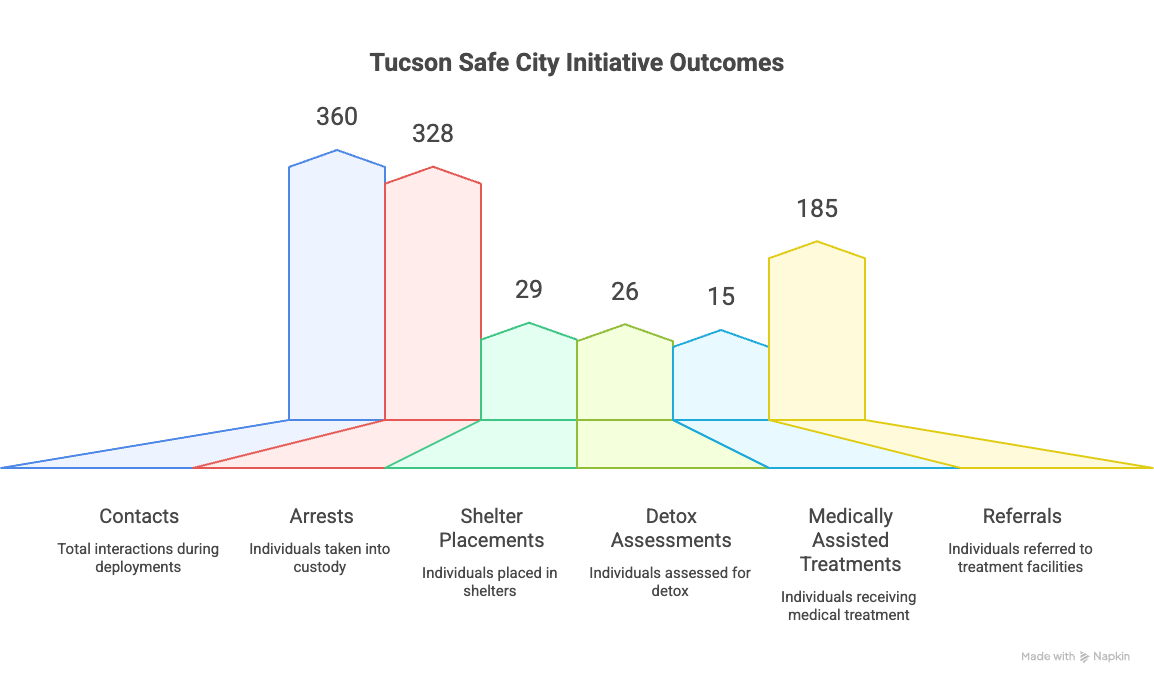
The city's own data from March lends some weight to that claim. Fifteen Safe City deployments resulted in 360 contacts, 328 arrests and 1,097 charges, clearing 15 encampments. Those same deployments produced 29 shelter placements, 26 detox assessments and 15 medically assisted treatments.
The groups say residents do not trust the city's offers of services when they are delivered alongside the threat of arrest, and that decades of research shows sweeps and arrests worsen homelessness rather than reduce it.
They also drew a direct line between the initiative and a 2025 Trump administration executive order on homelessness, accusing the mayor and council of carrying out that agenda locally.
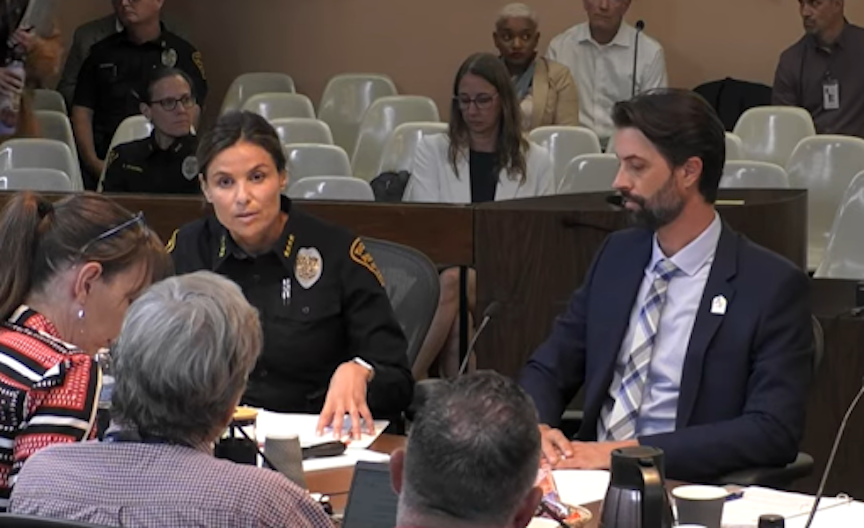
Tucson Police Chief Monica Prieto said during the April 7 city council meeting that TPD issued guidance to officers in January to improve how they collect information about an arrestee's behavior and criminal history, with the goal of better equipping prosecutors to pursue cases down the line.
"There are some individuals that have been arrested repeatedly for the same type of nuisance and drug-related offenses over very short periods of time. Often they are in the same places as well that they are arrested," Prieto said. "It's important to identify those top repeat offenders whose behaviors are not changing, and utilizing focused deterrent strategies to ensure there is accountability."
Prieto said enforcement alone is not enough, pointing to the need for deflection from the criminal justice system and service-based interventions. The city is working with community service providers and county administrators on those efforts, including three Clear Path deployments so far this year.
The transportation department has a stake in the Safe City effort too. Tucson's Department of Transportation and Mobility has formalized regular coordination meetings with TPD, SunTran and contracted security to develop shared data-reporting standards that better track where incidents are occurring.
The department also requested $350,000 to fund TPD special deployments, which launched March 9. In the program's first three weeks, 228 officer hours yielded 69 arrests, 129 warnings and nine referrals to services.
The transportation department is seeking an additional $150,000 for environmental improvements to bus stops with the aim of discouraging some of the "problematic events" taking place. These enhancements include adding lighting or removing obstructions.
The passage of Propositions 418 and 419 will generate roughly $2.5 million per year for traffic safety for the duration of the plan. Future goals include real-time monitoring capabilities through the Community Safety and Response Center and expanded contracted security.
Tucson's Housing and Community Development department spent the month collecting feedback from the Safe City task force and related nonprofits, using it to draft a new policy document.
The document defines two new concepts: a "safe outdoor space," which uses tents or encampments to connect unhoused individuals with services, and a "safe parking spot," a similar approach for unhoused families living in a car or RV.
"We're really trying to balance different needs here. We want to ensure the clients who are unhoused have a level of safety, we want to also make sure that these sites are good neighbors and we also want to try to make it easier for nonprofits and faith-based organizations to create these spaces as well," said Anne Chanecka, director of Tucson's Housing and Community Development department.
Tucson Mayor Regina Romero expressed excitement with the Safe City plan, saying she has seen positive impacts and received good feedback from local neighborhoods and businesses.
"Since the beginning of the Safe City initiative, I've been very clear that incarceration is not the goal, that treatment is, and connecting people to the treatments and resources that they need, and that's what I saw firsthand," Romero said.
Mutual aid groups are encouraging residents to register for upcoming public feedback sessions on the Safe City Initiative.
Ian Stash is a journalism major at the University of Arizona and Tucson Spotlight intern. Contact him at istash@arizona.edu.
Tucson Spotlight is a community-based newsroom that provides paid opportunities for students and rising journalists in Southern Arizona. Please consider supporting our work with a tax-deductible donation.