Santa Rita Park reopens in Tucson after $8M renovation
Tucson’s Santa Rita Park reopened after an $8 million renovation that added a splash pad, trees, a walking path and public art honoring its softball history.
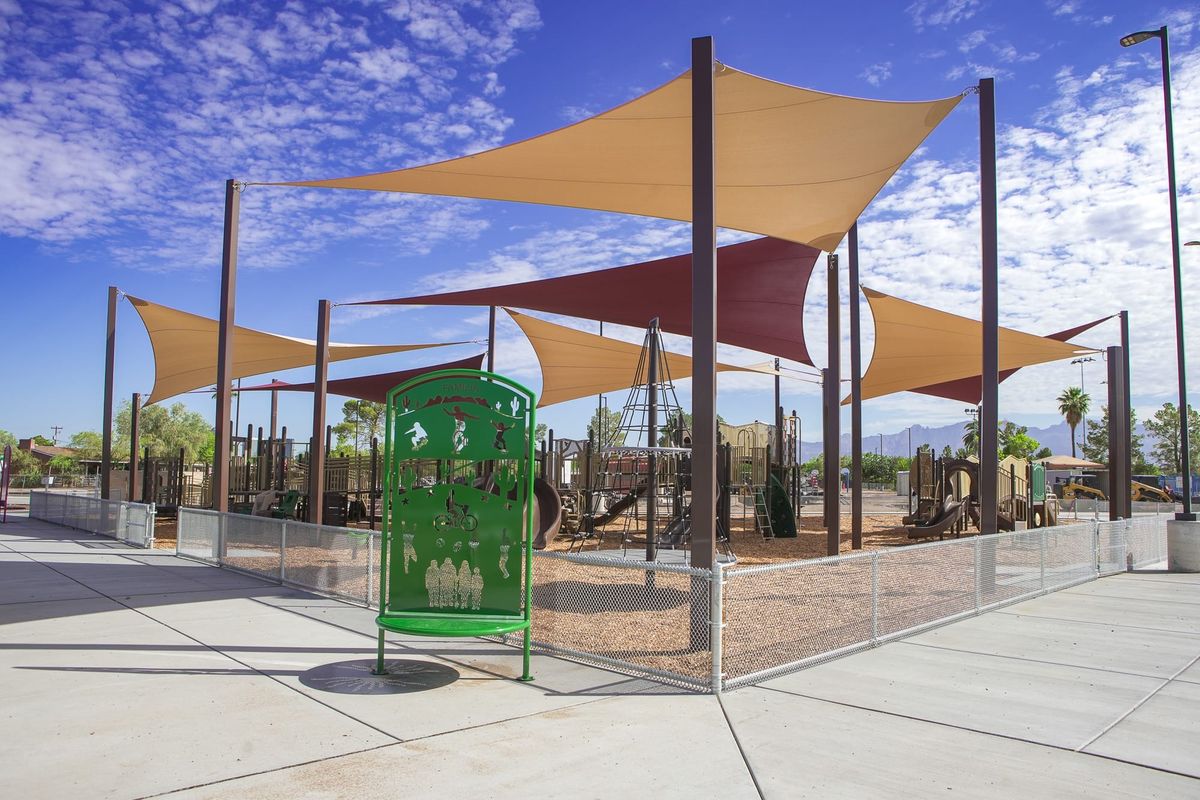
Santa Rita Park, one of Tucson’s oldest, reopened after an $8 million renovation that added a shaded splash pad, a new walking path and public art honoring the neighborhood’s softball history.
More than 1,000 people came out to celebrate the park’s reopening and see the additions to its 22-acre campus at 401 E. 22nd St. The renovation was based on community input from five public meetings and three surveys, which drew a combined 799 responses.
The renovation included the addition of more than 300 trees and shrubs, along with improvements to the basketball courts, parking lots, restrooms, skate park and playground.
Funding for the renovation came from multiple sources, including $5.38 million from Proposition 407, a Parks and Connections Bond initiative that was approved by voters in 2018. The proposition provides $225 million for park improvements and safer walking and biking connections through 2028.
Some of that money also went toward public art at the park.
Artist Oliverio Balcells, whose work spans murals, metalwork and mosaics, was chosen by the project’s public art panel in February 2024. He worked closely with the panel and neighbors to create public art that reflects the park’s legacy and the people around it, including two benches by the playground and a mosaic mural.
“This is amazing, the opportunity to meet more people in the neighborhood, the community, the city of Tucson … it’s amazing,” Balcells said, reflecting on his experience.
Tucson Spotlight trains the next generation of Southern Arizona journalists and publishes their work free for everyone. No paywalls, no corporate backing — just readers who believe this community deserves better local news.
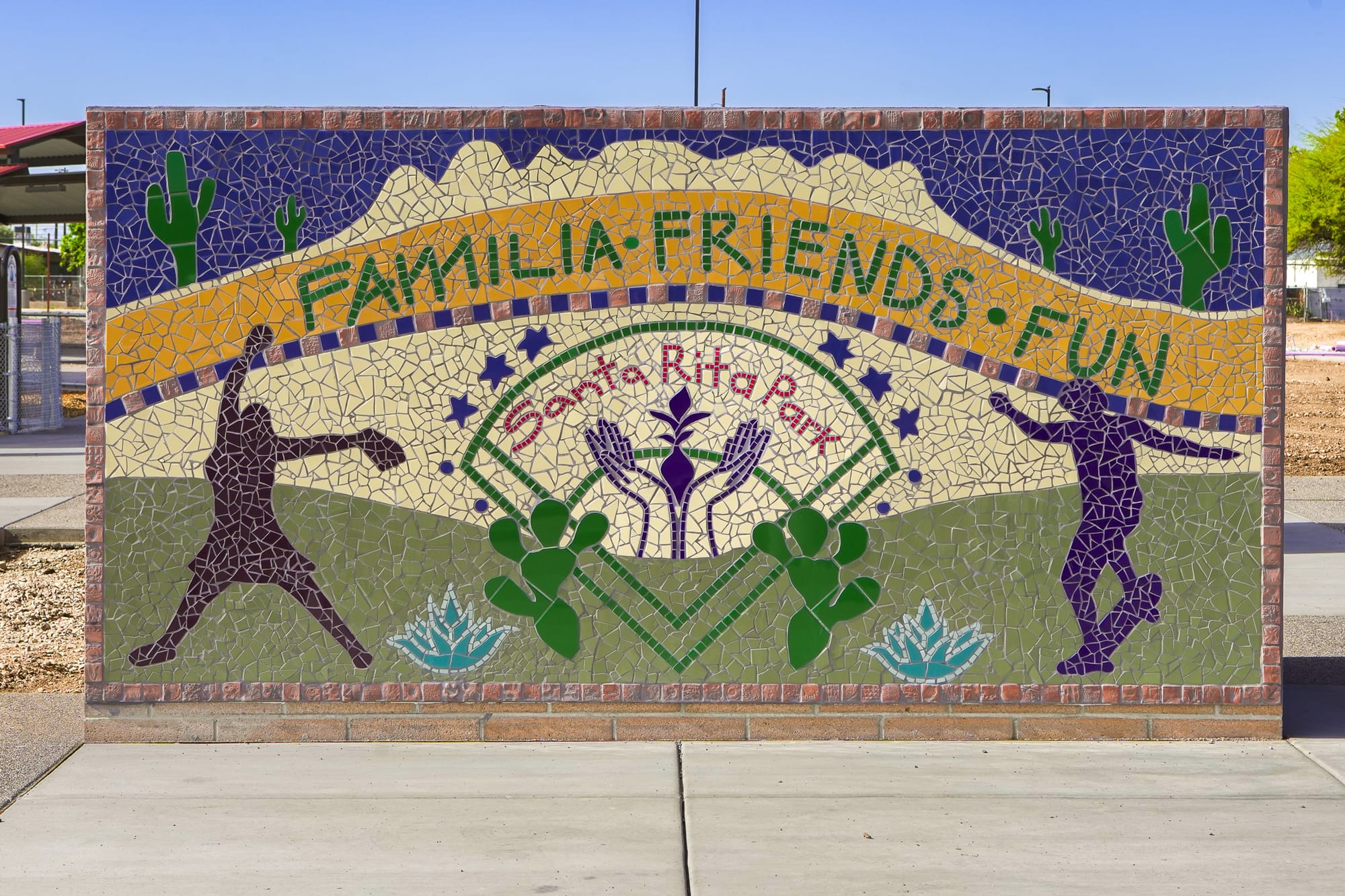
The tiled mural displays the words “Familia, Friends, Fun” and features a softball player, a skateboarder and hands centered in a baseball diamond. The images honor the teams that played in the park, the skate park and the community members who have been part of Santa Rita Park, past and present.
Community members also helped create the mural. Fourth- through sixth-grade students from Borton Elementary School made the 2-inch-by-2-inch ceramic tiles that form its border, under the guidance of outdoor learning teacher Mikeala Jones.
The art project, supported by the Arts Foundation of Southern Arizona, includes an oral storytelling component. A QR code next to the mural takes users to a website that features audio interviews of community members who played on the park’s men’s and women’s softball teams during the late 1950s into the 1960s.
“We would rather play ball than go to a party,” former Pacers player Connie Seres said in her interview. “We … didn’t have a team. We were at the ball game one night. We were sitting there … and Bill looked over at us. He said, ‘You know what, you find the girls,’ he says, ‘and I’ll coach you.’ We were scrambling. We were looking for people to play, and we made our own team, and Bill coached us, and we had so much fun.”
Another former player, Juan Soto, remembered how the ballfields used to look.
“When you go back and look at Santa Rita Park … field number one … there used to be bushes on the outside, all around the outside of the fence. There used to be vines on the fence back there. The aesthetic was just beautiful,” said Soto, who used to play for the Hawks.
Rosie, a Santa Rita Park resident and vice president of the neighborhood’s neighborhood association, lives across the street from the park and attended the reopening celebration. A participant in the renovation project, she said she was ecstatic to see the neighborhood use the park.
“I hope we really get to see kids and families really enjoying the park,” Rosie said. “Bringing back that traditional Sunday afternoon, coming to the park and carne asada and the kids running in the splash pad. We haven’t seen birthday parties at this park in years. I’m looking forward to all that.”
Tucson Mayor Regina Romero said hopes like Rosie’s shaped the renovation.
“The residents asked for more trees, shaded walking paths, splash pads, new playgrounds, and updated restrooms … amenities to bring back children, families, and sports leagues who have always counted on this place for recreation, connection, and joy,” Romero said. “Your feedback guided every step of the way and played a vital role in creating the final design that we see today. Thank you for trusting us with your vision.”
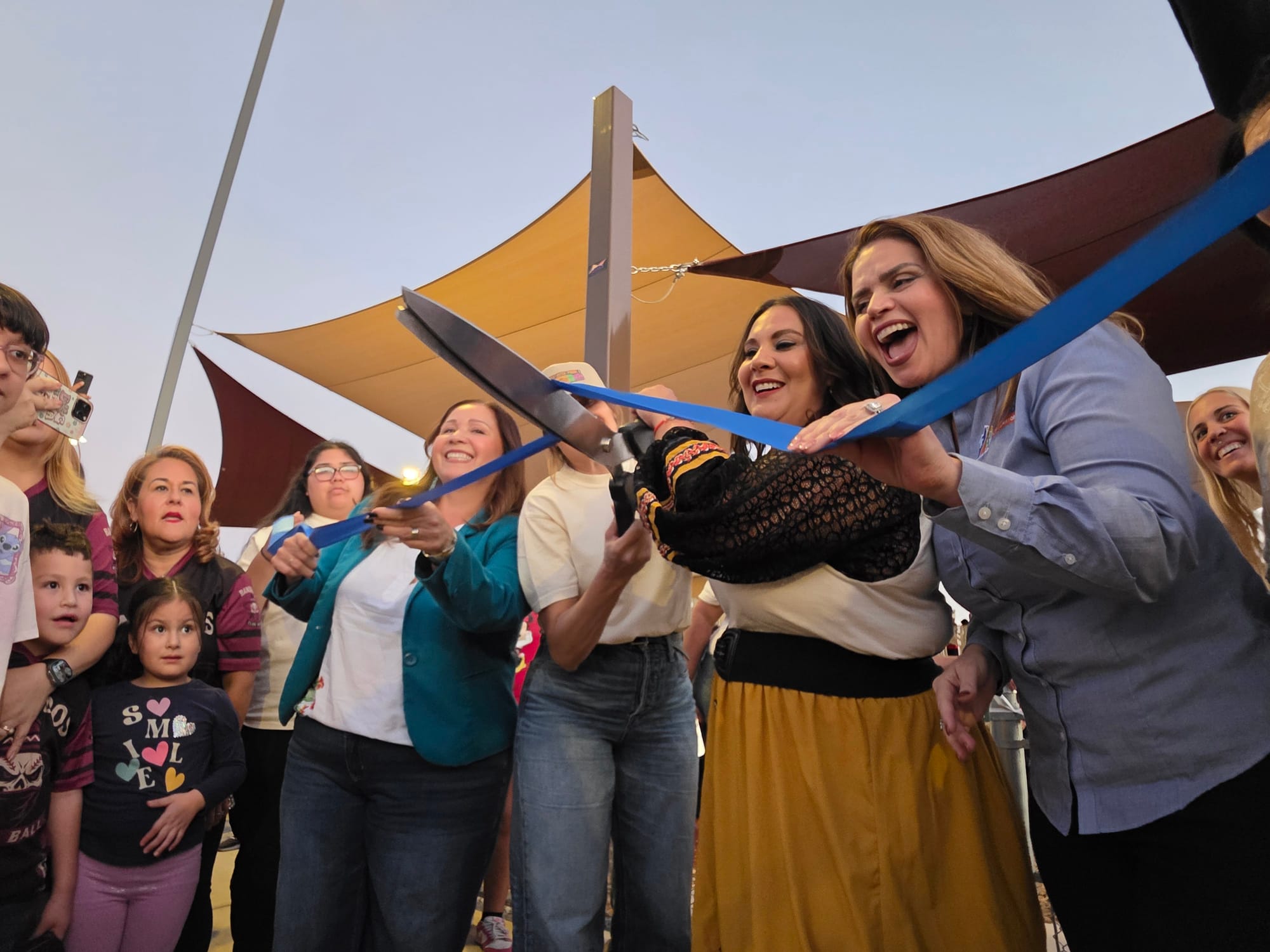
Carla Johnson, vice chair of the Tohono O’odham Nation, said she was excited about the park’s reopening and its new splash pad, which the nation helped fund with $150,000 from its gaming grant.
“The nation is wholeheartedly proud to be able to support you all, the community in this renovation here at Santa Rita Park, it’s an example of how tribal gaming benefits the entire community,” Johnson said. “We have seen the difference that good public parks can make on the nation, and we know it’s vital to help make Tucson a better place to live and thrive.”
Ward 5 Councilwoman Selina Barajas said the renovation reflects a broader goal for the city’s parks.
“Every child in Tucson deserves access to a beautiful, safe place to play, to participate in sports and to build memories with their families, no matter what neighborhood they call home … no matter the zip code,” Barajas said. “I remember visiting Santa Rita Park before the reconstruction … taking my daughters to the playground … and there wasn’t even a slide. I remember going home and telling my husband, ‘I’m going to get involved in this park.’ and here we are today.”
Barajas said Ward 5 is the hottest in Tucson because of the urban heat island effect, in which roads, buildings and parking lots absorb heat from the sun during the day and release it overnight, raising neighborhood temperatures a few degrees above surrounding wards.
The addition of trees, shrubs and bushes, like the ones recently planted at Santa Rita Park, can reduce that effect.
Parks offer benefits beyond cooling a neighborhood.
Neighborhood parks promote physical activity that helps prevent disease, and they support mental health by reducing stress and building community ties, according to a 2022 research report by the Urban Institute.
The same report touched on the economic impacts of parks, citing a study by the Trust for Public Land that estimated every $1 invested in green spaces yields $4 in natural goods and services.
“When a park is active and full of families, neighbors, and young athletes, it becomes a safer, more welcoming place for everyone,” Tucson Parks and Recreation said in a statement. “Our goal is for Santa Rita Park to be a source of pride for this community for years to come.”
Topacio “Topaz” Servellon is a reporter with Tucson Spotlight. Contact them at topacioserve@gmail.com.
Tucson Spotlight is a community-based newsroom that provides paid opportunities for students and rising journalists in Southern Arizona. Please consider supporting our work with a tax-deductible donation.