Oro Valley, Pima County move to restrict data centers
Oro Valley tightened its ban on large AI data centers Nov. 18, while Pima County’s planning commission backed stricter rules.
The newly seated Oro Valley Town Council voted unanimously Nov. 18 to tighten the town’s ban on large AI data centers, which the previous council adopted Oct. 28, the same day Pima County’s Planning and Zoning Commission backed stricter rules for data centers countywide.
Oro Valley’s zoning code is a general ban on large AI data centers, defined by the code as requiring 20 megawatts of power and often enormous water demand. It also revokes the “by-right” allowance, requires a conditional-use permit instead and still leaves room for ancillary data systems.
Mayor Melanie Barrett and council members Rosa Dailey, Rhonda Piña and Matt Wood were sworn in Nov. 4 after winning their races in the July primary. Barrett succeeded Joe Winfield, who was term-limited after eight years as mayor. Dailey, Piña and Wood filled the three council seats previously held by Barrett, who moved up from vice mayor, and Joyce Jones-Ivey and Josh Nicolson.
Winfield said during the Oct. 28 meeting that he and Barrett brought the item to the council three weeks earlier, and the discussion that night made clear it was meant as a two-step process, with a ban on data centers first and a more thorough analysis of the topic to follow.
Before the ban, data centers had been permitted in several Arizona jurisdictions, including Oro Valley, for a while due to the “by-right” zoning regulation.
“By-right” means land uses that are permissible without additional permitting. If a contractor plans to build housing on a lot already zoned for housing, no extra permitting, rezoning or committee meetings are required other than a construction permit, as long as their plans conform to the code.
Dailey, who had not yet been sworn in, spoke against the conditional-use permit as a member of the public during the Oct. 28 meeting’s public comment period.
“That change to the code does not go far enough, in my opinion,” Dailey said. “I believe we need to essentially ban, I hate to use that word, but ban all standalone datacenters of any size which support the remote infrastructure of artificial intelligence.
Dailey praised the council for trying to distinguish between ancillary, medium and large data centers, but felt that the distinction was not aligned with the amendment’s intention.
“We do not want to expand our code to give the signal that we are in the data center business,” Dailey said. “Data centers that remotely support the infrastructure of artificial intelligence are not appropriate for Oro Valley. These enterprises are cloaked in opaque business structures and wrapped in non-disclosure agreements, making it impossible to even assess how they will actually impact our communities resources.”
Your gift keeps local news free, bilingual and built for real life.
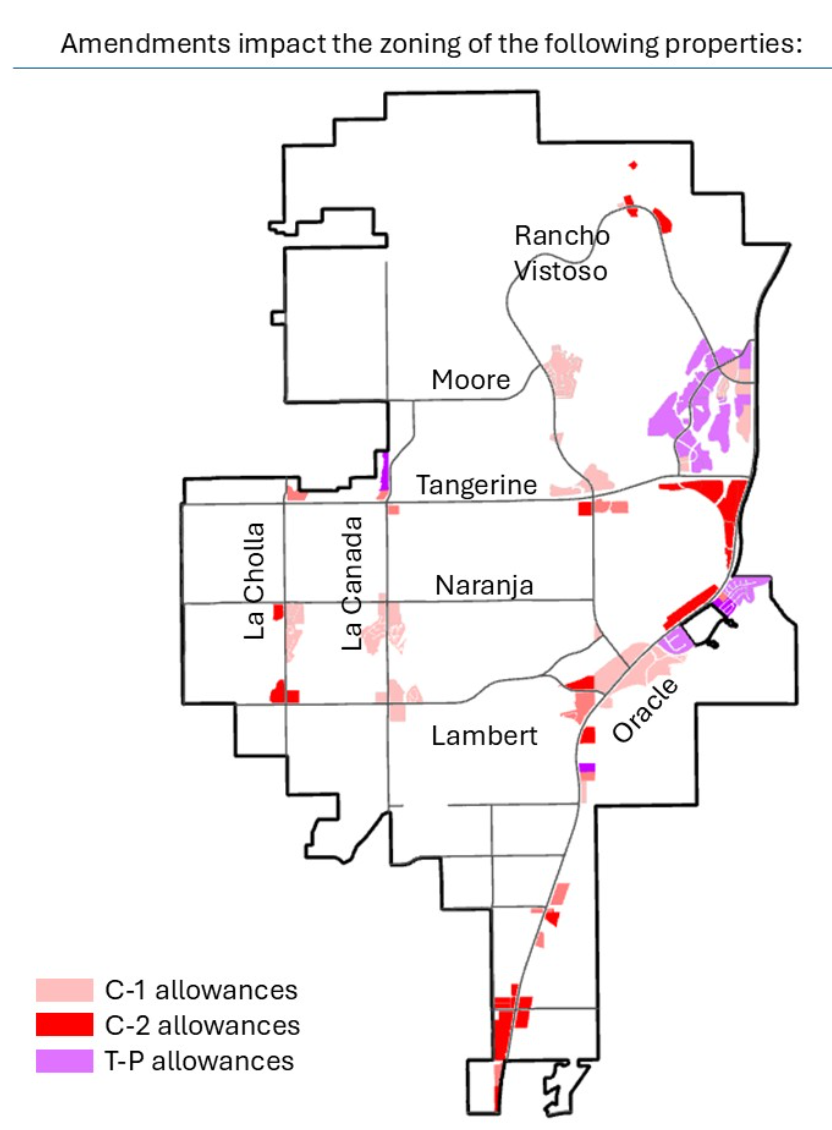
Three weeks later, during its Nov. 18 meeting, the newly seated council revisited the amendment to ensure that the code still reflects the will of the council and community.
The new language affirms the general ban, stating that “data centers are prohibited as a primary use in all zoning districts and Planned Area Developments.” It also adds general guidelines for ancillary use.
Planning Manager Bayer Vella told council members that no residents or property owners in Oro Valley had voiced opposition to the code amendments.
Vice Mayor Elizabeth Robb also successfully pushed to amend the code’s language to prevent leasing and sharing of data storage and processing from data centers.
“Since we learned recently that words are very important, there are other ways of allowing storage and processing service to other parties other than leasing it,” Robb said.
The council adopted the changes while retaining the ability to revisit the amendment later.
Oro Valley isn’t the only local government tightening its data center rules. The same day the town adopted its original ban, Pima County’s Planning and Zoning Commission voted to lower the county’s definition of a data center to 20 megawatts of power or 25,000 square feet of gross floor area, matching the City of Tucson’s. The power threshold is the same one Oro Valley uses for large AI data centers.
The commission’s 8-1 vote also added several more restrictive policies to its latest recommendations to the county Board of Supervisors on regulating data center projects.
Other changes to the recommendations include banning PFAS, a group of chemicals often found in water-resistant products, in the water of closed-loop cooling systems. The allowed noise near residential areas would drop from 55 decibels throughout the day to 50 decibels in the day and 40 decibels at night. Data centers would also have to sit half a mile from any residential, educational or hospital area, have generators and battery storage that can supply two hours of power during an outage, and have a clear plan for decommissioning, including removing equipment and storage and remediating the local environment.
The commission still plans to incorporate other concerns into its recommendations before they go formally to the Board of Supervisors. It directed county staff to explore additional water restrictions and a water conservation plan, and to further refine the definition of a data center.
The one dissenting vote came from Commissioner Bob Cook, who instead wanted to call for a complete moratorium on all data center development in the county.
Cook said the data center debate plays a big role in the affordability crisis because of the water and power that data centers require, and he tied that to his support for a moratorium.
“If you look at how demand gets scaled with these hyperscale data centers, you see this incredible multiplying of average demand,” Cook said. “You can’t look at the past, you have to look at the future and the impact this is going to have over time.”
In August 2025, the Pima County Board of Supervisors directed the commission to revise the zoning code to establish standards for data centers. In September, the board passed a 120-day moratorium on data center construction that runs through Jan. 20, 2027, giving the commission time to develop the recommendations it discussed at its meeting for the board to consider before the moratorium ends.
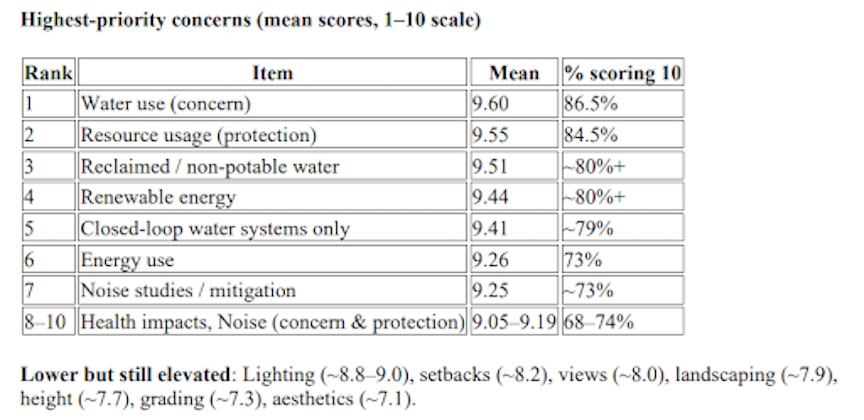
The commission’s changes were guided by a public opinion process, including two town halls to solicit resident feedback in September and October, and a survey to gauge concerns and preferences. The survey drew about 1,900 responses, with a particular emphasis on concerns about resource usage.
In the survey’s 1,250 open-ended responses, the overwhelming sentiment was distaste for data center development, according to the county. Between 25% and 30% called for an outright ban on data centers in Pima County, mostly over water concerns. Others in opposition asked for regulations such as a minimum distance from residential areas, self-sufficiency in power and water costs and supply, environmental protections and no tax breaks.
The survey also found a small minority who supported data centers under “reasonable conditions,” citing job and tax benefits to help the county’s struggling economy.
Neighboring Cochise County is also considering its own restrictions on data center development, with Pima County commissioners noting that whatever Pima County ultimately adopts could be used as a guide.
However, Arizona counties are subdivisions of the state, meaning that if the state adopted its own data center regulations, those would override Pima County’s. County staff also noted that it is important to manage the entire process carefully because of Proposition 207, a 2006 state law that lets property owners seek compensation when new land use rules reduce the value of their property.
Members of the public who spoke during the meeting were overwhelmingly opposed to data centers, calling for greater restrictions.
Resident Rick Rappaport said there were far too many unresolved issues and called for a moratorium. He said his primary concern is water use, which often gets traded around on paper like carbon emissions, a process he said does not work with water.
“It doesn’t matter how they’re cooled, they have an extensive water footprint,” Rappaport said. “Staff seem to have balanced both sides of the Congo with this plan, but it sounds like what Mike Tyson said when he was told his opponent had a plan: ‘Everyone’s got a plan until they get punched in the mouth.’”
Quentin Agnello is a University of Arizona alum and freelance journalist in Tucson. Contact him at qsagnello@gmail.com.
an Stash is University of Arizona alum and freelance journalist in Tucson. Contact him at ianjgs16@gmail.com.
Tucson Spotlight is a community-based newsroom that provides paid opportunities for students and rising journalists in Southern Arizona. Please consider supporting our work with a tax-deductible donation.