UA's endowment move comes as Phoenix project struggles
The University of Arizona denies its $70 million endowment transfer is connected to a struggling Phoenix research building's financing, but won't answer key questions about the project's bond status, fundraising, or cost changes.
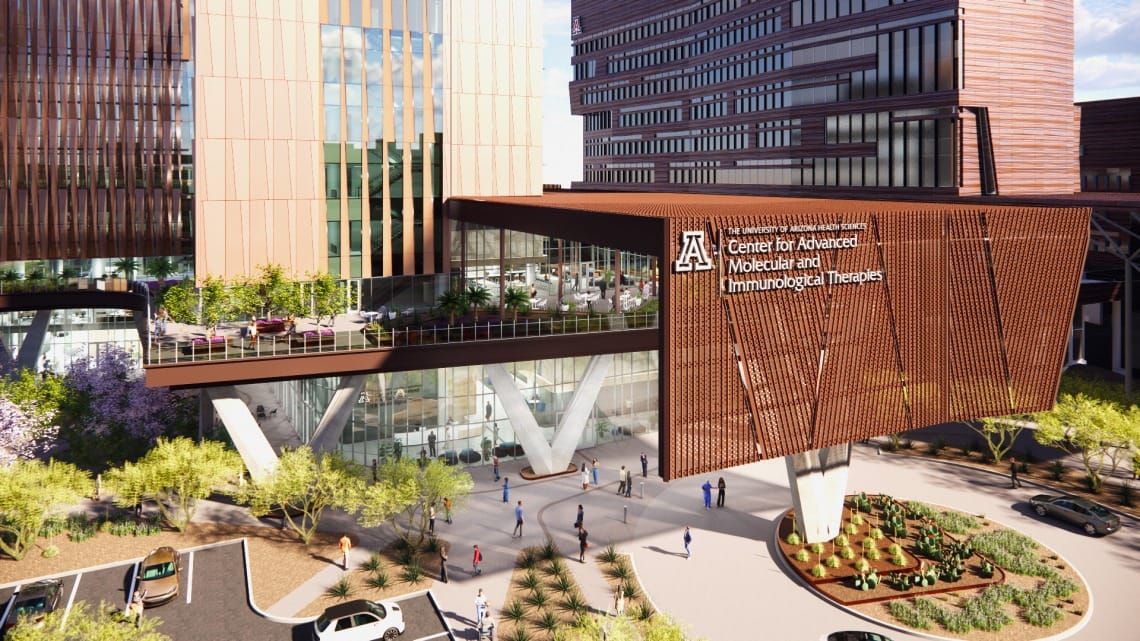
The University of Arizona’s decision to transfer $70 million in donor endowment funds to its direct control follows a move to issue $75 million in construction bonds to backstop financing of a new medical research building in downtown Phoenix. Although the amounts are similar, the UA says the two things are unrelated.
Arizona Board of Regents documents show that the UA has raised zero gift dollars for the $232 million Medical Innovations Building, known in earlier records as the Center for Advanced Molecular and Immunological Therapies, or CAMI. Last November, regents approved $75 million in bond financing for the building. In February, the board nearly doubled a state research fund allocation to the university, from $20 million to $39.7 million, to backstop the project's construction. The UA announced its decision to transfer donor endowment funds to its control earlier this month.
While university officials say there is no connection between the transfer and the Phoenix building's financing, they have not addressed the overlap in timing and dollar amounts between the two transactions, or answered questions about the building's bond status and fundraising progress.
The Medical Innovations Building's capital plan submitted to ABOR showed no gift fundraising progress as of September 2025, one year into construction. The documents do not indicate whether the university had an active fundraising effort underway for the project.
The project's total cost had dropped by $58 million between the 2024 and 2025 capital plan submissions. UA says the scope of the project was amended following "a universitywide evaluation of research infrastructure needs in 2025," but has not specified what changed or how it accounts for the $58 million figure.
The February allocation came from UA's Technology and Research Initiative Fund. Board documents state the funds were directed "to create capacity to backstop CAMI construction." A backstop, in financial terms, is a reserve set aside to cover a shortfall if a project's primary funding sources prove insufficient.
The foundation notified donors of the $70 million endowment transfer earlier this month. It is scheduled to close June 30, the last day of the university's fiscal year, when its Days Cash on Hand and other year-end financial metrics are calculated.
Tucson Spotlight requested university records on communications between administrators about the endowment transfer and the bond financing and whether the two are related, but the request has not yet been filled.
UA spokesman Mitch Zak said construction continues on the Phoenix project and that the university expects to secure the remaining project funding this summer. He did not say where that funding would come from.
Tucson Spotlight trains the next generation of Southern Arizona journalists and publishes their work free for everyone. No paywalls, no corporate backing. Just readers who believe this community deserves better local news.
 Caitlin Schmidt
He said the facility will strengthen the university's research enterprise and serve as a hub for advanced research and collaboration.
"The University of Arizona remains deeply committed to the Phoenix Bioscience Core and to its partnerships with the City of Phoenix, Maricopa County, the State of Arizona, and the federal government to advance world-class biomedical research that benefits the people of Arizona and beyond," Zak said.
He added that the project's development is unrelated to the endowment transfer.
Zak did not say how the remaining funding would be secured, whether the bond transaction has closed, or whether any gift revenue has been received since the September capital plan showed zero progress.
What is the Medical Innovations Building?
The Medical Innovations Building, known as CAMI on its website and in board records through 2025, is a 202,000 square foot research facility at the Phoenix Bioscience Core, a medical research campus in downtown Phoenix shared by UA, Arizona State University, and several hospital systems including Banner Health. It's designed to house labs for cancer vaccine research, immunotherapy, and organ transplant research, with the goal of attracting biotech companies and federal research dollars to the state. Arizona Board of Regents members have praised it publicly as positioning Arizona as a national leader in immunology.
The project has struggled financially since it was conceived during the tenure of former UA President Robert C. Robbins, who resigned in 2024 amid a roughly $177 million budget shortfall.
When the project was first presented to the board of regents in September 2023, Robbins' own performance goals were tied to its success. Board documents from that month show one of his FY 2022-23 performance targets was to secure at least $200 million in combined funding commitments from the state, local government, or private donors by June 30, 2023, citing CAMI's "economic and workforce development promise." That goal was tied to at-risk compensation, bonus pay contingent on hitting specific targets, separate from base salary.
The board rated the CAMI goal "partially achieved" and awarded Robbins $42,500 of the $45,000 in possible at-risk compensation tied to it. The board's records do not specify how much funding was actually committed toward the $200 million target, or how much, if any, came from private donors.
By September 2025, the project had changed shape. Since its 2023 debut, when it was planned as a 245,000 square foot building costing $195 million, the building had shrunk to 202,000 square feet while its total cost grew to $290 million and then back down to $232 million, a $58 million reduction between the 2024 and 2025 capital plan submissions.
Capital plan documents submitted to the Board of Regents that September show that gift fundraising toward the project stood at zero.
How the financing works
To finance construction of the building, the university planned to combine $158 million in state and county ARPA funds, federal pandemic relief money allocated through Arizona, with $75 million borrowed through bonds.
A bond is essentially a loan. Investors lend the university money up front, and the university agrees to pay it back over time, with interest, on a fixed schedule. Universities and other public institutions use bonds the way a family might use a mortgage: to pay for something big now and spread the cost out over decades.
The specific type of bond used for the building is called a SPEED bond, short for Stimulus Plan for Economic and Educational Development. These are issued by the Arizona Board of Regents on behalf of the state's three public universities, and they come with an unusual repayment arrangement: state law requires Arizona Lottery ticket revenue to cover up to 80% of the annual payment. The university covers the rest, in this case roughly $1 million of a $5 million annual payment through 2055.
That structure makes SPEED bonds attractive financing, because most of the repayment burden falls on lottery revenue rather than the university's own budget.
But before a university can actually borrow the money, lenders and rating agencies look at its financial health to decide whether the loan is a safe bet and on what terms. For the University of Arizona, the most closely watched measure of that financial health is Days Cash on Hand: a calculation of how many days the university could keep operating using only the cash it has available right then, without any new money coming in. ABOR requires UA to maintain at least 140 days. The university has reported approximately 78, roughly half the requirement.
In January, S&P Global Ratings upgraded UA's outlook from negative to stable, affirming its AA- rating and citing improved operations. But S&P warned that a weakening liquidity position, meaning less cash on hand, could reverse that decision. In plain terms: if UA's cash position looks too weak, it becomes harder and more expensive to borrow money.
And if the university can't secure financing on workable terms, it can't move forward with projects it has planned.
Last November, regents approved the $75 million SPEED bond financing for the Phoenix medical research building, listed under the CAMI name, on its consent agenda, a list of items approved in a single vote with no public discussion.
No regent asked about the fundraising gap or the zero gift progress, according to the meeting minutes.
Three months later, on February 5, the board held a special meeting conducted almost entirely in executive session, closed to the public by law, with minutes that are permanently confidential. The only item approved in the public portion of that meeting was the updated Technology and Research Initiative Fund budget that directed the additional $19.7 million toward UA to backstop construction.
 Caitlin Schmidt
A few months after that meeting, the UA Foundation sent the letter to donors notifying them that $70 million in non-scholarship endowment payouts would transfer to the university by June 30.
The foundation's letter to donors, signed by President and CEO John-Paul Roczniak, states the change was proposed by the university and would "assist the university in meeting the Days Cash on Hand targets mandated by ABOR and the university's bond rating agencies."
The university's public statement made no mention of Days Cash on Hand or bond rating agencies.
Faculty Senate Chair Leila Hudson estimates the $70 million adds roughly 10 days of cash on hand, consistent with the university's reported average daily expenditure of approximately $7 million.
What it means for donors
The endowment funds being transferred are restricted, meaning donors legally specified what the money funds, whether a named scholarship, a faculty chair, or a specific research program. Under the current arrangement, the foundation reviews every distribution request to confirm that it complies with those agreements before releasing funds to the university.
Beginning in July, all future annual endowment payouts, not just the $70 million currently held by the foundation, will transfer directly to the university, rather than passing through the foundation's review process first. Under the new arrangement, the university receives the funds directly, without that review.
The university has not said how it will ensure that spending distributions are used in accordance with donor terms and restrictions.
UA spokesman Zak did not respond to questions about what mechanism would enforce donor restrictions once the foundation's review process is removed, or whether the $39.7 million from the university’s Technology and Research Initiative Fund directed to the project in February was sufficient to meet financing needs for the building.
Tucson Spotlight has submitted a public records request seeking university communications about the endowment transfer and the bond transaction.
The UA Foundation, as a private, non-profit organization, is not subject to state public records law.
Caitlin Schmidt is Editor and Publisher of Tucson Spotlight. Contact her at caitlin@tucsonspotlight.org.
Tucson Spotlight is a community-based newsroom that provides paid opportunities for students and rising journalists in Southern Arizona. Please consider supporting our work with a tax-deductible donation.