UA students turn shipping container into Tucson housing
UA architecture students built a studio apartment from a shipping container to show how transitional housing could work in Tucson.
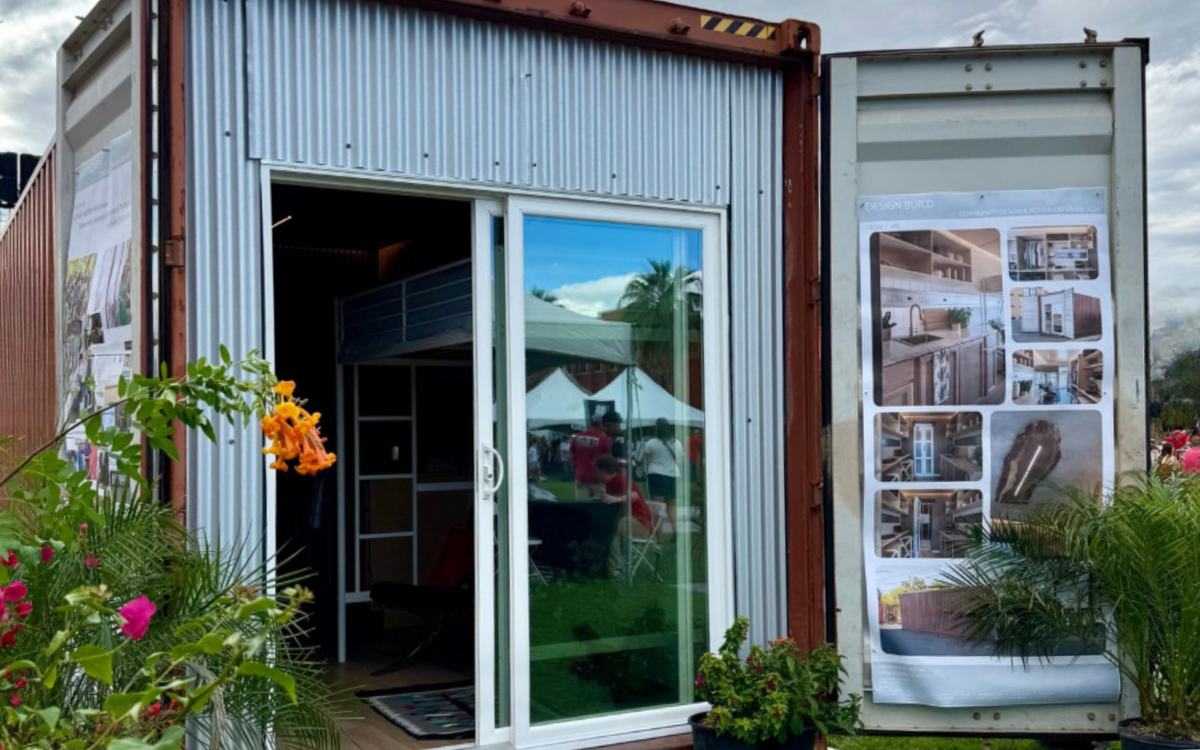
A shipping container on the University of Arizona Mall during Homecoming held a fully furnished studio apartment, built by architecture students to show how transitional housing could work in the Tucson desert.
Six students in the Community Design in Action capstone course spent 15 days building the 8-by-20-foot unit, which has a sleeping area, living room, full kitchen and full bathroom. The capstone is part of the University of Arizona’s College of Architecture, Planning and Landscape Architecture, known as CAPLA.
The unit grew out of a partnership with Apostolic Deliverance Ministry to develop a comprehensive master plan for a church site in Tucson. The design included community facilities such as a church building, a food distribution facility and a cafe, alongside a transitional housing village.
To ensure the housing component addressed the complex realities facing unhoused residents, students consulted with local stakeholders, including Dan Ranieri of La Frontera and Beau Phillips of Boxes of Hope, an organization dedicated to repurposing shipping containers for modular housing.
The proposed integration with La Frontera aimed to ensure that future village residents would receive supportive services, including health care and social services.
Guided by the principle that “everybody deserves a home,” the class prioritized reusing materials, turning steel shipping containers that would have sat unused in the desert into housing.
To test their strategies, the team created a prototype of a single studio unit within half of an 8-by-40-foot shipping container. The resulting 8-by-20-foot footprint was designed to use space as efficiently as possible.
The studio is designed as half of a duplex, paired with a mirror-image studio in the other half of the container, with a private entrance at each end. Beyond the prototype, the team developed scaled drawings and designs for one- and two-bedroom units for larger households.
Back the next byline. Give monthly or once.
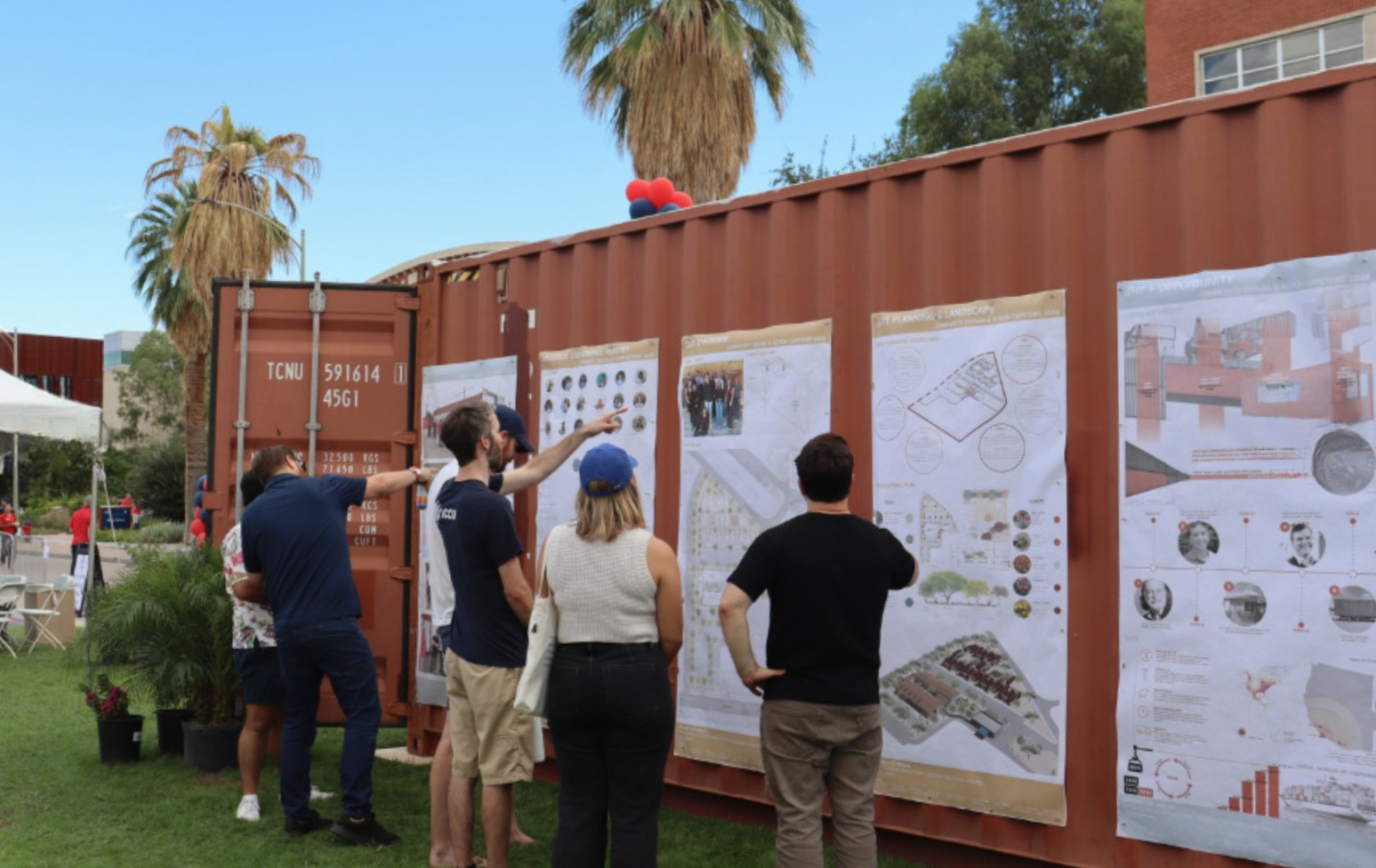
Adapting the steel containers for the Sonoran Desert’s climate required rigorous testing, since the steel absorbs the sun’s heat quickly, making it critical to keep the interior cool enough to live in.
“I did lots of research on the types of materials used to make these containers cooler and more habitable,” said student Ricky Arriaga. “We researched shading techniques and special reflective paint, such as ‘Cool Coat,’ a white elastomeric coat applied to the top of the container to reflect sunlight. As we applied it, we noticed over a couple of days that it felt cooler inside.”
Supported by the Peter and Pat Hirschman University Community Fund, the students moved from hand sketches and 3D-printed scale models to full-scale construction in an intensive build.
“It really allowed the opportunity to get out on the field and learn a lot by actually building up this container,” said Ryan Blake, another student who worked on the project. “It allowed people to step inside our work, rather than just look at a screen and understand our process of building what the community really needs.”
While digital models show ideal dimensions, physical construction requires real-time problem-solving and material management. Arriaga, who has worked as an apprentice alongside his father, helped lead the hands-on building.
“On the computer, everything is perfect, but when you’re actually making it, there are all these little details that might get in the way,” Arriaga said. “Having learned construction since I was younger, it was a proud moment to help guide my peers with tools and materials, managing the project so we could finish on time.”
Rather than assigning each person a set task, the team shared the work on design, budgeting, finding materials and construction.
“Nobody wanted to have one specific role, everybody wanted to do this together,” said student Dayton Bay. “We all had the same vision of creating a capstone project that was not just going to be a presentation board, but something that was going to last and spark interest for others.”
Assistant Professor Teresa Rosano said the project also taught students to work within real-world financial and logistical constraints.
“During the build part, being very organized and effective with their time and resources was both a challenge and where they really succeeded. They did a great job tracking costs and keeping receipts to stay within budget,” Rosano said.
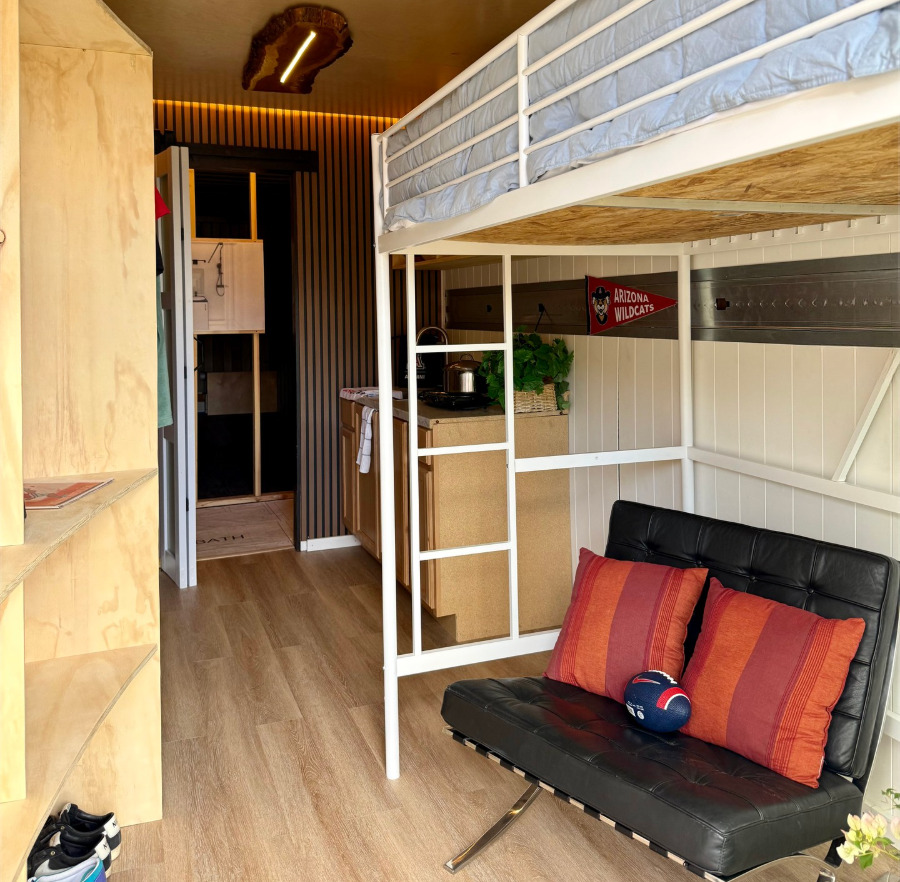
The completed prototype debuted on the University of Arizona Mall during Homecoming weekend, surrounded by native desert plants that created an entryway and a sense of place.
Public reception was overwhelmingly positive, with visitors praising the interior design and use of space.
“A lot of times containers are used for their strong steel shell, and interior features are an afterthought, going very simple or cheap,” Arriaga said. “We tried to make it cozy, that was a word we loved to use. People walked in and said it felt like a tiny home or a casita, which was exactly what we were aiming for.”
Blake said many visitors also wanted to talk about the project and what it could mean for Tucson.
“It was almost overwhelming how many people came up and interacted with the container,” said Blake. “We had alumni and community members saying, ‘We really need this in our community.’ Hearing that support proved people are behind wanting to help others.”
The students summed up the project’s greater impact as a lesson in community-centered practice.
“The number one biggest thing is listening: hearing the needs of whoever you’re trying to help first,” said Blake.
Bay said the lesson goes beyond housing, to how any project should be judged.
“Good design is not defined by the size or cost of a building. Whether it’s a compact housing unit or a custom home, the overall goal is improving how people live,” said Bay.
After the project’s success, Boxes of Hope and La Frontera, the two organizations the students consulted, partnered to secure 27 acres in South Tucson, where they plan to build a 300-container village with shared community facilities.
Isabel Vidrio is a University of Arizona alum and freelance journalist in Tucson. Contact her at ividrio40@gmail.com.
Tucson Spotlight is a community-based newsroom that provides paid opportunities for students and rising journalists in Southern Arizona. Please consider supporting our work with a tax-deductible donation.