UA helps Arizona rural communities access health funds
Arizona is distributing nearly $167 million in federal funding to expand healthcare access in rural and tribal communities, and the UA Center for Rural Health is helping organizations navigate the grant process.

Arizona's rural and tribal communities are about to see a wave of new grant opportunities and the University of Arizona's Center for Rural Health is positioning itself as the go-to resource for organizations looking to tap in.
The Arizona Rural Health Transformation Program is distributing nearly $167 million in federal funding to expand healthcare access in rural and tribal communities across the state, part of a $50 billion national initiative administered by the Centers for Medicare and Medicaid Services.
Each state received a base allocation of $100 million, with additional funding tied to the size of its rural population. Arizona, where about 11.5% of residents live in rural areas, was awarded just under $167 million for fiscal year 2026.
The first year will focus on program setup, including hiring staff and establishing contracts with sub-recipients, with the remaining four years dedicated to implementing health services and monitoring progress, according to the program's white paper.
"The idea behind the rural health restoration program was really, to help states transform their rural health delivery system in preparation for some of the things coming down the road as far as reduction in the number of people covered by Medicaid," said Daniel Derksen, vice president of Rural Health Workforce Development Initiatives at the University of Arizona. "In rural (areas,) more people are covered by Medicaid, and then once you get to a certain age, Medicare."
In the United States, 40% of rural children and 18% of rural adults rely on Medicaid for health coverage, with 22% being dual enrolled in Medicare and Medicaid, according to the American Hospital Association.
"One of the things that alarms me is that, yes, $10 billion a year, $50 billion over five years is a lot of money, for sure," Derksen said. "But it's nowhere near the $911 billion that's going to be cut for Medicaid over the next 10 years. The provisions that start in January 2027, instead of once a year having to redetermine eligibility, that goes to twice a year starting in January."
The UA Center for Rural Health has published a toolkit for organizations seeking to navigate the funding process and can provide letters of support to Arizona organizations writing rural-focused grant applications.
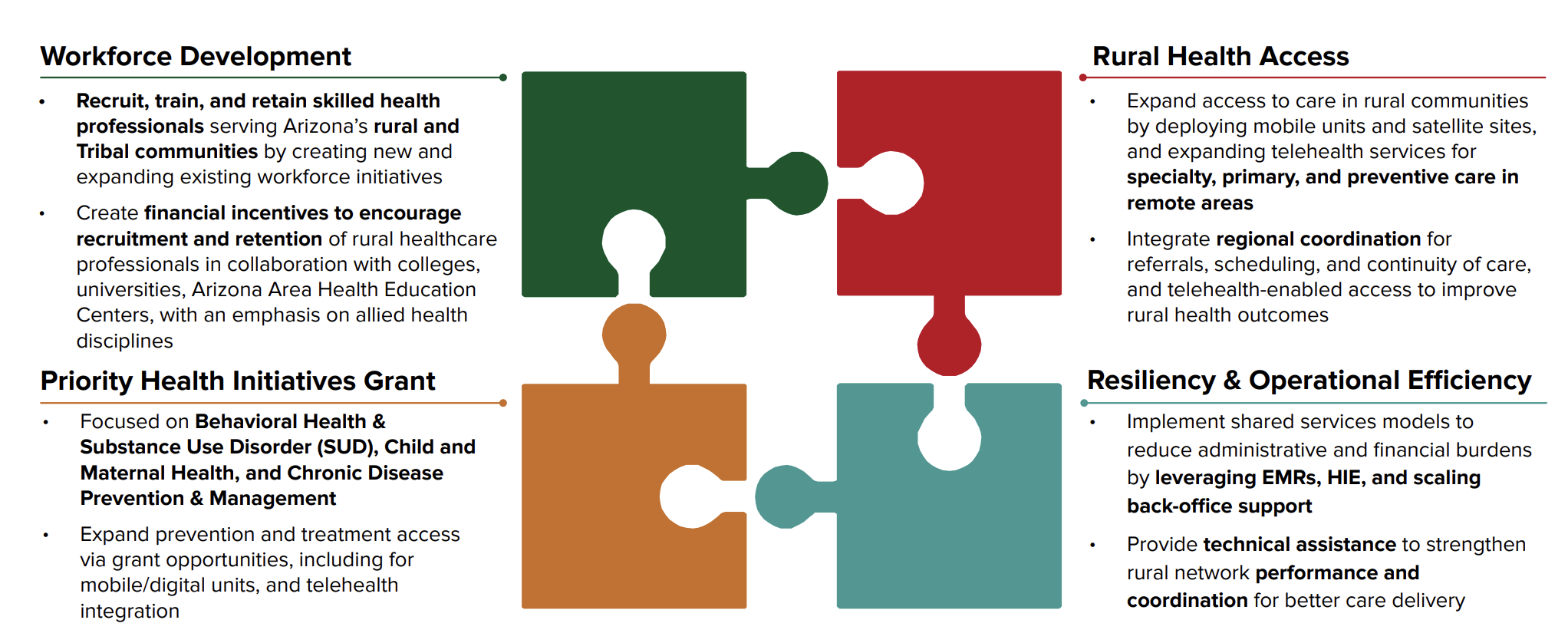
Each state will have two years to spend the funding they receive in the first year. The funding distribution in Arizona includes:
- $47.1 million for workforce development and training, including expanding rural clinical rotations and residency slots, sign-on financial incentives, educator training and rural high school health career pathways.
- $38.19 million to make rural healthcare resilient through shared-service networks, care hubs, integrated rural provider coalitions, cybersecurity and data sharing, and technical assistance for operational improvement.
- $27 million for priority health initiatives, including substance-use disorder and behavioral health programs, chronic disease prevention, maternal-fetal health, OB training and perinatal mental health services.
- $38 million for accessibility, including telehealth, remote patient monitoring, mobile and satellite clinics, and value-based payment models to promote efficiency and quality.
A significant barrier that the program seeks to address is the lack of healthcare providers in rural communities. In 2023, 92% of rural counties were considered primary care health professional shortage areas, according to the Commonwealth Fund.
"Ninety five percent of the training is occurring in big cities and 98% of the subsidies that help make that education affordable goes to big cities," Derksen said. "You're going to get the outcome there. People end up practicing within a mile or two of where they train."
Rural residents also tend to live much farther from hospitals and clinics than their urban counterparts, which is why 10% of the program's budget is dedicated to telehealth services.
Whether the program delivers will depend on whether the investments reach the communities that need them most. And for some of the state's most underserved residents, the stakes are high.
"I'd like to see a transformation. These 17 pages (that detail the Rural Health Transformation Program) were actually quite well done,” Derksen said. “I suspect, if they're able to show that each state has been a good steward of this public resource, that it's made a difference, that this would be extended beyond five years and it would continue going on."
Zoey Oberstein is a University of Arizona student majoring in journalism and a Tucson Spotlight intern. Contact her at zoeyoberstein@arizona.edu.
Tucson Spotlight is a community-based newsroom that provides paid opportunities for students and rising journalists in Southern Arizona. Please consider supporting our work with a tax-deductible donation.