Tucson's Reid Park Zoo works to protect endangered jaguars
Tucson's Reid Park Zoo is partnering with jaguar conservation groups to protect a species under threat, as habitat loss and persecution push jaguars toward endangerment across the American Southwest and South America.
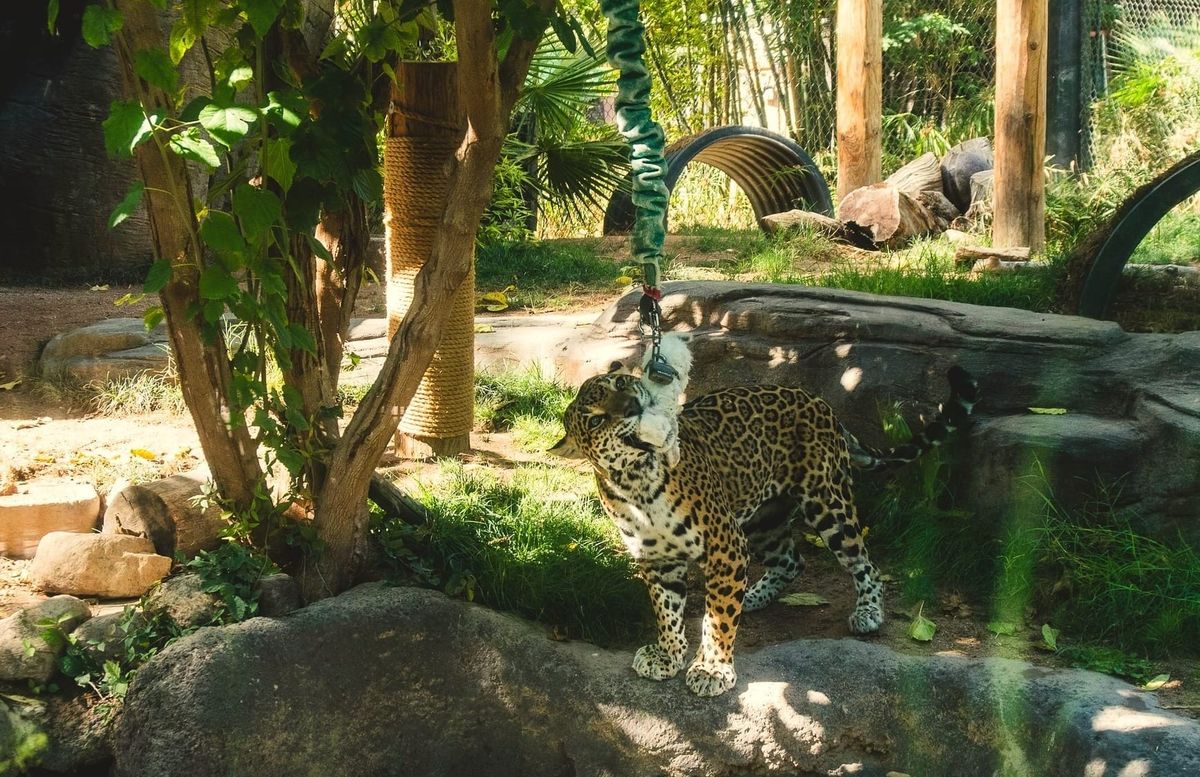
At 17 years old, Bella the jaguar has already outlived most of her wild counterparts, but her quiet life at Reid Park Zoo is also a window into a species fighting to survive a shrinking, fractured habitat that stretches from Arizona to Argentina.
With the strongest bite force of all large felines, Bella is widely seen as the apex predator of South America. Jaguars once ranged from South America all the way into North America, but mining, factory farming, industrialization and artificial borders have since pushed the species toward endangerment.
That's why Reid Park Zoo has partnered with programs like La Tierra del Jaguar to help protect jaguars and teach people about their importance to the larger ecosystem.
Bella is shy and heat-averse, preferring most days to stay in her air-conditioned back enclosure, hidden among the foliage the way jaguars are built to be: silent and unseen.
Erin Gleeson, director of conservation at Reid Park Zoo, said Bella is 17, which is beyond the median life expectancy of most captive jaguars, let alone wild ones. Part of what keeps a jaguar healthy that long is meeting certain environmental needs, including visibility, temperature and scents that allow them to mark territory. Without those conditions, a jaguar can decline quickly.
Allison Kreis, co-director of La Tierra del Jaguar, said she has worked with jaguars at the zoo for about 25 years, including a pair of sisters named Nikita and Simone who lived comfortably at Reid Park Zoo into their 20s.
"That was my first experience with jaguars before going into conservation," Kreis said.
Despite conservation efforts like preserves and protected spaces, Kreis said the shrinking distance between those spaces is threatening the species' survival. Jaguars are generally solitary animals, each claiming hundreds of miles of territory and only interacting when mating. As fragmented populations lose the ability to reach one another, reproduction has become harder to sustain.
"A lot of it has to do with the human systems," Kreis said. "The agriculture, the livestock management, the building of cities, mining, all these different things that just create disjointed populations."
That hostility has real consequences for jaguar populations.
"There's this attitude towards jaguars that they're dangerous, that they're evil," Gleeson said.
Kreis said that when cattle go missing without a trace, ranchers are often quick to blame apex predators like jaguars and bears, or smaller predators like wolves, and some communities even incentivize hunting them.
But Gleeson said part of Kreis' work is changing that perception, teaching people that jaguars are actually "majestic, beautiful" and keystones to a healthy landscape.
In most cases, Kreis said, the real culprits behind mysterious herd losses are packs of feral dogs, a well-documented problem in Tucson and other urban centers. What many ranchers don't know is that these dogs form roving packs that prey on cows and calves that stray from a herd. With modern cattle operations sometimes going a week or two between herd checks, most evidence of an attack has already disappeared by the time a rancher notices animals are missing.
"Working with communities is critical to protecting the jaguar and creating a longevity ... within jaguar habitats," Kreis said.
Gleeson echoed that message with a broader appeal.
"Understand that jaguars are native here and that ecosystems from the Southwestern US all the way down to Argentina evolved with jaguars," Gleeson said. "We need these cats to help maintain healthy, functional landscapes, and (as Allison's work is showing us), we can find ways to coexist."
Kreis encourages anyone interested in jaguar preservation to consider supporting organizations like Reid Park Zoo, La Tierra del Jaguar and the Northern Jaguar Project.
Quentin Agnello is a University of Arizona alum and freelance journalist in Tucson. Contact him at qsagnello@gmail.com.
Tucson Spotlight is a community-based newsroom that provides paid opportunities for students and rising journalists in Southern Arizona. Please consider supporting our work with a tax-deductible donation.