
Tucson nurses picket over staffing, contract dispute
Registered nurses picketed St. Mary's and St. Joseph's hospitals Friday, accusing Tenet Healthcare of understaffing and stalling six months of contract talks.
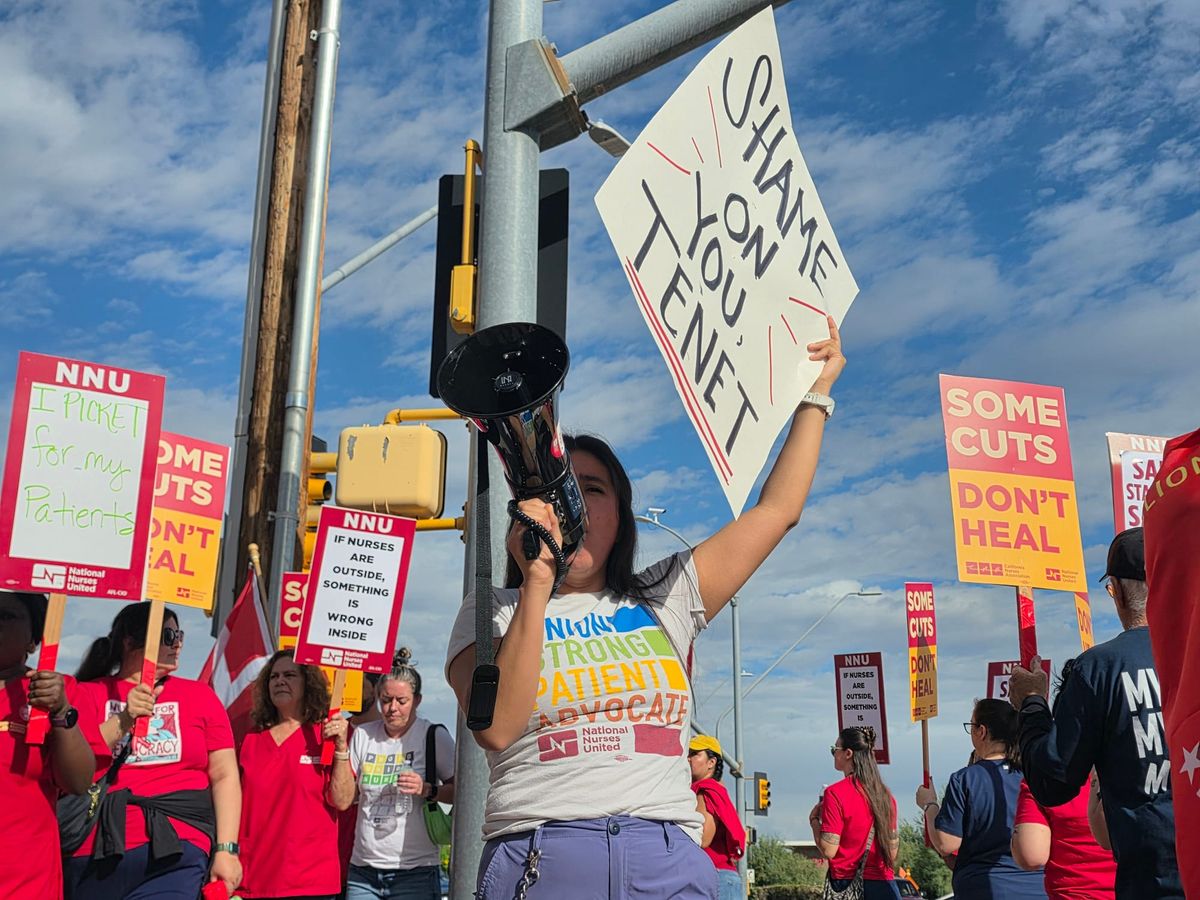
Registered nurses picketed outside St. Mary's and St. Joseph's hospitals Friday, accusing Tenet Healthcare of understaffing units and stonewalling six months of contract talks over patient safety and nurse breaks.
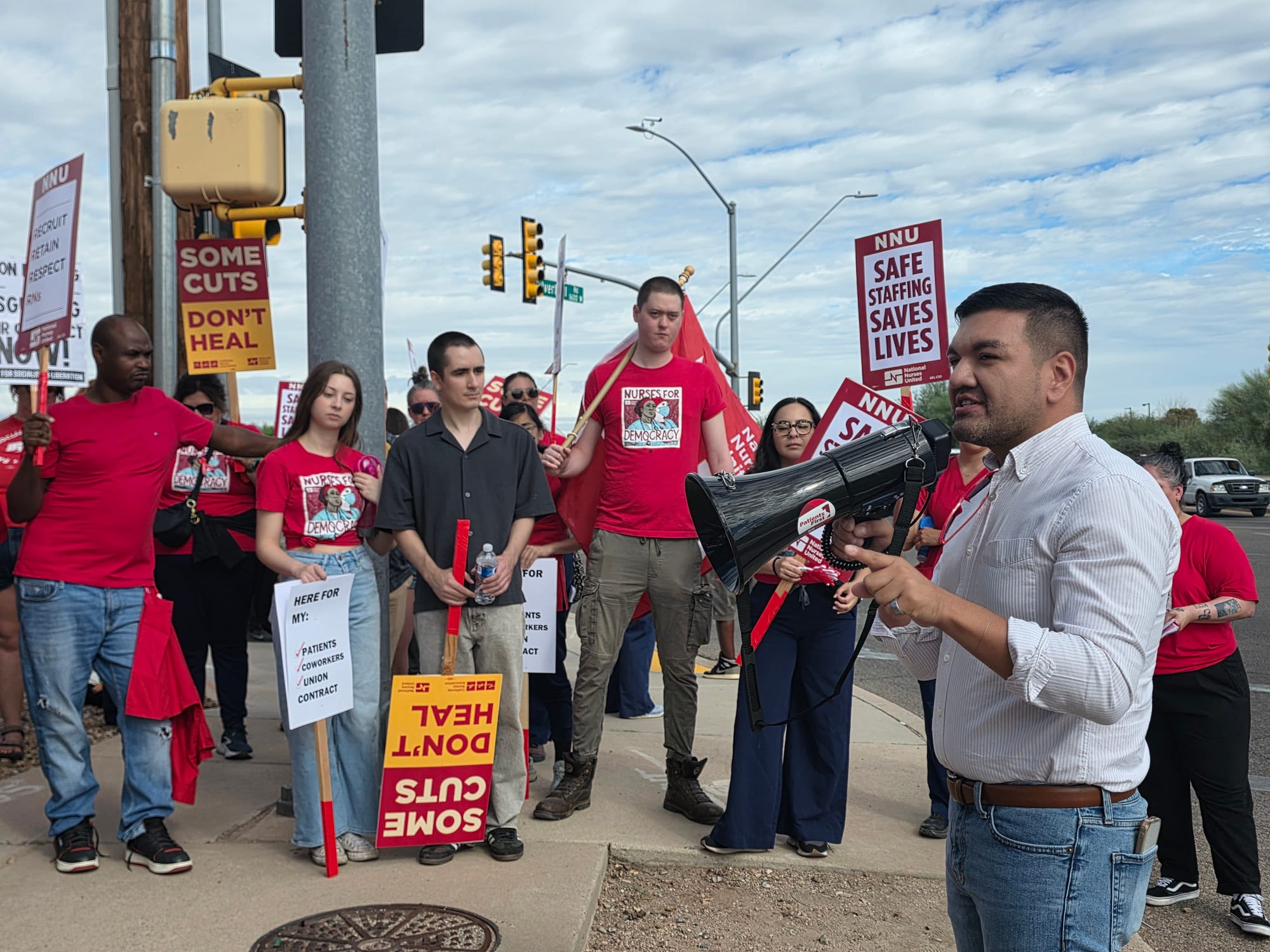
Union nurses from both hospitals held a morning picket outside of St. Mary's and an evening picket outside of St. Joseph's, asking for increased staffing and an updated contract.
Among those on the line was Jacqueline Steinke, a registered nurse at St. Mary's, who said she's witnessed firsthand the impact of understaffing on her unit.
"Our ratios are one to six (patients per nurse) on a telemetry floor. It's recommended that a floor like ours is one to four (patients,) so the two extra patients really make a difference, and it affects the kind of care that you're able to give," Steinke said. "I came into nursing because I care about people and I want to see the change in this profession … and I know that we can do better if we hold the corporations owning these hospitals accountable. And in part, that is making sure that they staff us adequately."
The situation is also detrimental to the patients who rely on the hospitals for care.
"We have been bargaining for six months, and management's response has so far been constant rejections to our proposals that would revisit patient safety and nurse safety," said one nurse who asked to remain anonymous.
Southern Arizona news written by journalists who live it. Free in your inbox.
A Tenet spokesperson pushed back on that characterization, saying the hospitals remained fully operational throughout the picket and that staff stayed focused on providing quality patient care.
"We are disappointed that the union took this approach, as it is not constructive or necessary," the spokesperson said. "We have made good progress toward new contracts with the union and will continue to negotiate in good faith in hopes of reaching a successful resolution. We hope that we can do so without unnecessary disruption from the union."
The dispute is rooted in years of negotiations between the union and hospital management. The Tucson chapter of the National Nurses Union started in 2018, with its first contract negotiations including floating clusters, or the ability for a nurse to be temporarily reassigned from their home unit to another unit that is short-staffed. In 2020, the nurses won that contract, including 30 other articles that benefited them.
In 2023, nurses negotiated their second contract, alleging that the hospitals did not want to place all nurses on the wage grid, or the transparent pay scale previously negotiated in their initial contract. In that second round of negotiations, all nurses were placed on the wage grid.
Nurses say the current negotiations have centered on staffing and break policies, and that Tenet Healthcare has rejected several of their proposals, including a dedicated rapid response nurse with no assigned patients who could respond first to ICU emergencies without pulling other nurses from their assigned patients, a lift team to help with high-risk patient transfers and mobility tasks, and guaranteed breaks.
"Nurses are working 13 hours with no break and sometimes no time to even use the bathroom," the nurse said. "This is unacceptable."
Those long, unbroken shifts carry real health risks. A 2024 OSHA Work-Related Injuries and Illness report found that registered nurses are the third highest reporting occupation for incidents among laborers of all trades, accounting for 9.3% of incidents reported. Between 2021 and 2022, nurses were twice as likely as workers in all other occupations to require at least one day away from work due to "overexertion" on the job, according to the U.S. Department of Labor.
The break issue is personal for nurses like Freddie Pepper, who has been a nurse at St. Joseph's Hospital for three years. When she got a job offer as a newly graduated registered nurse, she jumped at the opportunity to join the union.

In this latest round of negotiations, members requested mandatory breaks, which Pepper says are not being provided.
"Most of the places I've worked in, you have a badge that you clock in and out for your shift, you do the same at lunch," Pepper said. "Tenet has opted to instead default to deduct a 30-minute (break) from our pay without clocking in or out. The default is that they take that money as if we're getting lunch breaks."
Nurses do have the choice to opt out of a break. However, doing so requires signing their name in a binder and having management manually override the 30-minute deduction so it is not taken from their pay, a step Pepper says can be overwhelming for new graduates.
"One thing that a lot of people don't realize is that nurses, not only ethically but legally, cannot abandon our patients," Pepper said. "We cannot leave the unit that we're in … even if it's time for lunch, even if we have an emergency. We have to legally and ethically give the care of those patients to another nurse, and if (we don't), (we) could lose their license."
Other nurses echoed those frustrations. Todd Herres has been a registered nurse for eight years, working as a float nurse and union representative for the National Nurses Union. A strong supporter of organized labor, Herres noted that the union, not the hospital, provides a system for reporting grievances.
"Before we fill (the form) out, we talk to our house supervisor, and we try to have them remediate the problem because that's what we want. I think we had enough (of the objection forms) filled out to completely surround St. Mary's Hospital," Herres said. "We're here to serve our community. We're here to serve our patients. We don't want to be out here picketing right now. We want the hospital to do the right thing and to take this as seriously as we do."
The picket also drew support beyond the nursing staff. Other union groups and local officials joined in solidarity with nurses, including representatives from Mayor Regina Romero's Office, Ward 6, the Pima County Board of Supervisors and Rep. Adelita Grijalva.

Grijalva has met with the nurses union twice over the last month and has received reports of understaffing and retaliation against organizers, all while Medicaid funding cuts from H.R. 1, the federal budget reconciliation law passed last year, put hospitals such as St. Mary's at risk of closure.
"They're cutting out some of the essentials in order to make their budgets, but who they're getting rid of are like people who move patients from the ER to the operating room. Nurses are the ones that have to do that," Grijalva said. "I think it's important to stand in solidarity for those who take care of us when we're at our most vulnerable."
Pima County Supervisor Andrés Cano spoke to nurses at the St. Mary's picket line, saying this wasn't his first time picketing with them. He previously joined them while running for the state House.
"When we hear of situations where beds are at capacity at the emergency room, and when we have people waiting in the emergency room in the hallways to get access to healthcare, it is one corporation's responsibility to do the right thing, and Tenet is not," Cano told the nurses. "It's not a hard thing to ask for a fair contract, for fair wages, to ensure that you can do your job."
Pima County Supervisor Jennifer Allen attended the St. Joseph's picket, talking with nurses about their concerns.
"The demand that the union has been pushing for … It's in the hospital's interest. It's in patients' interests. It's in everyone's interest to let nurses have more time and have greater attention and care for patients in the hospital," Allen said.
Topacio “Topaz” Servellon is a reporter with Tucson Spotlight. Contact them at topacioserve@gmail.com.
Tucson Spotlight is a community-based newsroom that provides paid opportunities for students and rising journalists in Southern Arizona. Please consider supporting our work with a tax-deductible donation.