Pima Community College exhibit spans two sides of the border
“Artists From the Border” at Pima Community College’s Louis Carlos Bernal Gallery shows how the border shaped two artists’ lives through Dec. 11.
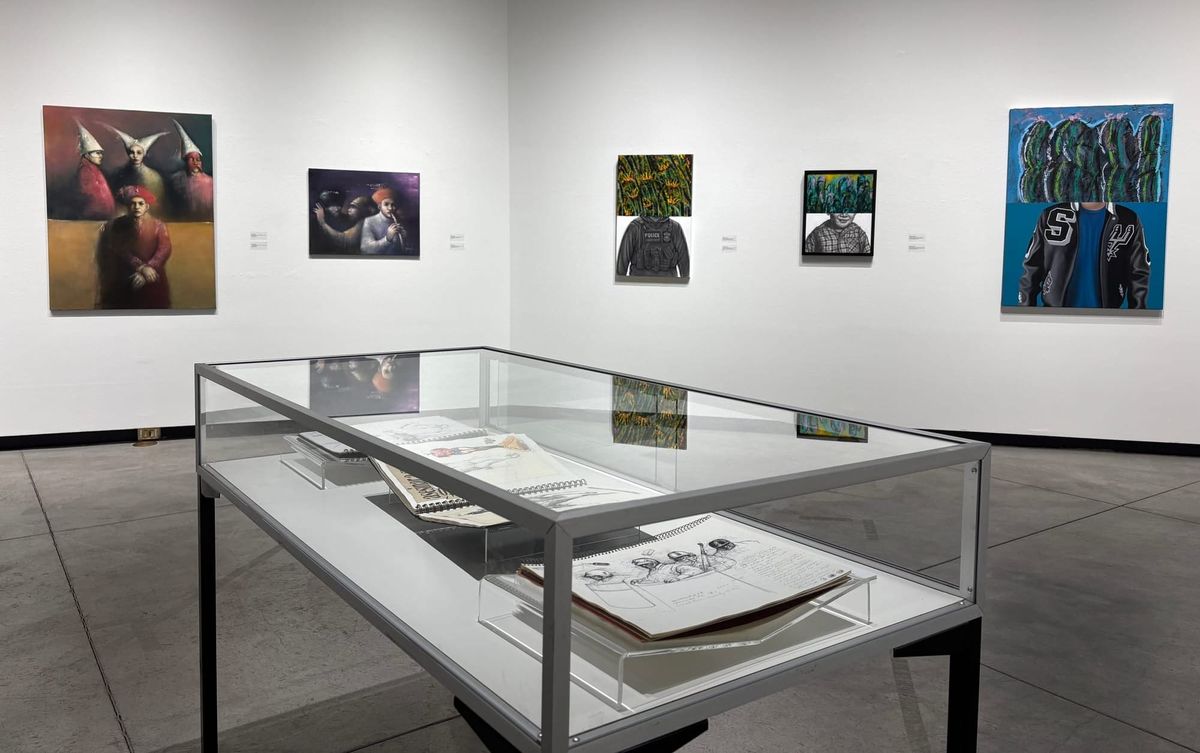
A Pima Community College exhibition splits its gallery in half, with one artist’s work up front and another’s in back, to show how the border shaped two lives.
The Louis Carlos Bernal Gallery’s latest exhibition, “Artists From the Border,” includes a small collection of paintings and sketches from modern artists Oscar Fernando Bernal and Alejandro Macias, whose work reflects their lived experiences on two different sides of the U.S.-Mexico border.
The exhibition opened Oct. 26 and runs through Dec. 11, with a free reception scheduled from 5 to 7 p.m. Nov. 12.
“One of my goals is to introduce artists at Pima to artists from Mexico, and vice versa,” said gallery director David Andres, who is also displaying his own work in a gallery in Hermosillo, Sonora. “That’s what this is about: drawing and painting . . . to help educate our students here. Not just about cultural significance, but of techniques that they might be able to use in their own work.”
Andres said that because of the relationship between the college and the University of Arizona, art students are often inspired to continue their studies at the UA. In fact, Macias is an associate professor in UA’s School of Art.
Andres said that while exhibiting artist Oscar Fernando Bernal is not related to gallery namesake Louis Carlos Bernal, both families have speculated otherwise.
Oscar Fernando Bernal was born in Nogales, Sonora, in 1945 and moved to Mexico City to study under renowned sculptor and painter Francisco Zúñiga. From there, he moved around northern Mexico, eventually settling in the San Francisco Bay Area.
Your membership pays emerging journalists to cover Southern Arizona the way it deserves.
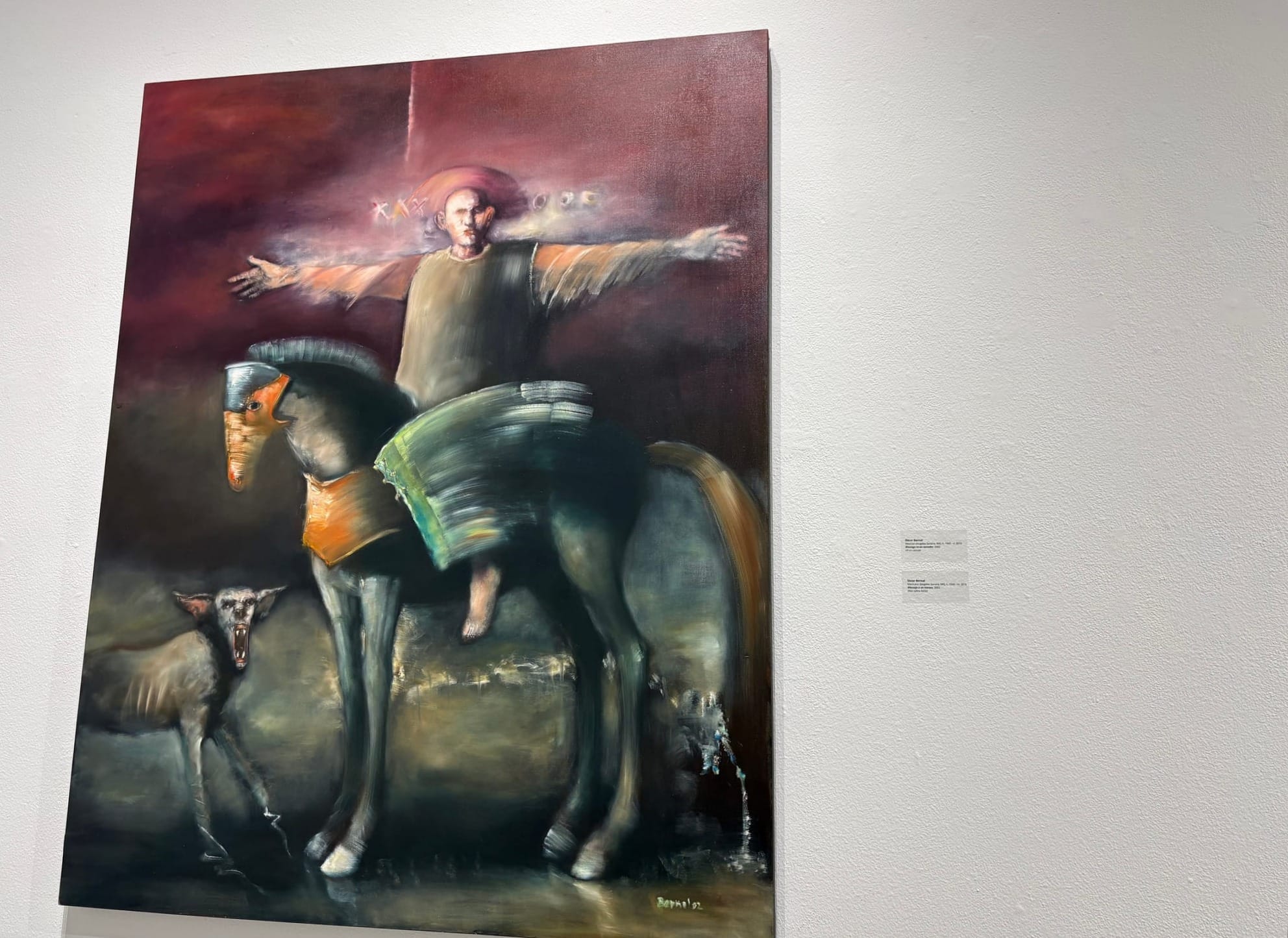
Andres said Oscar Fernando Bernal’s work was inspired by the cultural backgrounds of the times and places he experienced, but that the gallery has only a fraction of his work.
“This is not a complete representation of his work,” Andres said. “Most of his work was sold. We were lucky to get this amount of pieces.”
Oscar Fernando Bernal was inspired by artists including Goya, Velázquez and Rembrandt, blending the styles of these masters with his experiences of contemporary Mexico.
In the 1960s, despite an early economic and industrial boom, Mexico was ruled by a single party, the Institutional Revolutionary Party, which held the presidency until 2000. According to his online biography, Bernal became actively involved in the student revolt of 1968 and survived the massacre that followed at Tlatelolco Square.
Oscar Fernando Bernal’s displayed work mixes Catholic Church and Spanish imagery, such as bullfighters, with colors and fashion reminiscent of Soviet-era Russia.
The exhibition also includes his sketchbooks, which contain pop art and abstract human forms with animal features evocative of surrealist style.
Oscar Fernando Bernal died in 2016 after a motorcycle accident. His work fills the back of the gallery, while the front belongs to an artist who is still working.
Alejandro Macias is a contemporary artist who grew up in Brownsville, Texas. He works in pencil, pen, charcoal and oil paint.
“They’re all slightly different, but I think what the thread in all of the work is, most of it is compositionally divided,” Macias said. “A lot of the images manifested from those feelings of angst, of dealing with trying to fit in somewhere.”
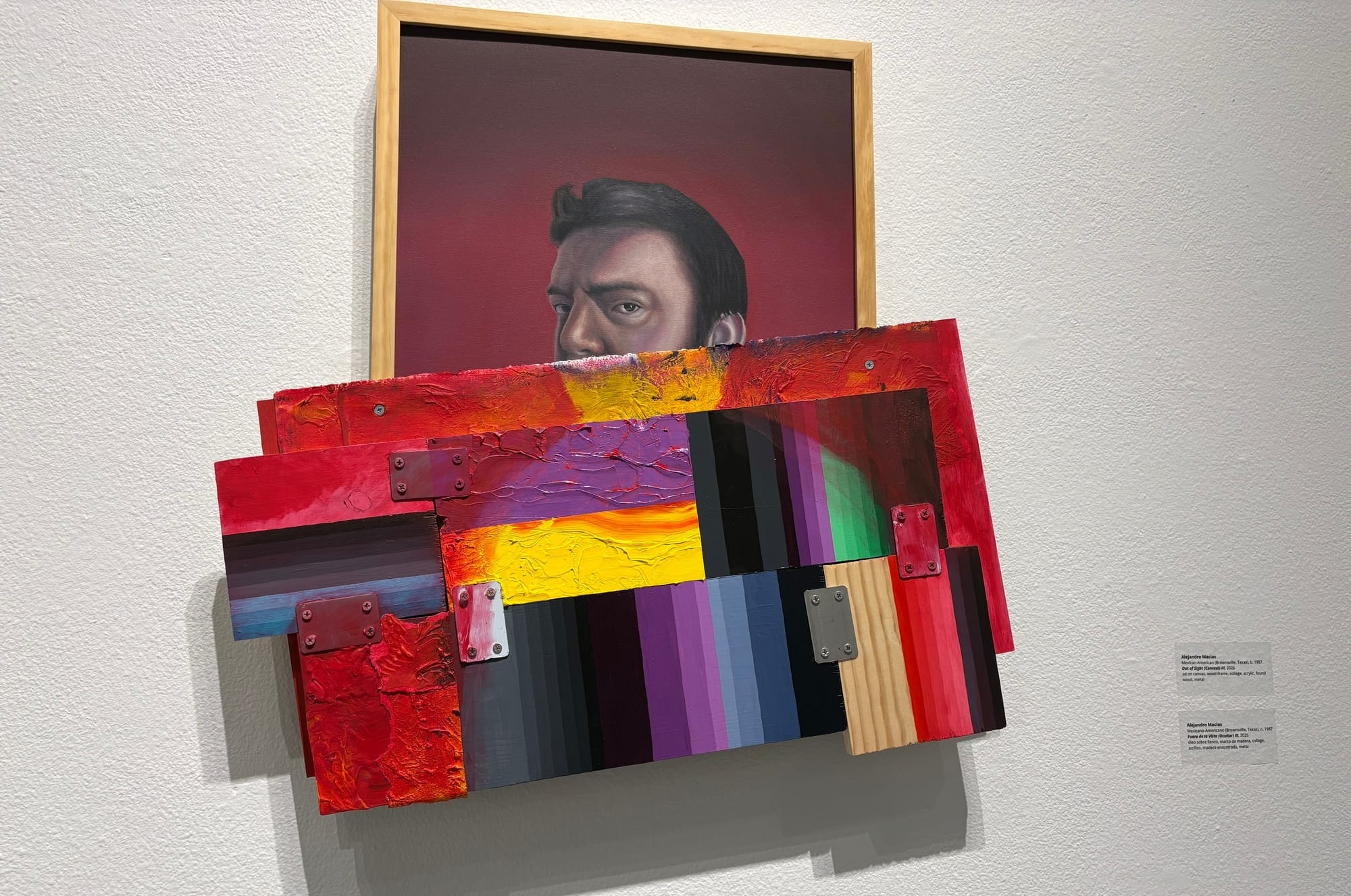
Macias said the imagery of cacti overlapping the portraits is symbolic of the colloquial term “nopal en la frente,” which means “with a cactus on your forehead” and refers to a person’s cultural identity and their connection to it.
The phrase is sometimes used negatively to suggest that someone of Mexican heritage, despite having the complexion and physical characteristics, is ignorant of their cultural ties or is rejecting them through their attire and profession.
“How do you deal with that?” Macias asked. “How do you confront that? How do you digest it daily? Those are the questions I’m trying to provoke.”
The phrase reflects how others perceive a larger cultural identity and how a person negotiates their own.
Macias hopes his work will inspire students at the college and that, if they go on to study at UA’s School of Art, they will feel more comfortable recognizing the work of a professor.
Though the gallery is divided, both halves represent two artists whose cultural heritage is intertwined, even as a national border separates their lived experiences.
Andres said that beyond teaching art students, the exhibition is meant to pull back the curtain in a media environment where people’s perception of Mexico is colored by fear generated through sensational coverage rather than lived experience.
The Louis Carlos Bernal Gallery is in the Center for the Arts on Pima Community College’s West Campus, 2202 W. Anklam Road. It is open 10 a.m. to 5 p.m. Monday through Thursday and 10 a.m. to 3 p.m. Friday. Admission is free.
Quentin Agnello is a University of Arizona alum and freelance journalist in Tucson. Contact him at qsagnello@gmail.com.
Tucson Spotlight is a community-based newsroom that provides paid opportunities for students and rising journalists in Southern Arizona. Please consider supporting our work with a tax-deductible donation.