
Tucson refugee quarantined with measles in ICE detention
A Russian refugee who fled the draft is quarantined with measles in an Arizona detention center weeks before his scheduled deportation, as his Tucson wife fights to keep him in the U.S.

Editor's note: This story reported, based on information from the subject's wife, that he had contracted measles while detained at the Florence Detention Center. She has since said, after speaking with him directly, that his diagnosis has not been confirmed. Read our follow-up here.
The wife of a Russian refugee who fled to avoid being drafted into the war in Ukraine said he's now sick with measles inside an Arizona immigration detention center, days before he is scheduled to be deported back to the country he escaped.
He's one of several detainees infected in an outbreak at the Florence Detention Center that the U.S. Department of Homeland Security confirmed Tuesday. The outbreak has drawn condemnation from Arizona lawmakers, who say overcrowding in immigration facilities created the conditions for a preventable disease to spread, and has added new urgency to his wife's fight to keep him in the United States.
For his wife, Andrea Landavazo, the diagnosis is the latest blow in a whirlwind year that began with an unexpected romance and has turned into a desperate effort to stop his deportation.
It started at the pharmacy where Landavazo works.
"When he walked up, he just had this really nice smile," Landavazo said.
As she looked up the young man's prescription, she joked about how many letters were in his last name. He introduced himself as Vlad.
"It takes me a lot to even just form connections … (but) he just looked so sweet," Landavazo said.
The two exchanged phone numbers and talked for three hours during their first call. Later that week, they went on a date to Funtasticks that lasted 12 hours.
They married exactly one year later.
Share Tucson Spotlight with a friend. Every signup earns you a raffle entry to win a gift card to a local Tucson favorite. Four winners drawn August 1.

Six days after their wedding, her husband walked into a Tucson ICE office and never came home.
Vlad, whose last name is being withheld for fear of retaliation, arrived in Mexico in 2022 along with his now ex-wife, presenting himself at a U.S. port of entry and filing for political asylum. He has had no criminal history in the United States and had recently been working overnight shifts at Walmart.
Vlad had legal counsel in his immigration case until February, when his California-based lawyers, who had represented him for four years, dropped him as a client over a conflict of interest involving their representation of his ex-wife, whom he divorced two years ago.
After losing his lawyers, Vlad missed an immigration hearing in May that had already been rescheduled several times.
Shortly after, he received a deportation order.
Vlad filed a motion to reopen his case, but it was denied. He then received a second letter ordering his deportation by the end of June.
On June 26, Vlad presented himself to the ICE field office with a second motion to reopen his case.
"I'm waiting for him, I'm in the living room, and an hour and a half had passed by, and I was like, 'Where is he?'" Landavazo said. "I was getting really nervous."
After her texts and calls to Vlad went unanswered, Landavazo received a call with no caller ID. It was him.
"I couldn't even talk," Landavazo said. "I was just so speechless, and (in) just so much in shock. And Vlad, of course, was just again so sweet about it. He said, 'It's okay, things will be okay.'"
Landavazo has admired Vlad's optimism throughout their relationship.
"Vlad, no matter what … always has something positive to say," Landavazo said. "Even when he called me to let me know he got detained."
In September 2022, when Russia announced its first mobilization since World War II for the war against Ukraine, it sparked protests across several cities, and more than 261,000 Russians fled the country.
That same month, more than 1,300 Russians, including Vlad, were arrested for protesting the war.
"He and his brother got arrested, and when he went to the (police) station, the cop had assaulted him with a pen," Landavazo said.
In 2020, the U.S. processed 467 Russian asylum cases at the U.S.-Mexico border. By 2022, more than 21,000 Russian asylum cases were processed in response to Russia's invasion of Ukraine, with more than 3,800 cases in October alone.
Russia's draft system requires 12 months of service for men ages 18 to 30, regardless of whether the country is at war. Draft evasion is a felony punishable by up to 26 months in prison or a large fine, and men are legally barred from employment unless they can demonstrate active military registration.
That fear of the Russian state, Landavazo said, followed Vlad even after he reached the U.S.
"He was really paranoid, and he even felt like ICE was following him sometimes, and so that constant feeling of him having to look behind his back … I just hate that for him," Landavazo said. "Four years, and he was still feeling that way in America, and he came here, you know, to seek refuge."
Landavazo's devastation turned into action after Vlad was detained. She contacted several representatives about Vlad's case, including U.S. Rep. Juan Ciscomani, Sen. Mark Kelly and Rep. Adelita Grijalva.
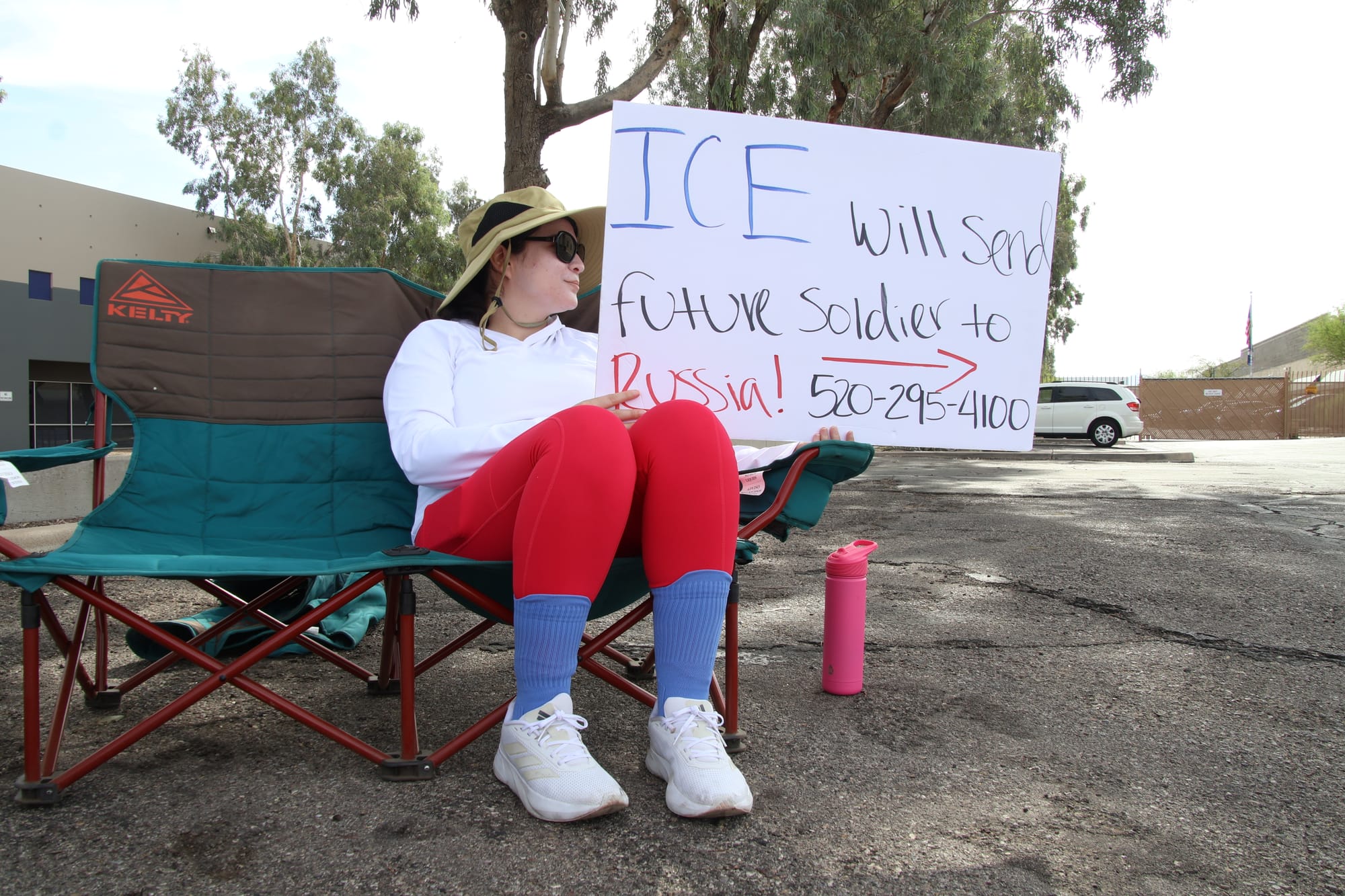
The day after Vlad was detained, Landavazo stood outside the ICE Field Office on Valencia and Country Club, holding a sign that said, "ICE will send future soldier to Russia" and asking passersby to call the office and ask for his release.
She returned to the field office the following Monday, where she participated in a peaceful demonstration with members of Tucson's Rapid Response Team.
"They told me what they were about. I told them my story, and then they pretty much helped me out, like right away," Landavazo said.

That same morning, Landavazo had been notified that Vlad had been moved to the Florence Detention Center.
She was approached by a woman whose husband is also detained in Florence, who asked her to pass along a message that Vlad was OK.
Earlier this week, after more than two weeks of not hearing from her husband, Landavazo was able to contact Vlad, when he again reassured her he was OK.
On July 2, U.S. Rep. Greg Stanton made an unannounced visit to the Eloy Detention Center, where he was informed that a few detainees were under quarantine from a measles outbreak at the processing center in Florence.
DHS confirmed the outbreak Tuesday, a day after Landavazo was informed Vlad had caught measles and is now in quarantine.
Grijalva addressed Vlad's case directly in a statement Thursday.
"This latest measles outbreak is the predictable outcome of Trump's mass deportation agenda, which has fueled dangerous overcrowding at detention facilities and created the conditions for preventable diseases to spread," Grijalva said. "This outbreak has infected people like Vlad, who faces the prospect of being drafted into the war in Ukraine if he is deported to his home country of Russia."
Grijalva called on ICE to delay the deportation proceedings of Vlad and all other affected individuals so they can pursue all legal avenues, which will be delayed by the outbreak.
"For ICE to say this is the 'best healthcare' these individuals have ever received while simultaneously presiding over a measles outbreak at one of its own facilities demonstrates how willfully blind or blatantly indifferent the agency is to the inhumane conditions right under its nose," Grijalva said.
Vlad's deportation is scheduled for July 30.
Topacio “Topaz” Servellon is a reporter with Tucson Spotlight. Contact them at topacioserve@gmail.com.
Tucson Spotlight is a community-based newsroom that provides paid opportunities for students and rising journalists in Southern Arizona. Please consider supporting our work with a tax-deductible donation.