
Tucson panel tackles trust and truth in local media
A panel of journalists, academics and community leaders discussed truth and trust in media, the rise of AI and the future of local news at the League of Women Voters' annual breakfast forum.
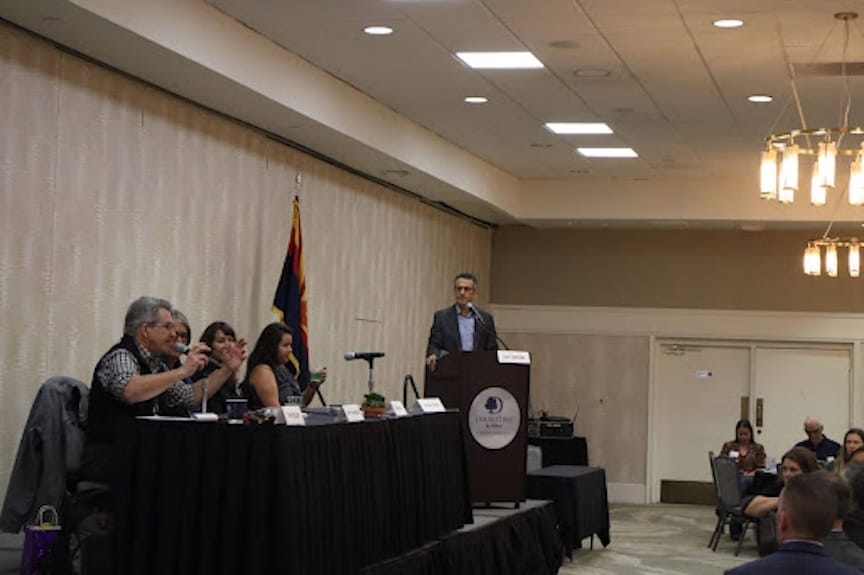
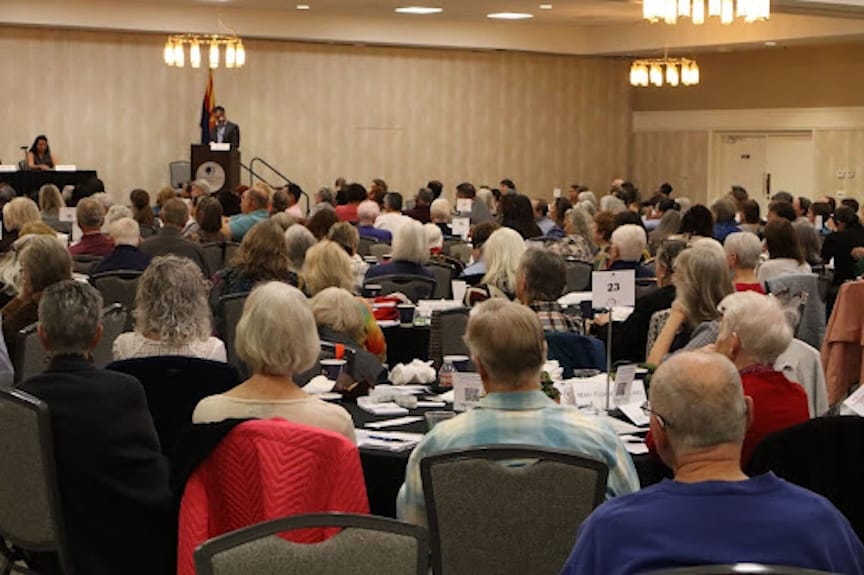
Journalists, academics and community leaders gathered over breakfast earlier this month to wrestle with a question that cuts to the heart of American democracy: can the public still trust what it reads, watches and scrolls past?
The League of Women Voters of Greater Tucson hosted its 13th annual Issues and Eggs breakfast forum March 6, bringing together a panel of experts to discuss truth and trust in media amid social media disinformation, artificial intelligence and First Amendment concerns.
Panelists reflected on what defines journalism, the challenges facing local news coverage and how news consumers can discern fact from fiction in a world where media is more accessible than ever.
LWV Tucson President Betsy Boggia opened the event by reading the First Amendment and reminding attendees of their constitutional rights.
"That seems to cover a lot that's under attack right now," she said.
From there, the conversation turned to the forces reshaping how information reaches the public.
Panelist Diana Daly, associate dean of academic affairs at the University of Arizona, said artificial intelligence is creating an unprecedented impact on public information. She noted that the technology has long relied on black box algorithms, systems whose coding and decision-making processes are hidden from users and often from developers themselves.
Daly said this reflects a broader philosophy of technological development, one that prioritizes growth over guardrails, a trend she said accelerated during and after the 2016 election.
"And what that means is that profit does end up being the focus of these technologies," Daly said. "Even if they are used informationally, unlike a library… the purpose of this emergence of technology has been and will continue to be, at least in this nation, engagement."
Daly noted that "engagement" means different things to different users — ranging from the revelation of encountering a new perspective to the simple reinforcement of existing beliefs — but that in either case, the goal of the technology is to keep users online to maximize ad revenue and data sales.
Arizona Daily Star opinion writer Tim Steller reflected on the changes in media coverage over his career, describing how the high cost of technology, production, staffing and distribution once created natural "gatekeepers," a small number of outlets that controlled the flow of information and profited from that position.
Steller argued that the end of the gatekeeper era made media more accessible, but said that came with tradeoffs. Anyone on social media can present themselves as a journalist, he noted, which may or may not reflect the quality or accuracy of their reporting.
"People kind of stopped caring as much, slowly, I think," Steller said. "As people were increasingly drawn to this increasingly additive technology, they turned away from local news or the typical outlets we were used to. And frankly, we weren't as needed."
On the other hand, he pointed to the press uncritically reporting the president's account of the Gulf of Tonkin incident, which later proved to be false, as an example of why the end of the gatekeeper era could be seen as a positive development.
"That's the kind of thing that these days would not occur because there's way too many eyes, way too many ways of seeing, of getting facts, of checking facts," Steller said.
Panelists agreed that local news is vital to countering democratic backsliding. Arizona Luminaria reporter Chelsea Curtis, who focuses on missing and murdered Indigenous women through data-centered reporting, said narratives get lost in today's politicized media landscape.
"Hearing directly from the community, being embedded in that community, and truly trying to get to the core of their issues and focusing on that, sticking with that, reporting on that, I think that goes a long way in building trust. It goes a long way in telemetry," Curtis said.
She also discussed the tension between journalists unfamiliar with corporate operations and the corporate model they're forced to work within, arguing that a nonprofit model would be far more productive for journalism as a whole.
UA journalism professor Patty Machelor also called for a robust nonprofit news model, saying the pressure of piecing together a budget and hoping it holds distracts from the work of actual journalism.
"The nonprofit news model is probably going to be, hopefully, what helps us move forward with democracy," Machelor said.
What has been most lost, she added, is intensive coverage of local government and courts, rather than journalists showing up only after a story has already gained attention.
Her ideal model, she said, would combine a large staff with the old-school approach of assigning a single reporter to a beat like city council to ensure comprehensive coverage.
Ian Stash is a journalism major at the University of Arizona and Tucson Spotlight intern. Contact him at istash@arizona.edu.
Tucson Spotlight is a community-based newsroom that provides paid opportunities for students and rising journalists in Southern Arizona. Please consider supporting our work with a tax-deductible donation.