Raytheon contract, protests put Tucson ties in focus
Raytheon landed a $335 million U.S. Navy missile contract, with 35% of the work taking place in Tucson, renewing scrutiny of the defense contractor's deep ties to the community amid protests over its role in U.S. airstrikes on Iran.
Raytheon landed a $335 million U.S. Navy missile contract last month, renewing scrutiny of the defense contractor's role in the Tucson community.
The April 24 contract modification funds the manufacturing, assembly and delivery of SM-6 missiles through May 2030, with 35% of the work taking place in Tucson, where Raytheon is one of the city's largest employers, according to The Defence Blog.
The company says it has invested nearly $900 million over the past three years to expand production capacity at its Tucson and Huntsville, Alabama facilities to meet what it describes as unprecedented demand.
The SM-6 is among the most versatile weapons in the U.S. Navy's surface warfare inventory, capable of engaging aircraft, cruise missiles, ballistic missiles and surface targets. The Navy has been burning through its stockpile at rates that peacetime production planning did not anticipate, driven by missile defense missions in the Red Sea in response to Houthi attacks on commercial and naval shipping.
"Standard Missile-6 is a critical, combat-proven system that provides a vital layer of protection for ships and sailors — a capability that has never been more critical than it is today," said Phil Jasper, president of Raytheon.
The contract is the latest reminder of how deeply Raytheon is woven into Tucson's economy, and for some residents, into its civic life in ways they find harder to accept.
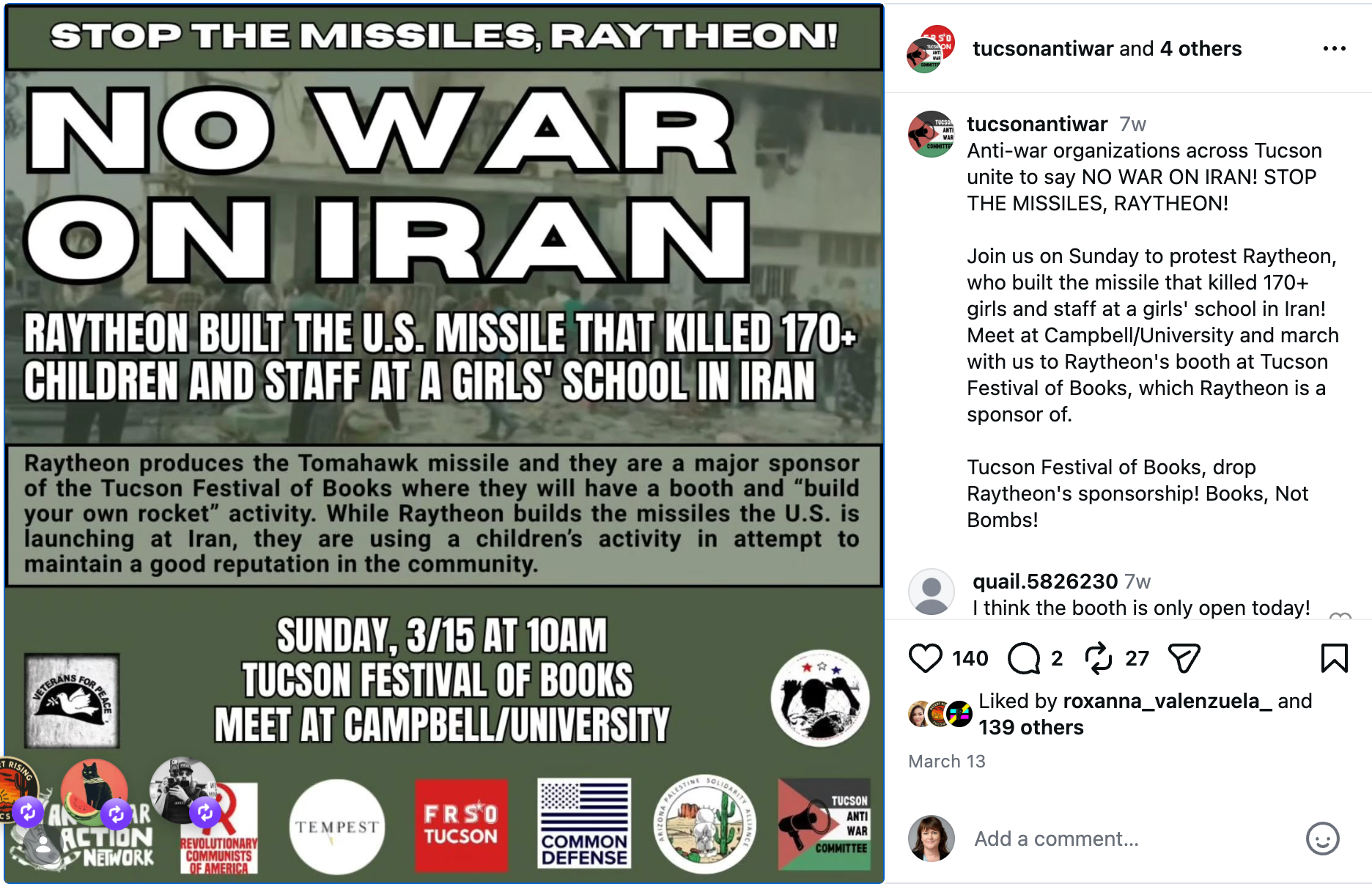
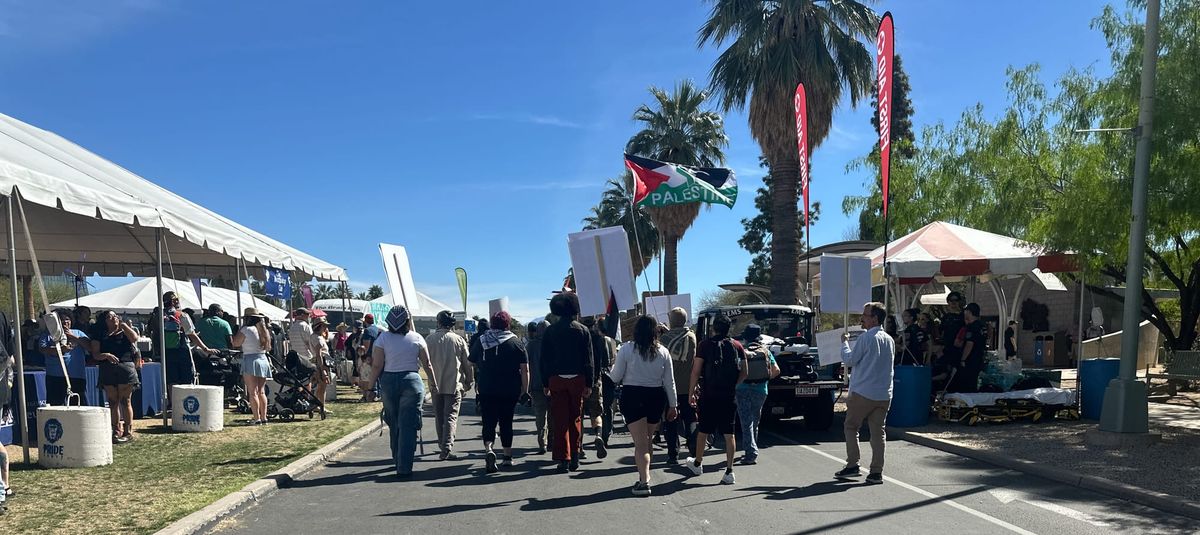
In March, protesters gathered at the Tucson Festival of Books to push back against Raytheon's presence at the event, pointing to reporting that a Raytheon-built missile was used in a U.S. airstrike that killed more than 165 people at an elementary school in southern Iran. Responsibility for the strike is still under investigation.
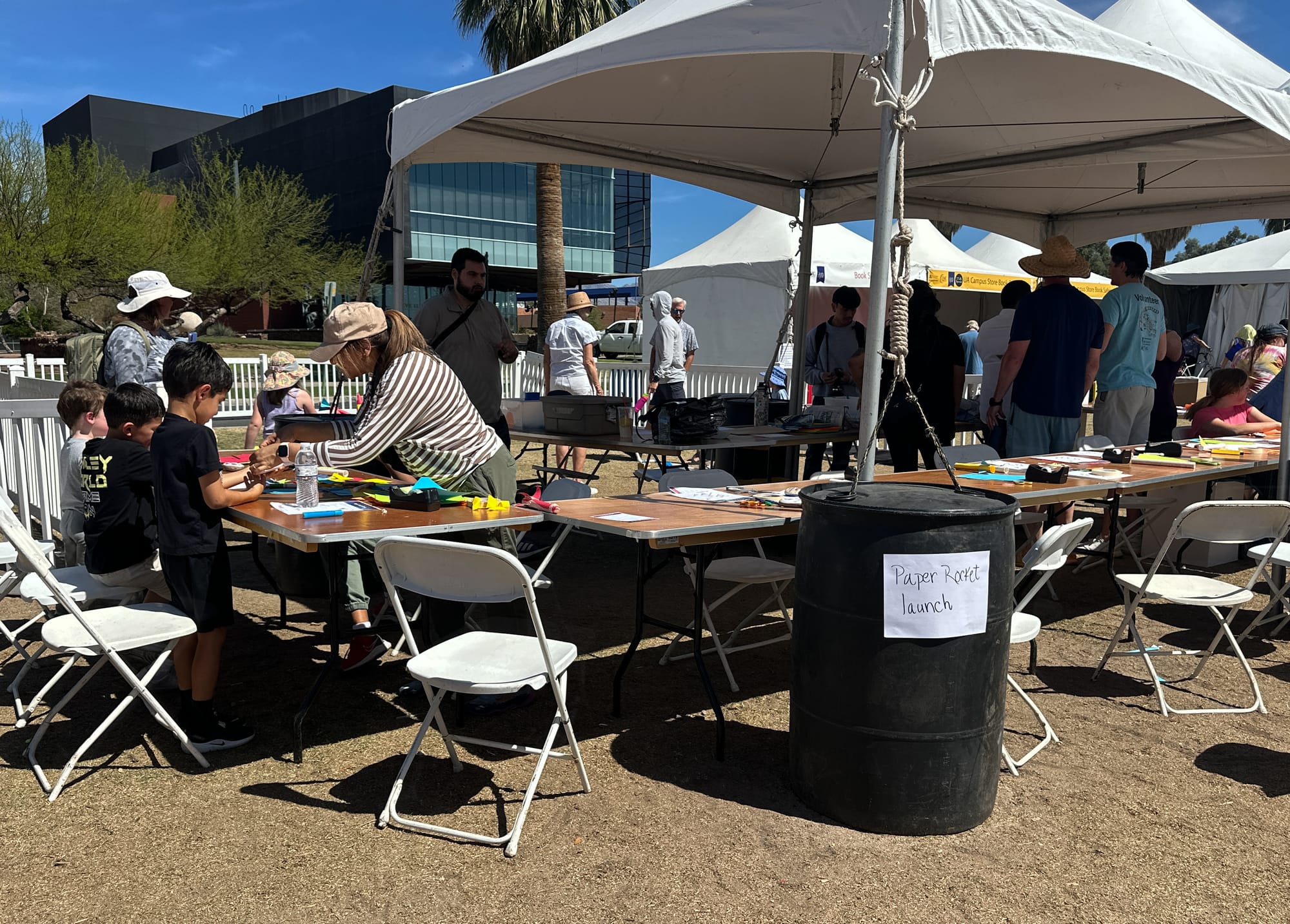
Raytheon's presence at the festival included partnering with a University of Arizona student group for a booth located near the children's area. The signage was discreet, with no company logo and only a small piece of paper taped to the booth that read "Paper rocket launch." In 2025, Raytheon drew criticism for hosting a booth that included hands-on paper airplane making activities for kids.
A Raytheon spokesperson did not immediately respond to Tucson Spotlight's request for comment.
"I don't want our taxes to be … (used) for bombs and killing children and bombing schools and bombing hospitals and things that our country is doing around the world," said a protester named Sarah, who asked that her last name be withheld.
Chandler, who attended with the Tucson Anti-War Committee, a local branch of the National Anti-War Action Network, called on the Festival of Books to cut ties with the company entirely.
"We would like to demand that the Festival of Books, as a nonprofit Tucson-based organization, completely financially and visibly divest from Raytheon," Chandler said. "They are one of the biggest … weapons manufacturers in the world and unfortunately have a lot of ties with our business community and we think that our workers and our educational events like this one deserve better."
A representative of the Tucson Festival of Books did not respond to Tucson Spotlight's request for comment.
Chandler also took issue with the activity at the booth, calling it "in very poor taste."
Madilynn, who also asked that her last name be withheld, called Raytheon's community presence horrific.
"I just think it's a beastly irony for Raytheon to be slaughtering children in Iran and across the world, bombing schools, bombing civilian places," Madilynn said. "It's like Raytheon's trying to prepare the American children of today to bomb the Iranian children that will never see tomorrow."
Madilynn said she sees Raytheon's sponsorships of community events as a deliberate strategy to normalize the company's presence in Tucson.
"This sort of insidious way how through their sponsorship of all sorts of Tucson community events that they're sort of trying to make a place in Tucson where they're desensitizing and normalizing the active presence of arms and war," Madilynn said. "They use it as a defense for themselves saying, 'Oh, look at all these good things that we do.' But is it really good when our community is being funded by bombs and the blood of innocent people? It's really just a matter of how can we as a community really stand for ourselves when we won't stand up for communities across the globe?"
Nya Belcastro is a University of Arizona student and Tucson Spotlight intern. Contact her at nya2005@arizona.edu.
Tucson Spotlight is a community-based newsroom that provides paid opportunities for students and rising journalists in Southern Arizona. Please consider supporting our work with a tax-deductible donation.