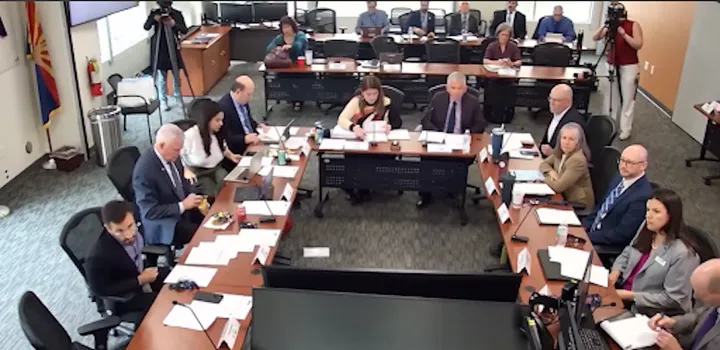
Pima supervisors approve measures limiting immigration enforcement
The Pima County Board of Supervisors voted 4-1 to approve measures limiting immigration enforcement on county property and opposing a proposed ICE detention center in Marana.

Citing concerns about public safety, transparency and community trust, the Pima County Board of Supervisors approved three measures aimed at curbing immigration enforcement activity in the county, drawing sharp opposition from the board’s lone Republican member.
All three measures passed by a 4-1 vote during the Feb. 3 meeting, with supervisors directing staff to draft an ordinance protecting county property from being used for immigration enforcement operations and banning the use of masks by law enforcement. They also adopted a resolution opposing the establishment of an Immigration and Customs Enforcement detention center in Marana.
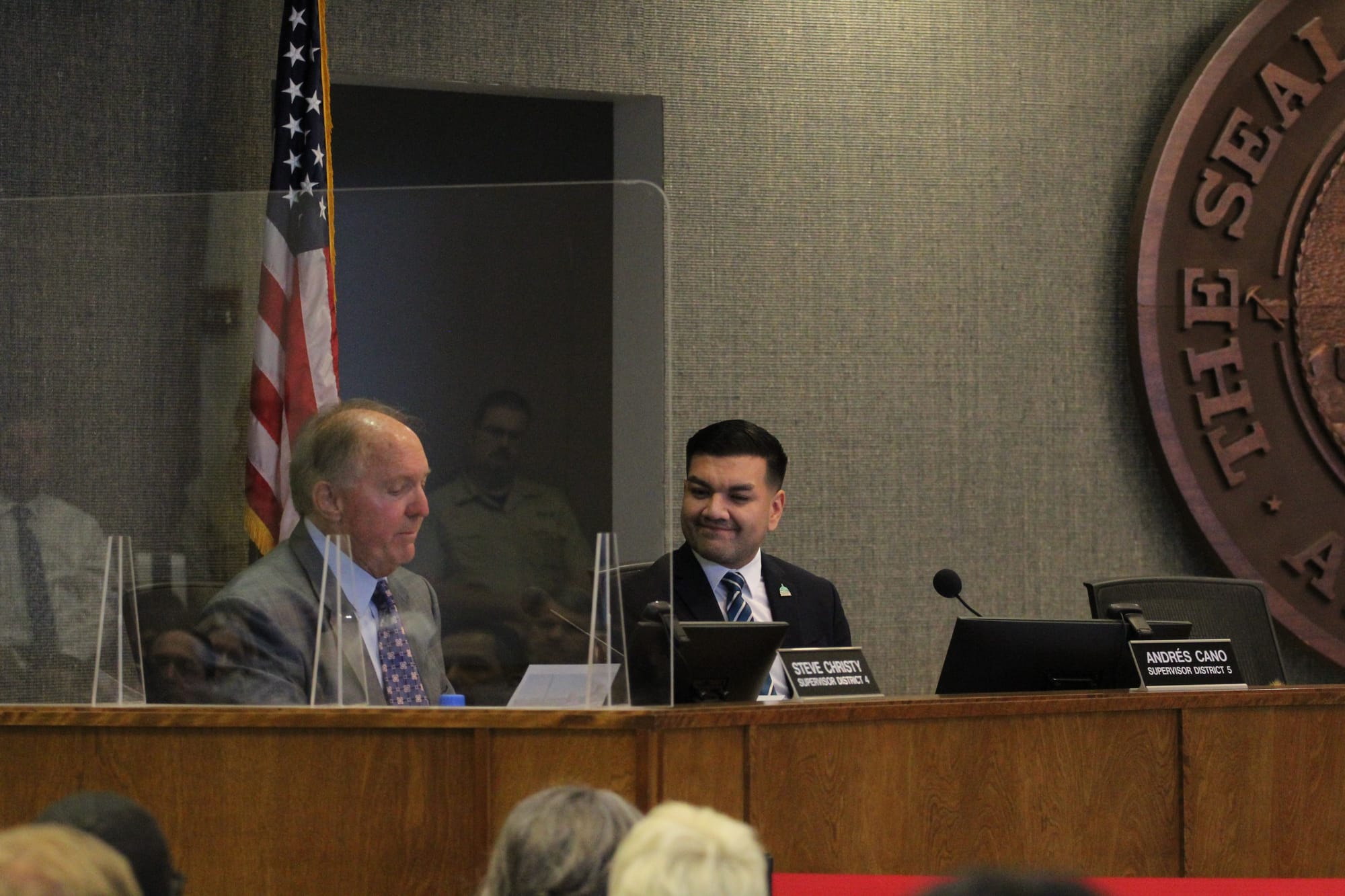
The board’s sole Republican, District 4 Supervisor Steve Christy, was the lone “no” vote on all three measures.
Christy said Pima County accepted $8 million in American Rescue Plan Act funding to operate a welcome center for asylum seekers on Drexel Road, which he described as part of the Biden administration’s policy. With that in mind, Christy made a substitute motion to enter into an agreement with the federal government to lease the Drexel Road facility so it could be used to facilitate the Trump administration’s immigration enforcement policies. He said the move would allow the county to recoup the previous expenditure.
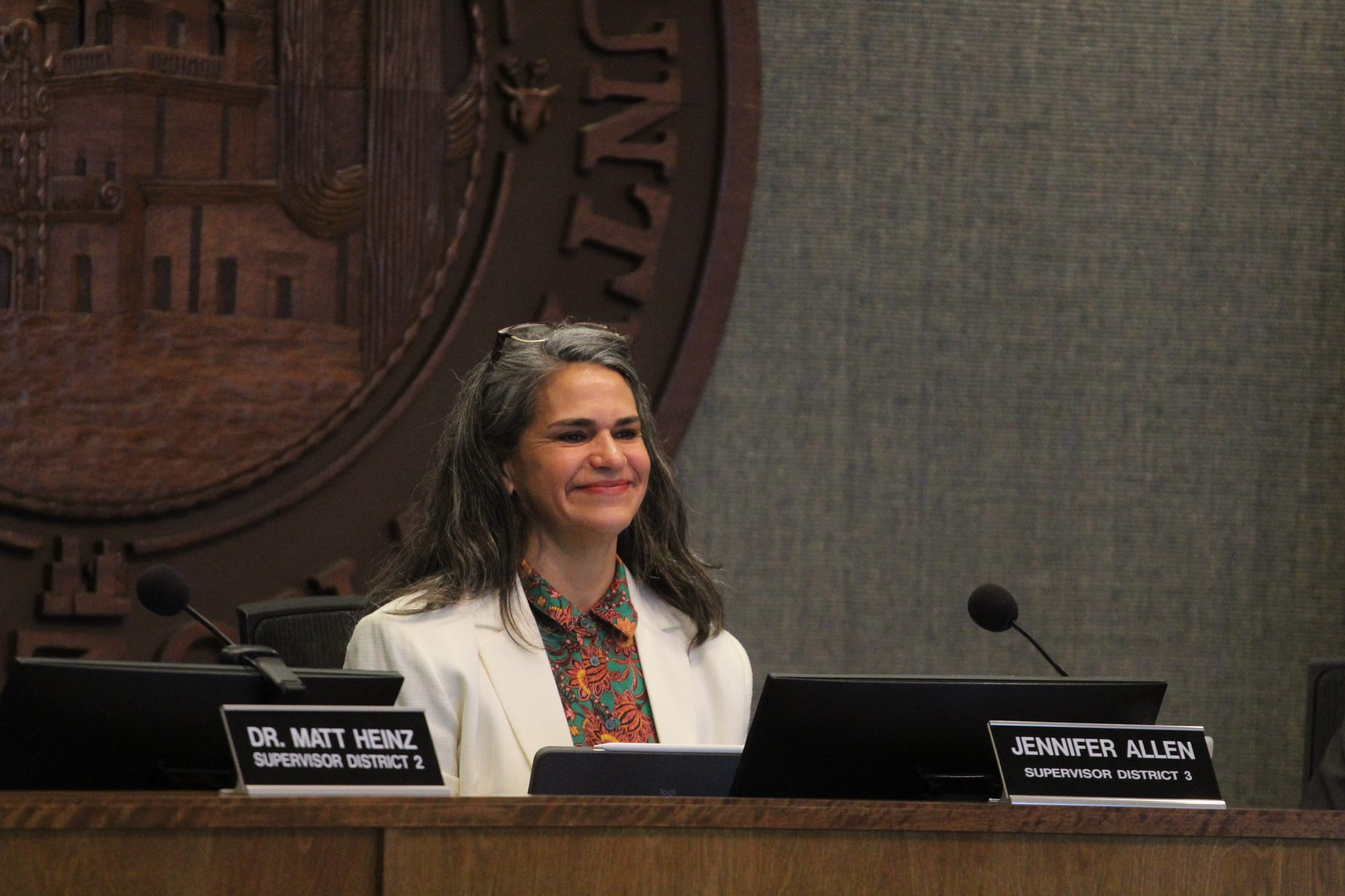
District 3 Supervisor and Board Chair Jennifer Allen pushed back against Christy’s proposal, arguing that recent immigration enforcement actions have caused harm in the community.
“What we have been witnessing is such an assault on people's safety and people's dignity that, like other folks in our community, I have been struggling to figure out what it is that we can do to stand up,” Allen said, adding that she has had family friends detained at the Florence Detention Center in the last two months, one of whom was denied access to necessary heart medication. “We have to stand up.”
Allen said she wanted the ordinance preventing county-owned spaces from being used for immigration enforcement to ensure that residents can continue to feel safe in libraries, schools and clinics.
Many local governments have passed similar ordinances, including the Tucson City Council.
District 1 Supervisor Rex Scott expressed strong support for the motion to prohibit county property from being used for immigration operations, adding that Christy’s retelling of events was not accurate and saying the county has received federal funds for the shelter and care of legally processed asylum seekers since the first Trump administration.
“I always supported accepting those funds and making use of them for one simple reason: it was a way of protecting public health and safety,” Scott said, adding that the policy prevented the street release of legally processed asylum seekers, which happened in other Southwestern cities, including San Diego and El Paso.
It also allowed Pima County to assist neighboring rural counties, including Cochise and Santa Cruz.
“Let's remember that (Alex). Pretti was shot by a Customs and Border Patrol official. Those are folks who are not supposed to be working within the interior of the country. They are Customs and Border Patrol, and yet this administration is sending them into the interior of the country where they are not trained to operate,” Scott said. “With regard to ICE, it is documented that they have scaled back their training standards. They have scaled back their hiring standards. They are operating under numeric quotas … that essentially call for 3,000 deportations a day.”
Christy’s substitute motion did not receive support from any other board members and therefore did not advance.
He questioned what would happen if immigration enforcement officials violated the ordinance prohibiting enforcement actions on county property, asking whether that would mean Tucson police or sheriff’s deputies would be sent to confront ICE, potentially resulting in an armed standoff.
“If there is any violence after this ordinance is passed, it'll be on the hands of my colleagues,” Christy said. “If you're asking for some sort of a civil insurrection, a violent one, you're treading on very dangerous territory.”
District 2 Supervisor Matt Heinz recalled his time in the state Legislature when SB 1070 was passed. Signed into law in 2010, SB 1070 was commonly known as the “show me your papers” law and required law enforcement officers to determine the immigration status of individuals they stopped, detained or arrested if there was reasonable suspicion they were in the country unlawfully.
Heinz said law enforcement’s role should focus on de-escalation, citing an incident in which ICE agents became surrounded in the parking lot of a Taco Giro and had to call the Tucson Police Department for assistance in leaving the area.
Allen said she believed the increasing practice of immigration agents wearing masks has significantly contributed to fear in the community. She said that concern prompted supervisors to put forward a motion directing staff to draft a second ordinance that would ban the use of face and vehicle masks by law enforcement at the local, state and federal levels, and instead require officers to wear proper identification.
“Secret police do not display their names or their badge numbers, and they wear face coverings to hide their identities,” Allen said. “The state of Arizona that has a history of rogue vigilante groups and where people openly carry visible and concealed guns having masked unidentified agents is a powder keg waiting to explode. So, let me be clear. This sort of behavior is textbook authoritarianism and should terrify all of us.”
Christy offered a second substitute motion to draft an ordinance banning doxxing — defined as the public release of a law enforcement officer’s personal information — while also requiring officers to wear identification. The motion failed after it did not receive a second, though Scott said he sympathized with the intent.
District 5 Supervisor Andrés Cano shared Allen’s concerns but urged the county to remain mindful of its legal limitations, including exemptions for personal protective equipment and the extent to which it can influence law enforcement agencies beyond the Pima County Sheriff’s Department.
Heinz said he believed the issue falls within the board’s purview because it has authority to regulate matters of public health. He argued that the “questionably legal” detention of individuals — and, in some cases, physical harm — could be legally defined as a public health matter due to the resulting injuries and widespread public anxiety.
“I do believe that this represents a significant public health threat and that we could possibly frame an ordinance in such a way relying on that public health authority to eliminate that public health threat by requiring full transparency and no masking of law enforcement agencies, with the exception for legitimate need for a health issue,” Heinz said.
The board also addressed concerns about the possible expansion of immigration detention facilities in the region.
The resolution opposing the establishment of an ICE detention center in Marana centers on the purchase of the now-closed Marana Community Correctional Facility by Management and Training Corp., a move that has drawn scrutiny from community members. Allen said MTC has submitted a request to the Department of Homeland Security seeking approval to open the facility, which she said is presumed to be for immigration detention. She also thanked community leaders in Pinal County and Marana for their efforts to oppose the facility’s reopening.
“They are warehousing our community members. We have seen deaths of folks in detention centers for lack of medical care,” Allen said. “MTC facilities across the country are riddled with lawsuits for the treatment of people in MTC facilities, for the conditions inside those facilities and by employees in those facilities for bad working conditions, for those that show up day in and day out. This resolution, I think, is essential for us to take a stand as the board of supervisors that we do not want this for our community, that warehousing our loved ones, our neighbors, our patients, our students, our employees is not the solution.”
Cano asked the health department to prepare a summary outlining how the county would prevent the spread of infectious diseases at the facility, citing a recent measles outbreak in Pinal County. He said he did not believe the private prison operator’s claims that health care would be provided in a timely manner.
“This is a superfluous, unnecessary action,” Christy said of the resolution. “You're more than welcome to take it, but it certainly is a lot like many of our resolutions. They don't mean a thing.”
Scott said he supported the resolution and opposed the proposed Marana detention facility but, like Christy, questioned the board’s jurisdiction over the matter. He asked the Pima County Attorney’s Office to determine whether the county has any authority over Marana’s zoning laws.
Ian Stash is a journalism major at the University of Arizona and Tucson Spotlight intern. Contact him at istash@arizona.edu.
Tucson Spotlight is a community-based newsroom that provides paid opportunities for students and rising journalists in Southern Arizona. Please consider supporting our work with a tax-deductible donation.