Arizona advocates say Prop. 139 hasn't solved abortion access
Reproductive rights advocates, congressional candidate JoAnna Mendoza and state Rep. Stephanie Stahl Hamilton gathered in Tucson to argue that despite Prop. 139's passage, Arizona women still face significant barriers to abortion access.
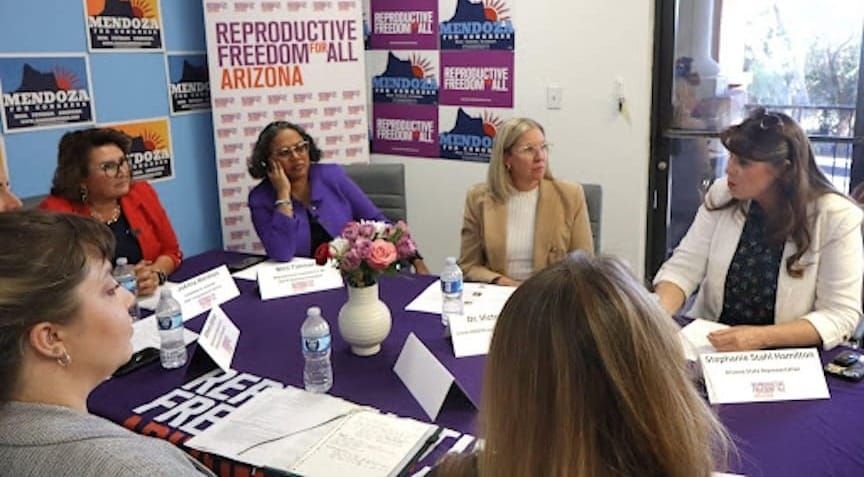
Reproductive rights advocates, a Democratic congressional candidate and a state lawmaker who helped repeal Arizona's 1864 abortion ban gathered in Tucson last week to argue that Prop. 139's passage has not translated into access on the ground.
Democratic candidate for Arizona's 6th Congressional District JoAnna Mendoza joined Reproductive Freedom for All President and CEO Mini Timmaraju and state Rep. Stephanie Stahl Hamilton for the May 26 event, inviting three other women to join the conversation.
Timmaraju said that despite the large margin of approval for Prop. 139, which was meant to enshrine abortion access in the Arizona constitution, there is still much work to be done when it comes to access.
"Across this district, the nearest (reproductive care) provider can be hours away. Due to the Trump administration, Planned Parenthood in Arizona was forced to stop accepting Medicaid patients last October, which has had devastating consequences," Timmaraju said. "Having access to care is the biggest hurdle. We have the protection, but without access, the protection can only go so far."
Timmaraju disputed CD-6 Rep. Juan Ciscomani's claims to be taking a moderate stance, saying he is "hiding" the facts about his time in office.
She said Ciscomani "celebrated" the overturning of Roe v. Wade and voted to defund Planned Parenthood and Medicaid, as well as voting to restrict service members' right to travel to seek reproductive care.
"Folks who have done everything they can to protect our nation's freedoms having their own freedoms taken away," Timmaraju said. "We believe that (the district) deserves a representative that actually represents you, and that fights for the things that we know that the majority of Arizonans care about in this district."
Timmaraju praised Mendoza's work campaigning for Prop. 139 years before her run for office, and her ongoing advocacy for veterans and rural communities, who she said have been hit hard by the system.
Mendoza said the issue is personal to her. As someone from a rural community, she has experienced not having access to healthcare, saying those communities face the same struggles still today.
Your membership pays emerging journalists to cover Southern Arizona the way it deserves.
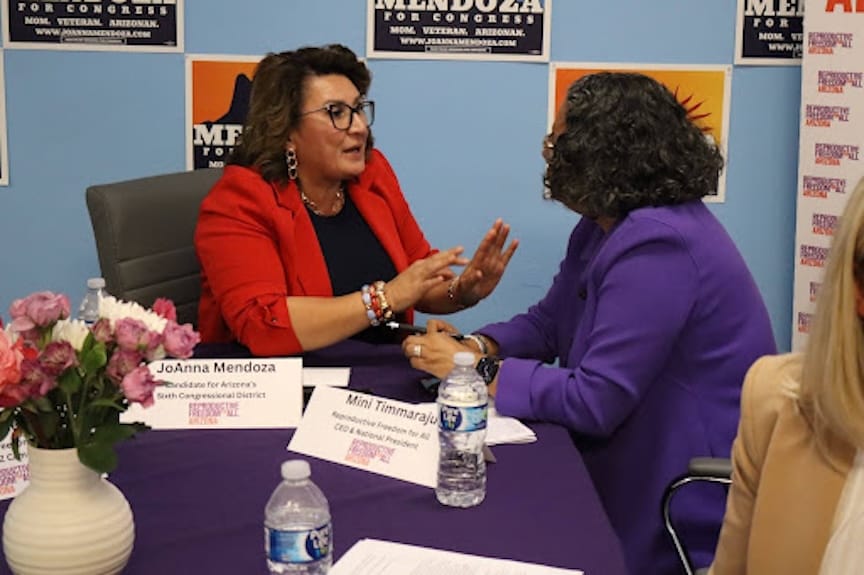
When a group of Arizonans began to push for the restoration of abortion protections in the state, Mendoza organized female veterans and military family members to form Operation Desert Rose, a coalition to protect women's reproductive rights and defend against restrictive state legislation.
"So many of us who have served, we have served overseas in the Middle East, we have come back to serve our communities. To take that fight up again after we had already won that fight was really an injustice, and to be quite honest, it pissed me off," Mendoza said. "We served, we sacrificed, we spent time away from our families, our friends. We've missed birthdays, holidays, and we come back to the homeland thinking we'll have the rights that we fought for, and we don't."
Mendoza questioned why veterans like her and future generations should be denied that choice, and vowed to be a steadfast supporter of reproductive rights.
Mendoza also spoke about cuts to safety net programs in the One Big Beautiful Bill, saying she grew up relying on many of them, including food stamps and Section 8 housing.
"It wasn't a handout for our families. Both my parents were farm workers that worked very hard, and like many folks in Arizona, that hard work doesn't come with healthcare," Mendoza said. "Right now, we're where families aren't able to make ends meet, and they rely on those programs to help them get through the month in a time where we're already experiencing tons of chaos."
She pointed to the consequences for rural areas, asking what it would mean for a mother with a high-risk pregnancy living two hours from the nearest provider.
Joining the discussion was Dr. Victoria Fewell, an OB-GYN and chair of the Arizona chapter of the American College of Obstetricians and Gynecologists, who said Arizona still has many laws on the books that restrict access to abortion.
She said the most egregious makes it illegal for doctors to refer patients for an abortion based on fetal diagnosis, even in cases of fatal anomalies. She pointed to another law requiring patients to wait 24 hours after consulting a doctor before obtaining an abortion, noting that many cannot afford to travel and spend the night during the waiting period. A separate law requiring an ultrasound before an abortion adds cost and another obstacle to the process, Fewell said.
Fewell said she and other providers still have to send patients out of state to receive an abortion.
Audrey Ford, a PhD candidate at the University of Arizona, began working with young people after the overturning of Roe v. Wade, saying there was immediate unrest on campus.
"We saw young people who were really fired up about abortion access, but kind of didn't know where to funnel that passion and that fire," Ford said. "I've gotten the privilege of working alongside young people who are trying to figure out like 'where do we go next?'"
Ford said students studying to become medical professionals are not being trained on abortion procedures, and noted that nurse practitioners were recently removed from campus for attempting to discuss abortion in the classroom.
Ford said she hopes younger generations will be able to grow up in an environment that fosters the freedom to talk about reproductive health that she and others used to have.
Jenalyn Lazena, a veteran and healthcare worker, said women in the military who are forced to carry a pregnancy often can't rely on multigenerational family structures to help them care for a baby once it is born.
"In the military, we swear an oath to uphold the constitution, and we risk our bodies," Lazena said. "We have the autonomy to risk our bodies. Why don't we have the autonomy to have that choice?"
Mendoza recalled her time as a drill instructor before women were fully integrated into the Marines, saying many of the women she trained had received no sex education and did not understand basic contraception, leaving her to educate them herself.
"It is really a matter of national security," Mendoza said. "If our service members are not healthy, if they have STDs, if they have a pregnancy, if they end up having a miscarriage and have to have an abortion, that not only impacts the individual service member, but it impacts the overall military and combat readiness."
Mendoza noted that military medical clinics keep bowls of condoms available for all service members, saying it is simply a matter of keeping them healthy.
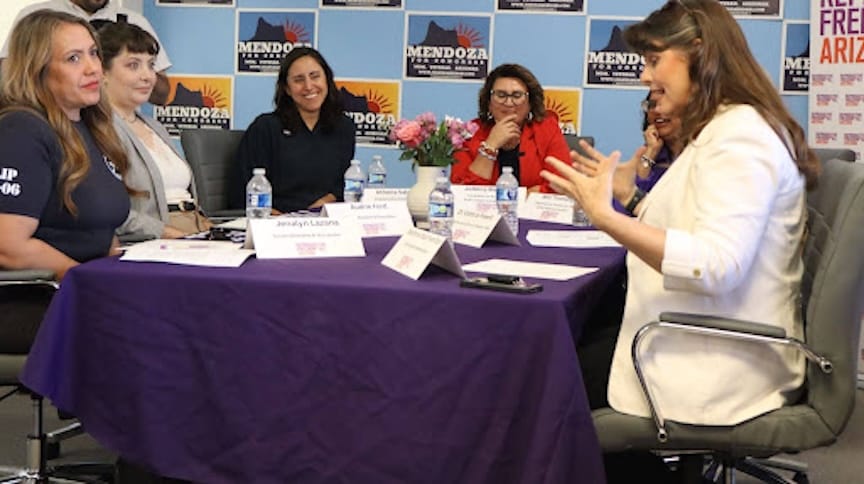
Timmaraju said the fight for reproductive health includes men too, since it involves the freedom to decide when, if and how to have a family. She said she has observed a growing pattern of men, especially young men, learning that for themselves.
"We can't win without men in the fight," Timmaraju said. "I also want my boys to have the freedom to have families as well with their partners in the future, and they currently have fewer rights than I have."
State Rep. Stahl Hamilton, who led the legislature's repeal of the state's 1864 abortion ban, said she used to lie awake worrying that the loss of Roe v. Wade protections would force the state to revert to older laws on the books.
She recalled the work that went into getting the governor to address the repeal of the 1864 law, the right to contraception and the unnecessary collection of personal data in her state of the state address.
In the months before the Arizona Supreme Court ruled on whether the state would readopt the territorial-era abortion ban, Stahl Hamilton said she was able to introduce bills on all three topics in the House and worked to build support for them, even doubting they would make it out of committee.
When Stahl Hamilton argued for the contraception bill, she was barred from using the word "contraception" on the floor. In protest, she got the caucus to wear pink.
The fight, Timmaraju said, is far from over, pointing to the large number of Arizonans who voted for Prop. 139 but still supported Republican candidates. She said the task now is to persuade those voters not to support candidates who would pursue anti-abortion policies.
Mendoza connected that to her campaign's effort to distinguish between "MAGA Republicans" and "McCain Republicans," saying she has seen Republicans approach her campaign who support reproductive choice. She predicted November will bring a "reckoning" that crosses partisan lines.
Timmaraju said Republican politicians have grown nervous about the abortion issue but still pose a threat, and would pass a statewide and nationwide ban if given the chance.
"They now know they have to hide it, they have to pretend to be a moderate, they have to pretend to compromise," Timmaraju said. "They know now that it's a powerful issue that their own base opposes them on."
Ian Stash is University of Arizona alum and freelance journalist in Tucson. Contact him at ianjgs16@gmail.com.
Tucson Spotlight is a community-based newsroom that provides paid opportunities for students and rising journalists in Southern Arizona. Please consider supporting our work with a tax-deductible donation.