University of Arizona hosts ‘Navajo Boy’ screening
The University of Arizona hosted a 25th anniversary screening of “The Return of Navajo Boy,” highlighting Diné family history and the lasting impact of uranium mining in Monument Valley.
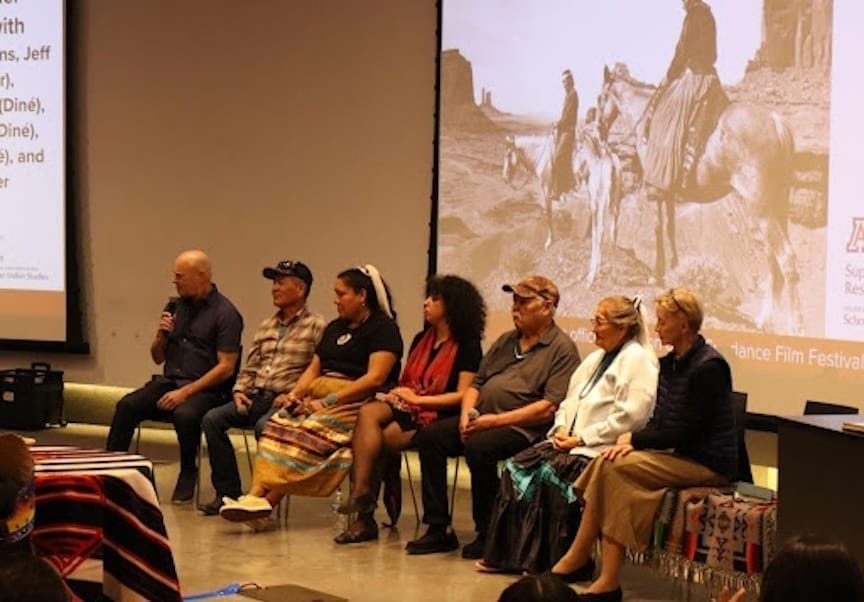
Family members, researchers and students filled a University of Arizona auditorium in February to mark 25 years since “The Return of Navajo Boy” first documented a Diné family’s story and the ongoing toll of uranium mining in Monument Valley.
Prior to the screening, director Jeff Spitz shared his experience making the film, describing his love of vintage photos and how he integrated them with stories family members told as they reflected on what the images captured.
“As an outsider, what I learned that is most valuable is something you don’t get to learn in school, it cannot be shown,” he said.
Spitz also spoke about his production partner, Bennie Klaine, who he said was essential in translating the Diné language — something he, as an outsider, could not do effectively.
Following Spitz’s remarks, attendees watched a full screening of the film, which begins with Lorenzo Begay meeting Bill Kennedy, the son of a filmmaker who created the original silent film “The Navajo Boy.”
Because the elder Kennedy never recorded narration or credits, his son sought out the Diné family members who appeared in the film, giving them an opportunity decades later to tell their own story.
Through interviews and archival footage, the documentary follows the Cly-Begay family in Monument Valley as they reflect on their childhoods, cultural traditions and the disruption of their lives by uranium mining.
Family members recount health struggles, lost livestock and the long-term effects of radiation exposure, while also sharing stories of ancestors such as Happy Cly, who appeared frequently in midcentury photographs and films but was rarely credited by name.
The film culminates in an emotional reunion with John Wayne Cly, who was separated from his family as an infant and later reconnected with them as an adult amid renewed attention to uranium’s legacy in the region.
An epilogue traces Elsie Mae Begay’s advocacy work as she travels the country speaking about the cancer deaths of her sons and the broader environmental injustices facing Diné communities.
The documentary also places the family’s experience within the broader history of uranium mining in the Navajo Nation, which expanded during the Cold War and left lasting environmental and public health consequences. In response, the Navajo Nation imposed a moratorium on new uranium mining in 1983 and later passed the Diné Natural Resources Protection Act in 2005, banning uranium mining and processing on tribal lands.
That history resonated beyond the screen. Several members of the Cly-Begay family attended the screening, including Elsie Mae Begay and John Wayne Cly.
Lorenzo Begay reflected on how his family has grown, welcoming new grandchildren since the film was produced, and said they now consider Spitz a member of their family after years of getting to know one another.
The conversation then widened beyond the family’s story to the film’s international reach and the broader legacy of uranium mining.
“We were able to have our film premiere in Kazakhstan,” Spitz said. “Kazakstan has indigenous people too. And they happen to be the miners of uranium in the world’s biggest uranium supplying-country, all of whom were forced to speak Russian and were part of these ‘nuclear colonization projects’ that has happened in Australia, New Zealand, Canada, Brazil, Kazakhstan. But unfortunately, uranium seems to grow underneath the feet of indigenous people.”
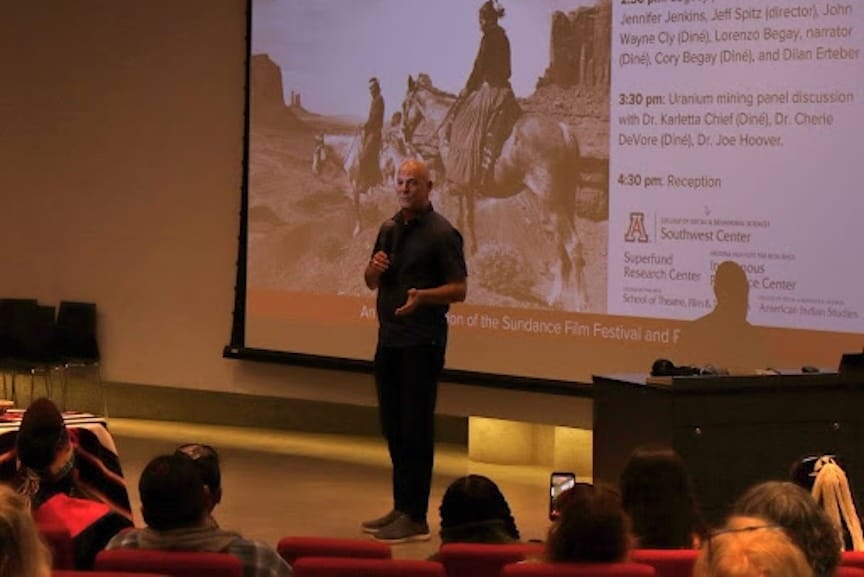
Spitz said he believes the environmental regulations referenced in the film are now “a thing of the past” and that this poses a threat, combined with the highest uranium prices in 15 to 20 years. He called on audience members to raise awareness about fast-track uranium approval processes and the need to protect environmental health.
The discussion then shifted to research and advocacy efforts tied to uranium’s ongoing impact. University of Arizona researcher Cherie De Vore told attendees she is the first and only Indigenous engineering professor at the university and one of six nationwide on the tenure track.
De Vore spoke about positionality, or evaluating one’s own position and power based on worldview, life experience and funding mechanisms. She said her field carries significant positionality because people are often more willing to trust and fund engineering endeavors.
“Positionality is becoming more and more an awareness that we should have,” De Vore said. “At the same time, when we welcome students from all intersectional backgrounds, indigenous students specifically, they are bringing with them their very, very unique strengths, assets and worldviews that enable the science to be better.”
Fellow University of Arizona researcher Joe Hoover spoke about a project in which he and his team began geotagging sheep grazing near uranium mines in New Mexico in 2017 to help the Navajo Nation understand how 52 abandoned mines might affect livestock, including sheep, cattle and goats.
The tagged livestock were found to have little uranium in their internal organs, as well as low concentrations in the soil and water where they grazed. Local herders, Hoover said, viewed the findings as confirmation of what they already knew because they avoid letting animals graze in irradiated areas. He added that the data played a small role in securing federal assistance for cleanup efforts.
“On one hand, it was a very expensive way to demonstrate what people already knew,” Hoover said. “But it was the language that USEPA regulators responded to in a positive way because we could demonstrate where these animals were going and it took the conversation in a slightly different way.”
Closing out the event, Diné University of Arizona student and Miss Native University of Arizona Daeyln Nez reflected on how she had heard about the “old ways” from her grandparents but finally had the chance to see what those times looked like with her own eyes.
“It’s hard being here as a student,” Nez said. “I’ve run into things that no other student should run into. Being an advocate for our native population has been hard, but I continue to do it.”
Ian Stash is a journalism major at the University of Arizona and Tucson Spotlight intern. Contact him at istash@arizona.edu.
Tucson Spotlight is a community-based newsroom that provides paid opportunities for students and rising journalists in Southern Arizona. Please consider supporting our work with a tax-deductible donation.