UA Innovation Expo showcases student startups
The University of Arizona’s McGuire Center Innovation Expo showcased student startups ranging from eco-friendly products to safety technology, marking the program’s 10th anniversary.
Student entrepreneurs unveiled everything from eco-friendly cleaning products to ballistic window blinds at the University of Arizona Mall last week during the McGuire Center for Entrepreneurship’s annual Innovation Expo.
The event, held Feb. 18, showcased ventures developed through the New Venture Development program and marked the center’s 10th year of bringing student-led startups to the public stage.
The McGuire Center gives students from a range of majors the opportunity to develop innovation and product design skills. The Innovation Expo allows teams to present their group ventures to the public and a panel of judges, who evaluate their potential for future development.
“These booths that these teams have set up today are just so much more intricate, involved and impressive than in years past,” said program coordinator Lindsay Sparks Figueroa. “It seems like every year, students just get more excited about how to entice people.”
The goal of the New Venture Development program is for teams to develop a business venture and prepare it for launch by the end of the year.
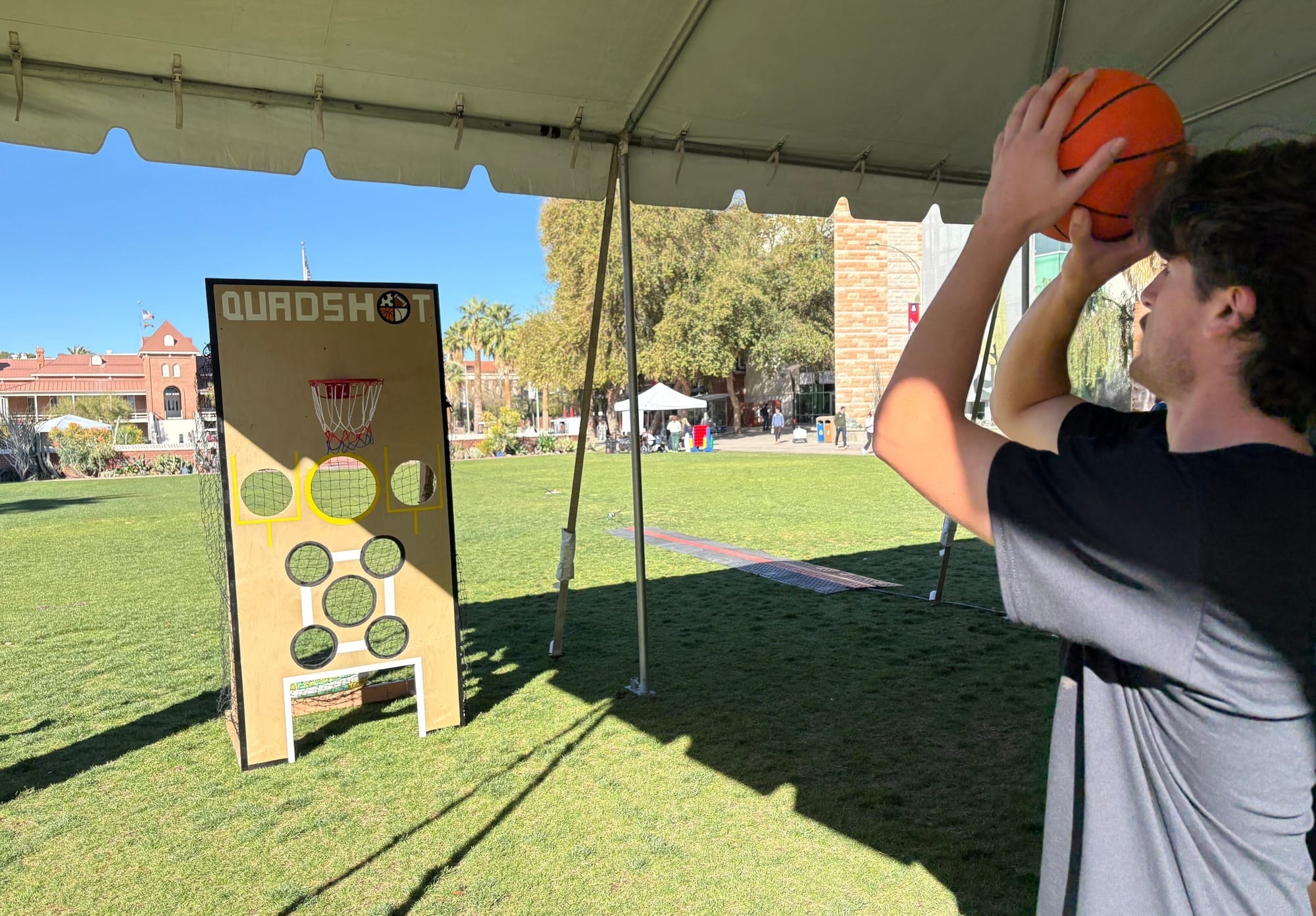
Because the McGuire program is not limited to Eller students, the range of product designs is broad, from eco-friendly wipes and recreational lawn games to barbell support cushions and ballistic window blinds.
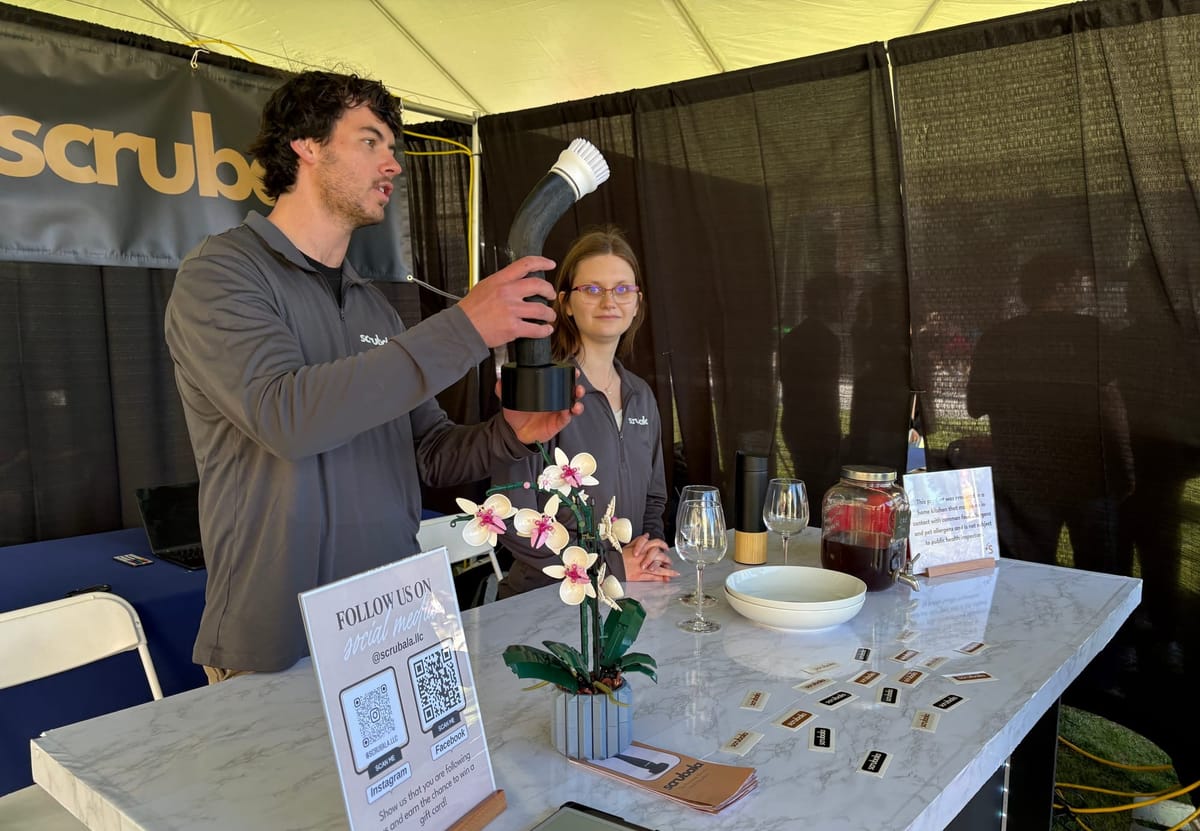
Andy Wages, a student promoting his team’s product “Scrubala,” said the idea for a handheld electric kitchen brush came to the group while shopping for cleaning tools.
“We want to downsize and make it way more appealing,” Wages said. “From there, we hope to launch by next year and have it ready to go by Christmas.”
Wages said the McGuire Center provided the team with the support and resources needed to develop the project.
“It’s awesome what all the advisors do for us and how much they help us with our innovative progress,” Wages said.
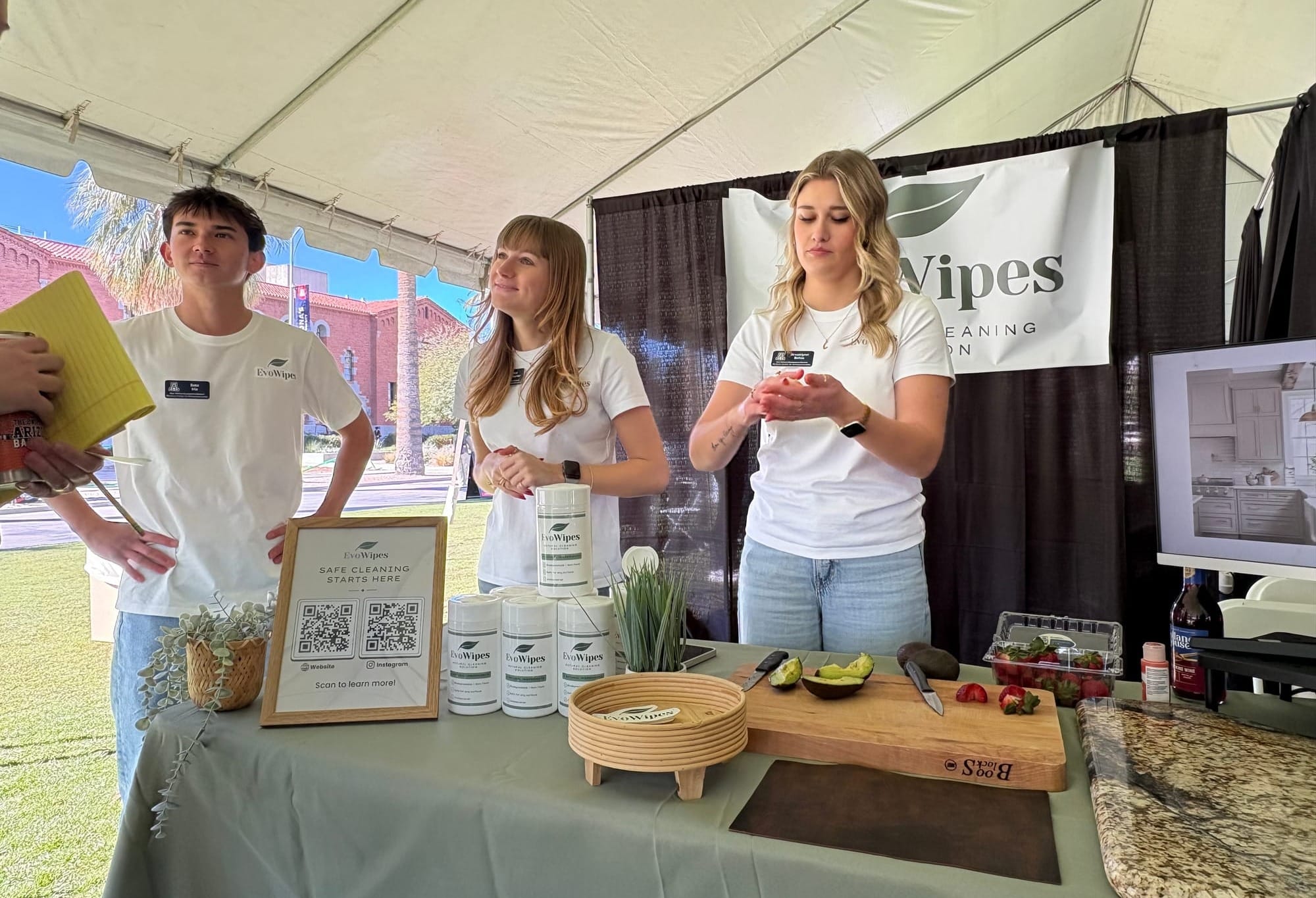
Similarly, Grace Deslaurier, Brooklynn Botos and Sota Irla developed “EvoWipes,” a non-toxic, biodegradable wet wipe designed for cleaning food preparation surfaces without leaving behind hazardous elements.
“Brook was definitely the main person who came up with this idea,” said Deslaurier.
The team said the idea quickly evolved beyond a single product concept and into a broader business strategy.
“We’re starting with just this baseline consumer product,” said Botos. “But our initial plan is a two-pronged approach for our go to market. So, starting with consumers and then branching into commercial space.”
Beyond convenience products, ventures like “Ilium” were inspired by a shared hobby. Paulina Ruelas said her team members frequently went to the gym and shared similar discomfort during barbell hip-thrust workouts. They named the product “Ilium” after the pelvic bone.
“We’re starting with just the hip-thrust pads, but we’re hoping to make a whole line of ergonomic pads,” said Ruelas.
The product improves on existing barbell cushions, which the team said are often cheaply made and prone to slipping. Their design features multiple layers of foam padding and a Velcro loop to help keep it securely in place.
Some of the most ergonomic designs were rooted in personal experience. Nisi Zarate said her team’s product, “Ankor,” was inspired by the story of teammate Adamaris Serrano, whose close family member lost an arm and much of their dexterity. As a result, everyday tasks such as fastening buttons and hooks became nearly impossible to do alone.
That’s why “Ankor” is modeled after a multicolor pen design. It is intended as an easy-to-use multitool to assist with everyday latches and clothing fasteners that many people take for granted.
One product, “Barricade Blinds,” was developed in response to repeated school shootings in the United States. Steven Raizer and Brooke Quinzi said the design combines Kevlar and high-molecular-weight polyethylene to create a reinforced window covering.
It is designed as an emergency window blind for schools that can be deployed quickly and magnetically secured to prevent tampering. The team displayed a scaled-up model at the Expo, making it one of the largest and most mechanically complex products on exhibit.
All participating teams will advance to the next stage of competition. On April 24 in Berger Auditorium at McClelland Hall, they will present updated versions of their ventures in a “Shark Tank”-style event. Finalists will compete for a $5,000 grand prize.
Quentin Agnello is a University of Arizona alum and freelance journalist in Tucson. Contact him at qsagnello@gmail.com.
Tucson Spotlight is a community-based newsroom that provides paid opportunities for students and rising journalists in Southern Arizona. Please consider supporting our work with a tax-deductible donation.