Tucson warned of major transit cuts if RTA Next fails
Tucson officials warned that failure of RTA Next in March could lead to major transit cuts and delayed road projects, as the City Council also voted to limit ICE use of city property.
With a March election looming, Tucson city leaders were warned that failure of the Regional Transportation Authority renewal could lead to sweeping cuts in transit service, delayed road projects and the loss of hundreds of millions of dollars in funding.
The warnings centered on RTA Next, a proposed renewal and expansion of Pima County’s Regional Transportation Authority that would extend the county’s half-cent sales tax for another 20 years, funding a $2.67 billion regional transportation plan that would support construction and transit-related jobs and allow long-planned projects to move forward. The proposal includes $726 million for transit services, $177 million for arterial and collector pavement rehabilitation, and funding for road, safety and mobility projects across Tucson and surrounding communities.
Tucson Mayor Regina Romero requested the update for the council’s Jan. 21 meeting, ahead of the RTA Next board meeting, to clarify how city services could be affected if Propositions 418 and 419 fail at the polls.
Proposition 418 would renew Pima County’s existing half-cent sales tax for another 20 years to fund RTA Next. That funding would support road repairs, transit service, safety improvements and major infrastructure projects across Tucson and the region.
Proposition 419 would authorize the specific RTA Next expenditure plan, outlining how tax revenue would be allocated among transit expansion, roadway improvements, pavement rehabilitation and other transportation investments.
City officials said failure of the propositions could result in major transit service reductions, stalled roadway improvements and the loss of long-planned regional investments.
Director of Transportation and Mobility Sam Credio told the council the city is focused on planning, designing and constructing the remaining projects from the 2006 RTA agreement, including the downtown links project, which is nearing completion in early 2026.
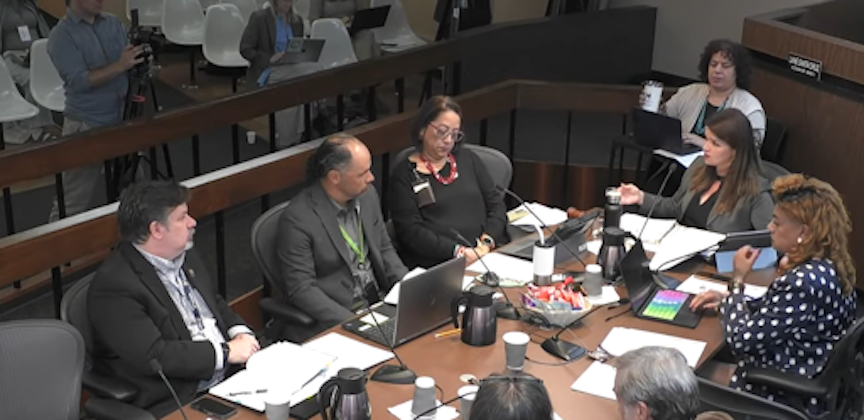
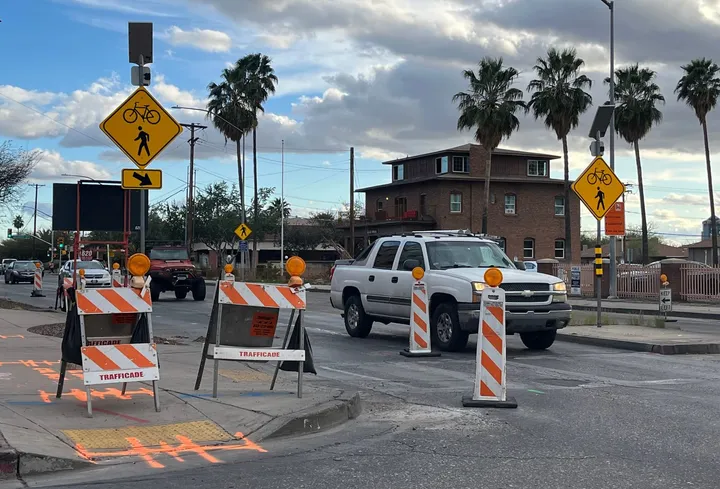
Credio also said the city is ready to begin work next week on the long-planned 22nd Street bridge reconstruction, a project that has been in development for many years and was awarded a grant. With demolition imminent, Credio said the road will close in early March and remain shut down for about two and a half years.
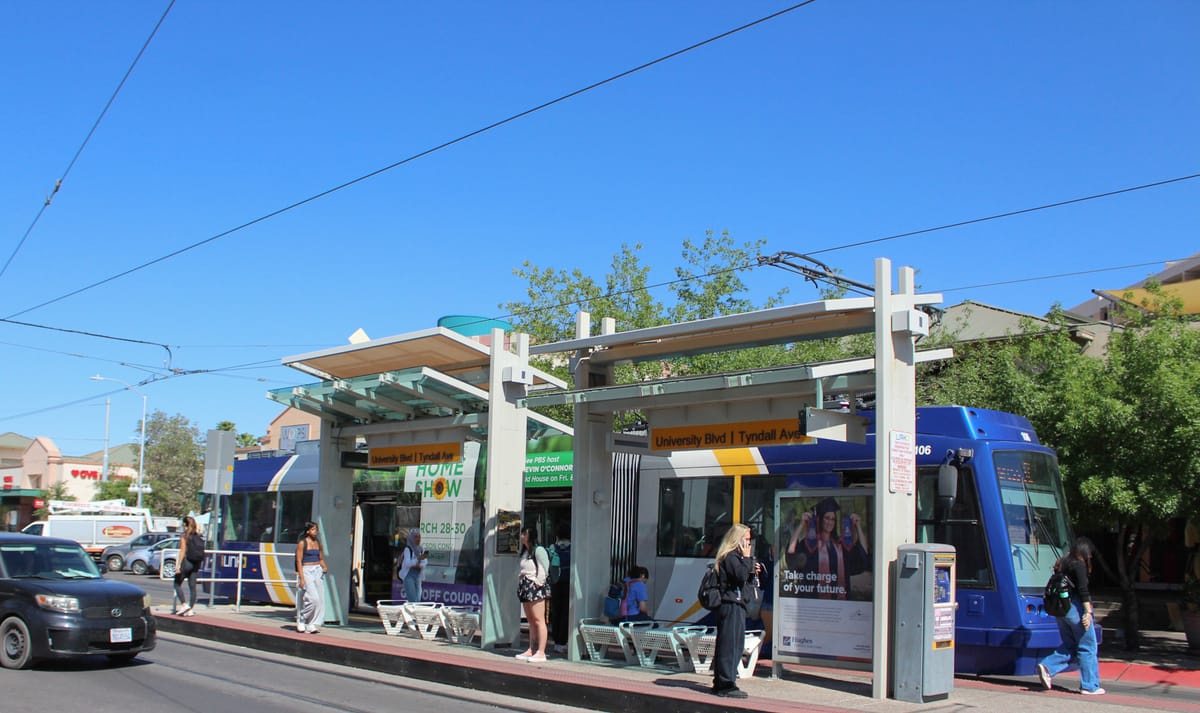
Tucson entered into two intergovernmental agreements with the RTA board in December, one approving projects to expand service areas, special-needs services and nighttime and weekend bus availability, and a second focused largely on transit service to other parts of Pima County, including South Tucson and Marana. Together, the agreements represent a $21.8 million investment, with $10.3 million allocated for services within Tucson and $11.5 million for services outside the city limits.
The plan also includes $177 million for arterial and collector pavement rehabilitation, including road repaving and modernization. That funding would not be available if the RTA Next plan is not implemented.
Of the 51 projects in the original RTA plan approved by voters in 2006, four are not yet complete. Two projects on Houghton Road and West 22nd Street were deferred to the RTA Next plan due to changes in scope, while projects on First Avenue and Grant Road phases five and six were deferred due to funding needs.
“If RTA Next is successful, we would maintain the current service levels, but we'd also look at reimplementing the recommended service changes that were included in the COA, which was approved back in 2024,” Credio said. “The other thing I want to note is that if the RTA Next plan is successful, there is $726 million of transit funding across the 20 years in the plan. Some of that funding does include funding for expanded service.”
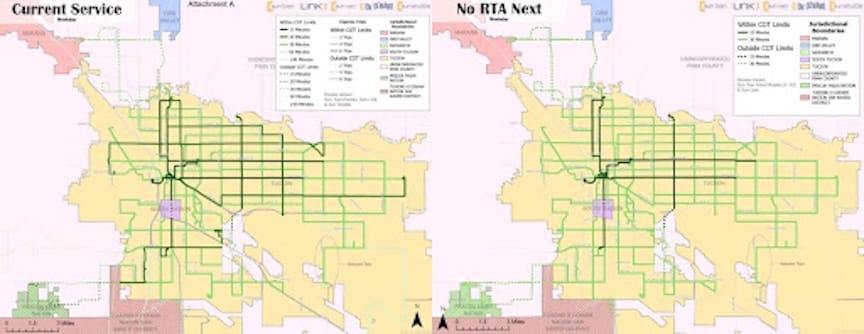
Failure of the RTA Next plan in the March election would result in a decline in city public transit service, including reductions of 141 weekday trips, 205 Saturday trips and 115 Sunday trips, according to Credio. That would translate to reduced service hours on 21 routes and longer headways on 13 routes. Credio also said the four projects from the 2006 RTA plan that carried over into RTA Next would be canceled.
Failure of the RTA Next plan would also eliminate the city’s two Sun On Demand service zones, which are fully funded by the RTA general fund. That would end 34 daily trips on 11 express routes, as well as Sun Shuttle and Sun Shuttle Dial-A-Ride service if the city is unable to raise $10.6 million to maintain those services.
Ward 6 Councilmember Miranda Schubert recalled meeting with a group of politically active constituents at a neighborhood association meeting who were angry about the RTA Next plan and described it as regressive. Schubert added that she did not want to “control the voters.”
“I just feel that by focusing exclusively on service losses and omitting discussion of backup strategies, shared responsibility or financial flexibility,” Schubert said. “We're being asked to support RTA Next based on worst-case assumptions rather than a full understanding of all of our options.”
Schubert cited the 22nd Street bridge as an example of what she called creative solutions for public transit, which she said remains an essential service.
Ward 5 Councilmember Selina Barajas spoke about public transit expansion under the plan and expressed doubt that the city will continue to be able to provide fare-free transit without RTA Next.
“I want to see those efforts succeed and I want us to be able to build upon that dream of bringing high capacity transit to the southern segment of that corridor, and I know that dream is many years from happening but making it a reality requires investment starting now,” Barajas said.
Romero, who said requests for road repairs are the most common requests she receives from residents, discussed her experience on the PAG RTA board and the planning process, saying she tried to fight for the best plan but was frustrated that numerous groups that could have participated never did.
“We don't know what's going to happen in March of this year with Proposition 418 and 419, but as mayor and council, we have a responsibility to talk about the potential consequences of not seeing an initiative that frankly all of us at this table worked really hard to get to where it's at,” Romero said. “Is it perfect? Absolutely not. Could we have more investment? Of course, we could have it all. But I think that it is important that my colleagues here on the council really know what the scenario is.”
In addition to the transportation debate, the council also took unanimous action on federal immigration enforcement, voting unanimously to prohibit federal agencies such as Immigration and Customs Enforcement and Homeland Security Investigations from using city-owned or controlled property to stage civil immigration enforcement operations.
The motion directs city staff to draft an ordinance covering any non-city use of municipal property without explicit permission and to establish consistent, citywide protocols for federal immigration requests and access to city property, including employee training, departmental procedures and a designated point of contact.
City officials said the city has clear authority to regulate the use of city-owned property through existing enforcement mechanisms, but council members expressed doubt about their ability to stop immigration enforcement operations on private property, citing concerns about potentially dangerous confrontations between the Tucson Police Department and ICE.
Several council members who have been outspoken about the Trump administration’s immigration policies said they are frequently approached by constituents asking what the city plans to do in response to increasingly controversial immigration operations, beyond steps the city has already taken, such as creating a Know Your Rights resources website.
Romero recalled the days of S.B. 1070, when she served on the City Council and approved changes to TPD policies to ensure people felt safe reporting crimes regardless of immigration status. She added that she has been in contact with mayors across the country to discuss issues such as the treatment of juvenile detainees.
Romero noted that Tucson’s form of city government limits quick, unilateral actions such as executive orders and said the city does not have the same level of support from the state Legislature as some other municipalities, which she said constrains the actions Tucson can take.
“I'm going to use this forum to call it what it is. It is fascism in America,” said Ward 3 Councilmember Kevin Dahl. “Our founding fathers did not envision the president having his own palace troops to be deployed wherever he wants. Greenland, Venezuela, Minneapolis, Portland. Hopefully not Tucson.”
Dahl said he believes the community would be better served if ICE’s budget were distributed to municipal governments to hire more police, adding that no one feels safe with ICE around.
Vice Mayor Lane Santa Cruz suggested following an approach she said is being used in Minneapolis amid publicized ICE activity, in which city staff provided guidance on designing signs that property owners could choose to post to restrict ICE activity on their premises.
“I will continue to make sure to work with other elected officials in the state to work with organizations that want to work with me and want to work with us to help protect our community,” Romero said. “I'm open and willing to work with anyone to help make sure that we are protecting our residents as much as we possibly can."
Ian Stash is a journalism major at the University of Arizona and Tucson Spotlight intern. Contact him at istash@arizona.edu.
Tucson Spotlight is a community-based newsroom that provides paid opportunities for students and rising journalists in Southern Arizona. Please consider supporting our work with a tax-deductible donation.