Tucson, Pima County take stock of public safety efforts
Local officials shared progress on their respective public safety initiatives, with both governments pledging to collaborate on issues too big for either to handle alone.
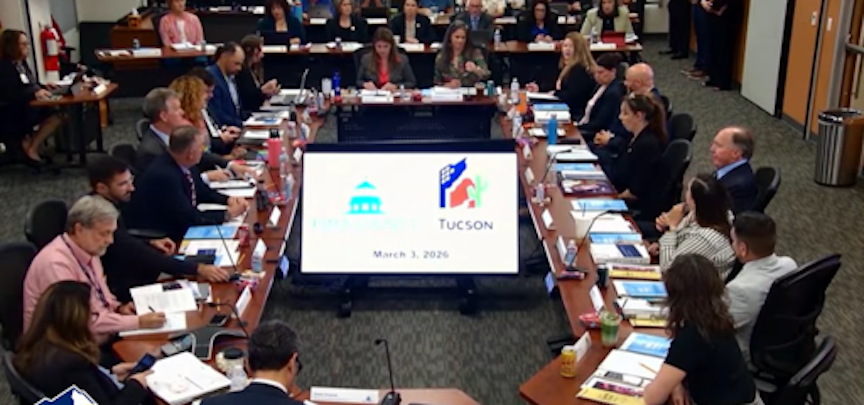
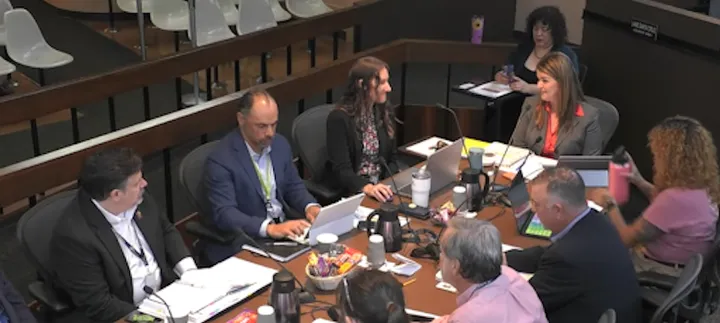
The Tucson City Council and Pima County Board of Supervisors outlined progress on their respective public safety initiatives at a rare joint session, with both governments pledging to work together on problems too big for either to solve alone.
The groups met March 3 in their second joint meeting to share updates and discuss collaboration on their respective public safety efforts: Tucson's Safe City initiative and Pima County's One Pima initiative. Officials with both governments expressed hope that the meetings would become a quarterly tradition.
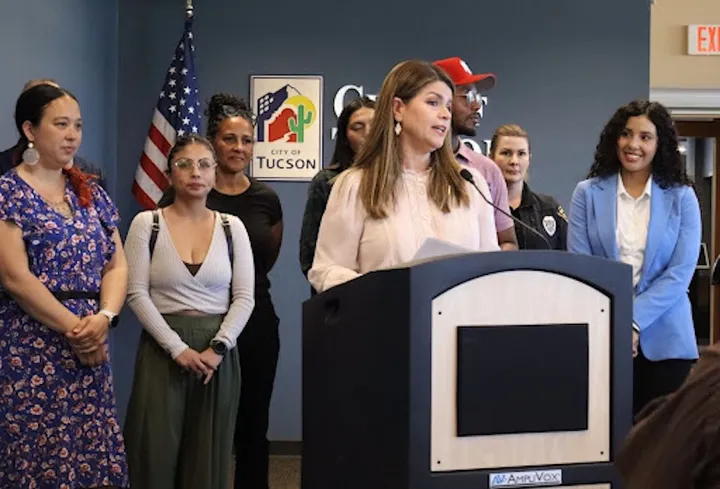
"Our intention is to find solutions," said Tucson Mayor Regina Romero. "Mutual solutions we all agree on on issues that are bigger than just one jurisdiction can handle."
Pima County's District 3 Supervisor and Board Chair Jennifer Allen outlined numerous efforts by both groups to address substance use disorders, mental health issues and homelessness.
She said cross-system collaboration is necessary because the problems of each jurisdiction bleed into one another, since Tucson residents are also residents of Pima County.
"We understand as evidenced by the complexity of the plans that we have in place that there is no single fix, right? Because at the root of it all is humans," Allen said. "And we are all complex little beings. So therefore, the problems and the solutions are complex and require not a one-size-fits-all and systems thinking. And I think this is evidenced by seeing that if you squeeze the balloon on one side, it pops up somewhere else."
Assistant City Manager Liz Morales shared updates on the Safe City initiative, which established a task force in November 2025 to review city policies, identify gaps and provide feedback through cross-representation.
The Tucson Police Department made 360 contacts with 328 arrests during 15 Safe City deployments. The 1,097 charges levied included 332 misdemeanors and 68 felonies, and resulted in the clearing of 15 encampments.
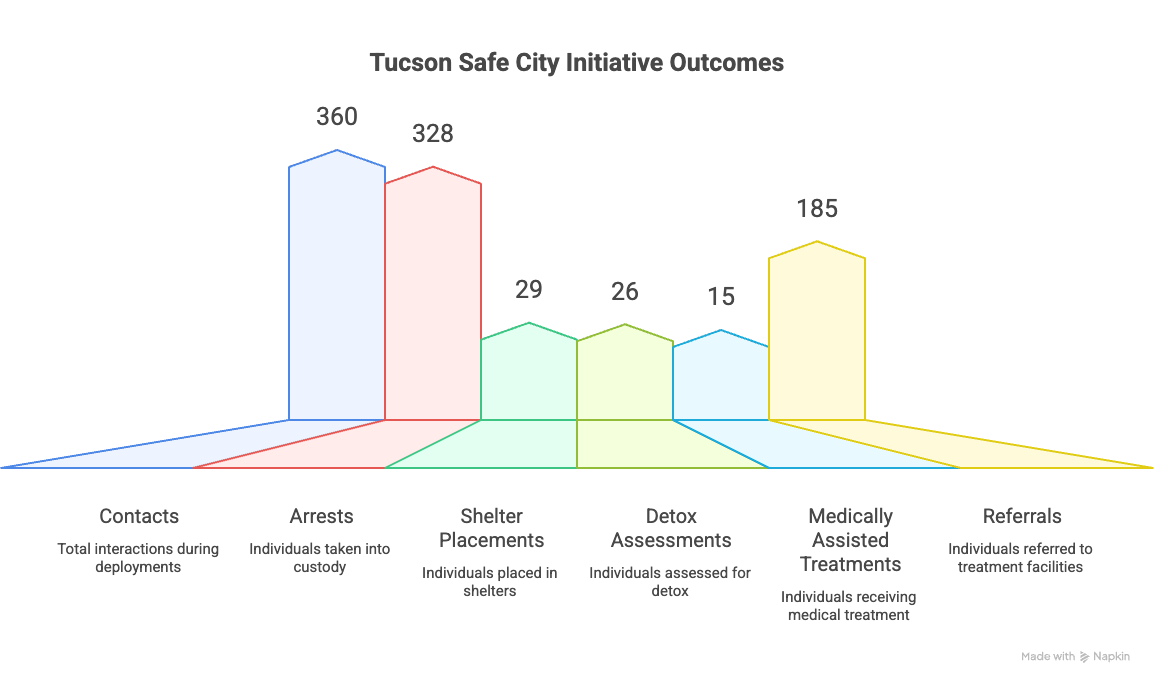
The Safe City initiative emphasizes treatment and stabilization over incarceration, with law enforcement assessing each person individually. Those 15 deployments resulted in 29 shelter placements, 26 detox assessments and 15 medically assisted treatments.
Before the Safe City initiative launched, the city made 95 referrals to substance or mental health treatment facilities. Since then, the number has nearly doubled to 185.
"While deflection is prioritized when feasible, we know that not every situation meets the criteria," Morales said.
The city has also been focusing on its STAR Village program, which aims to stabilize residents and fill the gap in low-shelter options. The outcomes-focused program has provided shelter and services to 73 individuals in roughly four months of operation, with cooperation from nonprofits and neighbor engagement resulting in a 34% reduction in police incidents. Four residents have been placed in permanent housing and eight in temporary housing.
On the legal side, City Attorney Roy Lusk created a draft ordinance that originally targeted open-air drug use but pivoted toward strengthening existing legal tools, improving charging documentation, clearer post-arrest treatment pathways and better cross-agency collaboration.
The Safe City Initiative's action plan is still in the draft stage, outlining defined strategies and measurable metrics, and is currently in the public engagement process.
"The action plan outlines and proposes clear priorities, roles and coordinated strategies across departments and partners," Morales said. "It has defined strategies that's paired with measurable metrics to ensure accountability to track progress and to guide continuous improvement."
Pima County presented its own efforts through the One Pima initiative, which prioritizes treatment and homelessness prevention.
The Pima County Health Department underwent a comprehensive evaluation of its treatment and housing plans, with a particular focus on heat-related collaboration ahead of the summer season.
"Right now we're dealing with a lot of issues with health care in general and how those that are willing to actually go through treatment, are they able to even um afford the services," said Deputy County Administrator Steve Holmes.
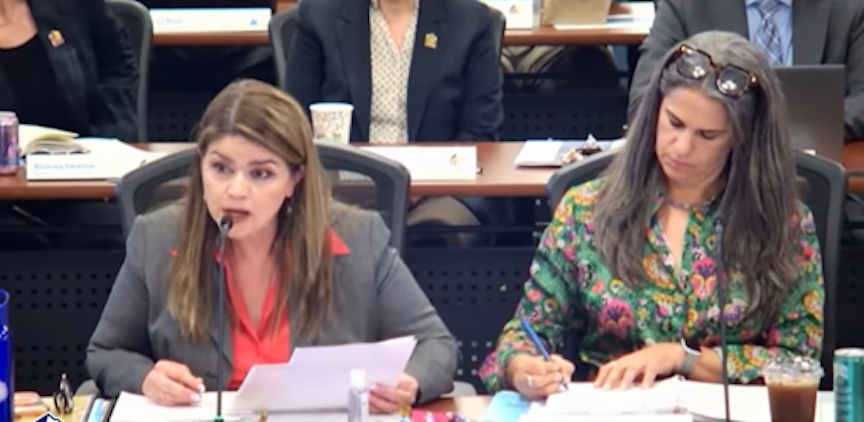
Holmes said the health department is planning to create a subdivision specifically to address environmental issues, including extreme heat.
The Pima County Transition Center will begin hiring in April to expand to seven days a week. The center has also been working with its Supportive Treatment and Engagement Programs with Services program, which provides roughly 686 qualifying individuals per year with resources, though only half completed the program. Both efforts operate alongside the county's Drug Treatment Alternative to Prison drug court system.
Pima County received $31 million in opioid settlement funds, distributed through various means, with a total of $126 million expected. Since the payments arrive unpredictably, Holmes cautioned against the county relying on a steady stream of funds. The last payment came in August 2025.
The county approved $8 million in allocations for request proposals, including $1.25 million each for youth prevention and peer navigation support, $2 million for traditional wraparound support, $600,000 for law enforcement co-response, $300,000 for medication-assisted treatment services, $2.2 million for Sobering Alternative for Recovery implementation over three years and $400,000 for Pima County Health Department overdose prevention staffing.
An additional $1.8 million was awarded in November 2025 for the SAFR pilot program and another $3.9 million in January for the four priorities.
Ward 4 Councilmember Nikki Lee compared the relationship between the city and county to two friends splitting a restaurant check, with Tucson as the friend "going broke" and Pima County as the one who just got a raise.
"To be completely honest, we are really struggling, and we're going to have really difficult conversations about programs that we have built that are above and beyond core services," Lee said. "We're going to have to have support from the county to help us carry, because we won't be able to carry that weight."
District 4 Supervisor Steve Christy said that while he believes treatment is a priority, the efforts don't do enough to address crime itself, despite crime reduction being the primary reason the community pushed for them.
"I see no analytics about how these programs have impacted one way or the other crime in our community and crime in our community was what created these demands for some sort of action, but all I've seen is treatment," Christy said. "What about what effect it's having on crime in our community?"
Romero disagreed, citing data from the STAR Village program indicating a 35% reduction in crime in the first five months.
Ian Stash is a journalism major at the University of Arizona and Tucson Spotlight intern. Contact him at istash@arizona.edu.
Tucson Spotlight is a community-based newsroom that provides paid opportunities for students and rising journalists in Southern Arizona. Please consider supporting our work with a tax-deductible donation.