Tucson grad helps run deep-sea livestream near Wake Island
Tucson’s Adam Harper went from watching Nautilus livestreams as a UA student to helping run one during a 30-day Pacific expedition near Wake Island.
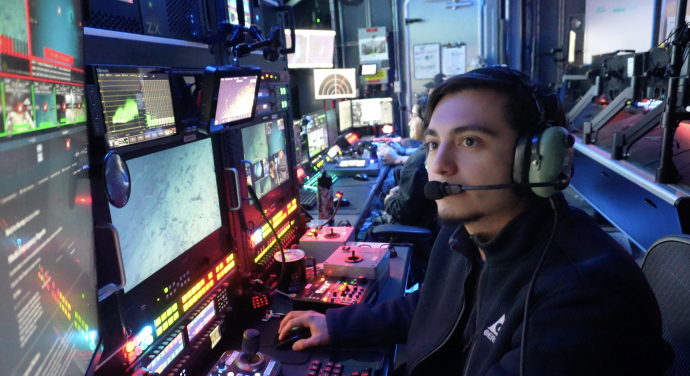
Adam Harper used to watch ocean exploration livestreams in the background while studying at the University of Arizona, and this summer he spent 30 days picking the camera shots for one.
Harper, a UA and Catalina Foothills High School graduate, worked as a video engineering intern with the Nautilus Live Science and Engineering internship program, a highly competitive opportunity that receives hundreds of applications each year.
As part of his internship, Harper participated in an exploration of Wake Island’s deep sea from Aug. 20 to Sept. 18. Located approximately halfway between Hawaii and the Mariana Islands, Wake Island is among the most remote landmasses on Earth.
The area has been surveyed before, including by NOAA’s Okeanos Explorer in 2016, but the Nautilus team was still breaking new ground.
“No matter what, we knew we were setting a new foundation,” Harper told the Tucson Spotlight.
The journey represented “one of the most poorly surveyed areas under U.S. jurisdiction,” according to Nautilus Live, which says most of the roughly 157,000 square miles of seafloor around Wake remains unmapped. The 30-day expedition used the remotely operated vehicle, mapping and telepresence systems of E/V Nautilus, with a focus on “science priorities of the Pacific Islands Heritage Marine National Monument and the Wake Atoll National Wildlife Refuge.”
Harper’s job was to run the livestreams, choosing camera shots for viewers and keeping the audio clear so the scientists could be heard.
“It’s a lot of button pushing and back-to-back action, but it’s an important position for sure, and one that has been an incredible opportunity to join the team and contribute,” according to nautiluslive.org.
Help us build local news that brings people together, not apart.
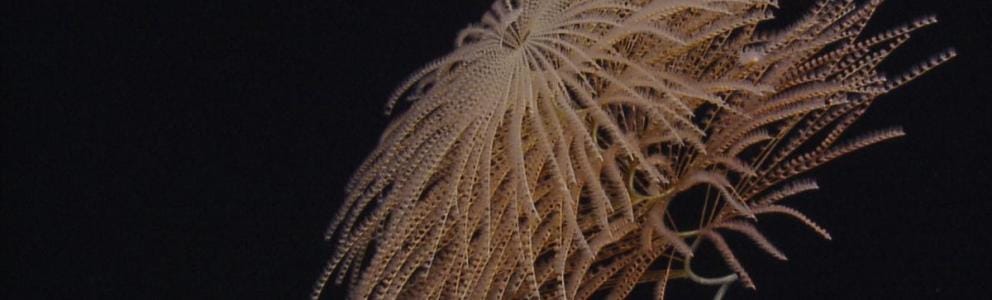
Nautilus produces 24/7 livestreams of its exploration vessel. Harper first learned about the program as a regular viewer, watching the livestreams in the background as he studied for exams. Harper graduated from the University of Arizona with a degree in film and television and a minor in marine sciences.
“Once I got (the minor) established, I would watch aquarium or nature ambience (channels), and while on one of those, I saw a video from a live stream at E/V Nautilus,” Harper said. “It wasn’t until 2025 I got home from working at Spirit Halloween. I had heard them say on their live stream that ... applications for the internship (were) open.”
Less than a year later, Harper was on an expedition of his own, exploring one of the least explored areas of the ocean. The trip set records for the organization.
“We mapped more seafloor than our organization has seen before,” Harper said. “We had spent many hours underwater, we had the record for the longest dives spent underwater, we were underwater for almost four full days, which is rarely seen in our organization.”
The trip was not all about records, though. Harper recalls both scary and fun moments.
“We ended up dodging a total of four typhoons and tropical storms due to the very active El Niño weather activation,” he said. “Even despite the trials, we still produced a high-quality stream and found important information for future dives.”
Harper, who had never traveled solo before, said the most stressful moment came about three nights into the trip, though not because of the travel itself.
“When I actually got on the ship and set sail, there were some things I needed to adjust to. But nothing that had me worried until about three nights in, during one of our extended dives, hearing lots of noise coming from a room that I hadn’t heard, and I was like, ‘Do we need to report this? Am I the only one noticing this engine draining in the room?’” Harper said. “Thankfully it ended up being a non-issue. There was a secondary door and someone just left it open.”
Harper found an unexpected link between his work with the University of Arizona hockey team and his job on Nautilus. He credits his past film jobs with preparing him for the work at sea.
“While I was at the U of A, I worked really closely with the hockey team. I was the technical director for broadcasting,” Harper said. “I can say confidently that my broadcasting internship helped prepare me for what I had to do with E/V Nautilus as well.”
As Harper settles back on dry land, his post-grad plans are still evolving. He plans to return to his family business and look for local film jobs, but the ocean is still on his mind.
“I’m crossing all my fingers and toes, hoping I could work with (E/V Nautilus) again,” Harper said. “I remember when I first got off the ship I instantly started looking for more opportunities with them or their partners.”
Macy Hernandez is Tucson Spotlight's social media manager and a journalism and business administration major at the University of Arizona. Contact her at macyhernandez@arizona.edu.
Tucson Spotlight is a community-based newsroom that provides paid opportunities for students and rising journalists in Southern Arizona. Please consider supporting our work with a tax-deductible donation.