Tucson considers new rules for large water users
Tucson officials are reviewing water policies regulating large water users after a new ordinance sparked community discussions about conservation and economic development.
Tucson officials are reviewing the city’s water policies after a newly adopted ordinance triggered discussions about how large water users should be regulated.
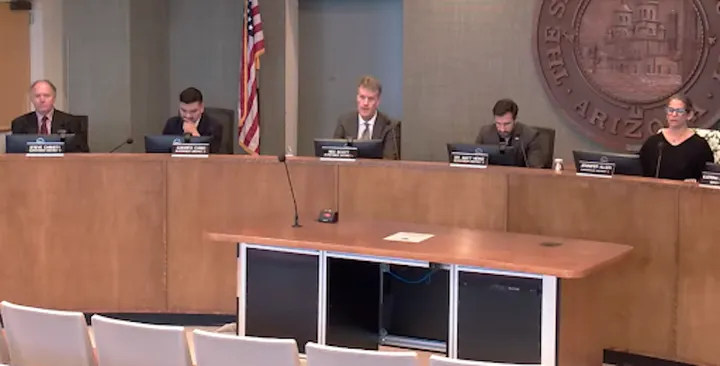
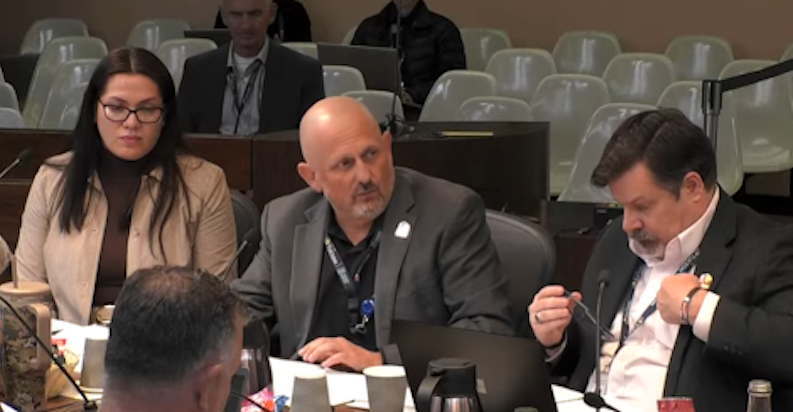
Amid ongoing concerns about Tucson’s water supply, city staff have been leading an ad hoc group made up of consultants, community members and water experts tasked with reviewing the city’s water operations and developing policy recommendations. The group’s leaders met with the Tucson City Council on Feb. 18 to provide updates and discuss potential changes to city water policy.
The effort stems from an ordinance unanimously approved by the Tucson City Council in August 2025 with input from local stakeholders concerned about water use in the region. City officials held four stakeholder meetings between October and December 2025 — more than the two meetings originally planned.
“The community has protections against a large water user coming in presently. The challenge was should that ordinance be uh amended or adopted or evolved to better suit Tucson,” City Manager Timothy Thomure said during the council's Feb. 18 meeting. “We did, quite honestly, bring that forward pretty quickly in order to just plant our flag.”
In addition to reviewing the ordinance, discussions with local stakeholders also focused on the city’s broader preparation for its water supply if a large water user were to enter the market, as well as existing safeguards. City officials said their goal was to remain neutral and provide a platform for the community to discuss environmental, financial and legal concerns.
One of the most discussed topics among community members, according to Tucson Water Director John Kmiec, was the threshold level. Under the City Council’s ordinance, the threshold is set at 10,000 centum cubic feet per month for large water users. Those users must disclose the purpose of their water consumption, and exceeding the limit would trigger water conservation strategies.
Kmiec said some members of the group expressed interest in changing the threshold, but the discussions did not produce a consensus.
There was also discussion about how to interpret the city’s water offset policy. Some participants believed an offset for drinking water could be met with reclaimed water, while others said it would require drinking water. Kmiec said there was “good discussion” on the topic.
“They recognize the flexibility in a water conservation plan is something that can be creative, either technically or scientifically, and and would help the community in the long run if we keep it broad enough where people can bring new ideas that haven't even been discovered yet in the water industry help save and conserve as much water as possible,” Kmiec said.
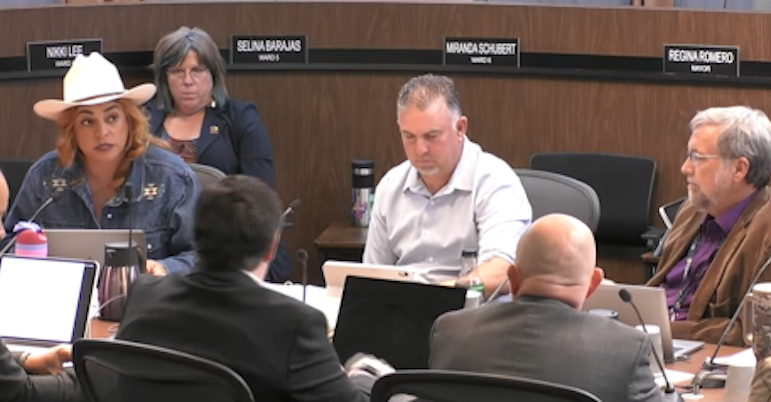
Mayor Regina Romero said the City Council rushed to pass the water ordinance last summer to address public calls for guardrails on large water users and based it on research into actions taken by other Arizona communities.
The ordinance was adopted amid sustained public pushback against AI data centers over water usage and other environmental concerns.
“This ordinance is really planning ahead on responsible water use and attaching economic development, the right type of economic development to water use in our community,” Romero said.
Several council members also weighed in on the policy discussion.
Ward 3 Councilmember Kevin Dahl said he supports net-zero water use in Tucson and the One Water 100-year master plan, noting the energy required to reclaim water.
“Doing zero net cost water means our current customers are not subsidizing these new users. The in lieu fees can be a great benefit,” Dahl said. “We know how to do water conservation. We can do it in lots of different ways, and we can do it in ways that support our most vulnerable neighbors who don't have the ability to do water conservation. It would help save their bills.”
Dahl also called for penalties targeting “big folks,” saying existing penalties, such as shutoffs, disproportionately affect lower-income customers who are unable to pay their bills.
Ward 4 Councilmember Nikki Lee said Tucson was the only city among its peers to lose jobs for two consecutive years. She also noted that about 4.5 billion gallons of water leave the urban system each year past Trico Road, raising questions about how the city could retain and use that water to support economic development.
Lee asked how the city could retain that water and use it to attract higher-quality jobs, and stressed the need for clarification on anti-evasion measures and the water offset rule.
Ward 1 Councilmember Lane Santa Cruz also raised concerns about the lack of tribal involvement in the process. She said inviting tribes to participate in a convening may not be the best approach but encouraged the city to have direct conversations with tribal governments to seek their feedback.
“We can't treat the tribes like they're another stakeholder or nonprofit,” Santa Cruz said. “We have to treat them like their own sovereign government entity and we should be communicating with them as such.”
Ward 2 Councilmember Paul Cunningham noted the absence of recreational water parks in the city. He recalled that Tucson had three water parks when he was growing up and said they could be beneficial in a warm-weather place like Tucson, though he added they can consume as much as 3.75 million gallons of water over roughly eight months each year. He said some circulating water parks can operate using about 27,000 gallons per month.
The council also heard an update at the meeting on PFAS, or “forever chemicals,” in the city’s water supply.
Kmiec said Tucson Water continues to meet all regulatory standards and that, in some cases, city standards are even more stringent than federal requirements, with Tucson targeting levels below 2 parts per trillion for PFOA and PFOS.
From Oct. 1 to Dec. 31, 2025, the city collected 449 PFAS samples across the system, and Kmiec said all potable water delivered to customers continues to meet those standards. PFAS detections caused 24 wells to be air-gapped from active service, with an additional eight designated for emergency use only. The remaining 10 TARP wells have been removed from potable use and are now used for recycled water.
Regarding groundwater extraction, initial well drilling and development have been completed, though the yield did not meet the anticipated capacity.
Ian Stash is a journalism major at the University of Arizona and Tucson Spotlight intern. Contact him at istash@arizona.edu.
Tucson Spotlight is a community-based newsroom that provides paid opportunities for students and rising journalists in Southern Arizona. Please consider supporting our work with a tax-deductible donation.