
Tech firms’ ICE ties spotlighted by #NoTechForICE campaign
Organizers with Mijente are raising awareness about technology companies supplying data and surveillance tools to ICE through federal contracts.
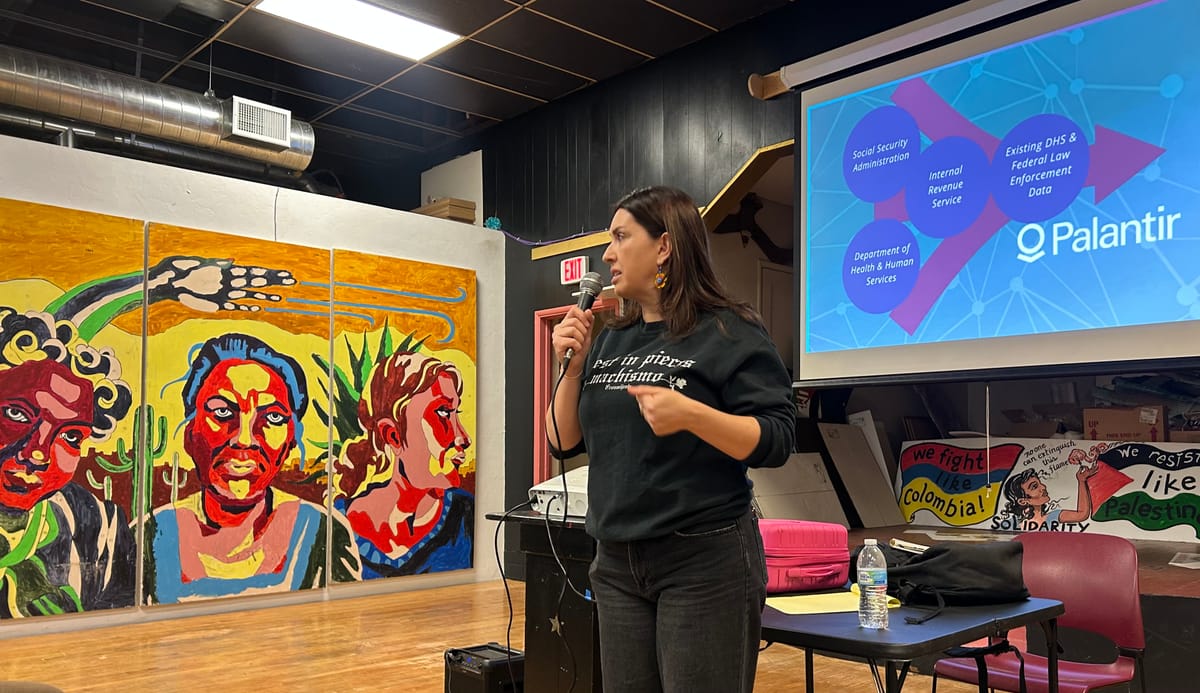
As immigration enforcement expands nationwide, a growing coalition of organizers is drawing attention to the technology companies quietly powering U.S. Immigration and Customs Enforcement operations, arguing that data tools and surveillance systems have become central to detention and deportation efforts.
Immigrant communities and overpoliced minority groups have long faced surveillance by ICE. But the Department of Homeland Security and its subagencies are not building that technological infrastructure alone. For decades, it has been fueled through contracts with major technology companies.
As detentions and disappearances increase in sanctuary cities across the country, so do the technological capabilities supporting federal enforcement operations.
The digital and grassroots Latinx and Chicanx organization Mijente is mobilizing across Arizona for its #NoTechForICE campaign to raise awareness about these partnerships and how they affect digital safety and privacy. The group’s latest stop was in Tucson for a Jan. 22 event at the Global Justice Center.
The campaign, led by Jacinta González, is informed by the group’s 2018 report, Who’s Behind ICE, an investigation of “the technology industry’s ‘revolving door’ relationship with federal agencies” and how these companies fuel immigrant arrest, detention and deportation systems. The research, commissioned by Empower LLC, is a collaboration between Mijente, the National Immigration Project and the Immigrant Defense Project.
“What we have seen happen is that the criminalization of migration has become incredibly profitable,” González said. “For a long time, it was profitable to the detention centers, right? CCA and GEO have made billions of dollars off detaining our communities. But now, the tech industry has also seen that it is an incredibly lucrative industry.”
Mijente has been fighting for immigrant justice since its inception in 2015 following the #Not1MoreDeportation campaign. Now, the group is visiting communities across Arizona to educate residents about these partnerships.
What are the major contracts between tech giants and DHS?
Companies including Palantir, Amazon, Salesforce, Microsoft and Hewlett-Packard hold contracts with DHS to provide digital tools used for detection and detention. Among them, Amazon Web Services and Palantir are currently at the forefront of technology supply and data storage.
About 10% of DHS’s $64 billion budget for fiscal year 2026 is dedicated to data management, with most data systems supporting immigration enforcement either hosted on commercial cloud storage platforms or in the process of moving to the cloud.
This shift is known as the cloud industrial complex, or the “public-private partnership among industry lobbyists, tech executives, key federal legislators, and tech executives-turned-government officials,” according to the report.
DHS maintains contracts with Amazon’s data management program, Amazon Web Services, to store case management information and biometric data such as fingerprints and iris and facial scans.
Amazon holds more federal authorizations to manage this data than any other technology company. In fiscal year 2025, Amazon held 114 authorizations under the Federal Risk Management and Authorization Program alone.
“All of this data tracking has really made it so that the Fourth Amendment is optional for agencies like ICE, because why would you get a warrant if you can purchase the information from a tech company?” González said.
Software and data analysis firm Palantir also sells two major operational tools to ICE, even as human rights organizations investigate its involvement in AI system development for the Israel Defense Forces.
Those tools include the Investigative Case Management system and the FALCON Search and Analysis system. ICM is the core case management tool for Homeland Security Investigations. Like other Palantir products, the FALCON-SA system maps relationships between people and places and creates data visualizations linking individuals, addresses, organizations and personal information.

What can residents do to protect their data and digital identity?
After Alex Pretti was killed by federal agents in Minneapolis, these companies have come under increased public scrutiny.
Anti-authoritarian organizers and scholars stress the importance of community members distancing themselves from a regime’s “pillars of support,” noting that businesses are among the most influential nonstate institutions within any political system.
Consumer pressure can influence corporate decisions, as seen with Avena Airlines and the Minneapolis Hilton hotel chain. Nonviolent civil disobedience and boycott tactics can also include setting up anonymous tip lines for employees to report ICE collaborations, leafleting customers about a company’s federal contracts or authorizations, and avoiding purchases from companies with federal partnerships.
“Student organizing against recruitment fairs, against contracts, against all of this has been super, super helpful,” González said. “Immigrant rights organizing, fighting to make sure you have better policies. Making sure you catch data loopholes if you do have a sanctuary city, making sure you cut Flock cameras, if you have them in your city, make sure that you don't get the extra drones that your sheriff wants.”
Mijente’s website provides a wide variety of toolkits for community and campus organizing. González stressed the importance of students and young people in these efforts and urged readers to explore the group’s #NoTechForICE student toolkit.
Ruby Wray is a journalism and creative writing major at the University of Arizona and Tucson Spotlight intern. Contact her at rubywray@arizona.edu.
Tucson Spotlight is a community-based newsroom that provides paid opportunities for students and rising journalists in Southern Arizona. Please consider supporting our work with a tax-deductible donation.