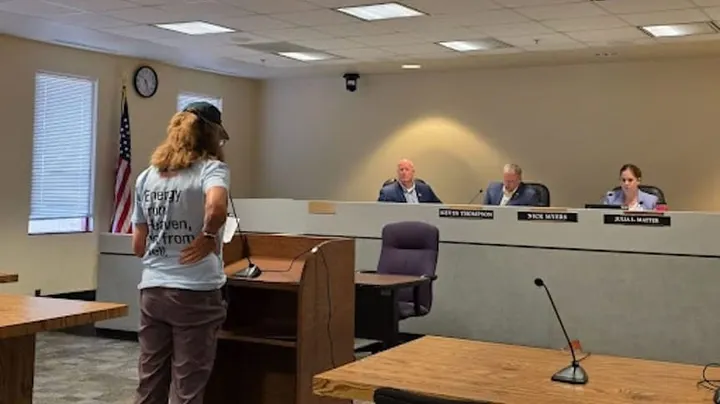
Supervisors to finalize Nanos inquiry questions
The Pima County Board of Supervisors voted unanimously to require Sheriff Chris Nanos to turn over records and testify under oath, citing concerns about his disciplinary history and conduct in office.
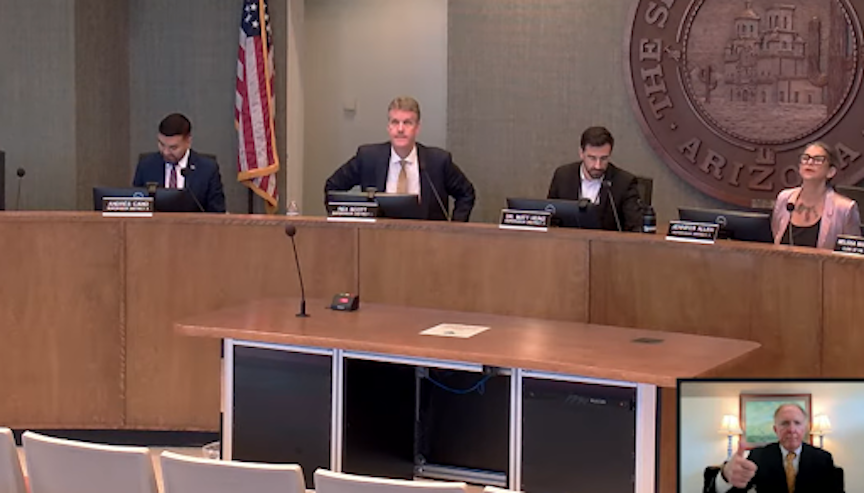
The Pima County Board of Supervisors is set to question Sheriff Chris Nanos under oath, with supervisors meeting today to finalize the scope of their inquiry, which could cover everything from his work history and internal affairs matters to immigration enforcement and other duties of his office.
Supervisors discussed the situation with attorneys during their March 24 meeting, voting unanimously to request reports from Nanos and for outside counsel to return with the reports during the April 7 meeting.
District 2 Supervisor Matt Heinz had previously expressed concern over Nanos' work history and apparent related false statements, and related personnel, management, internal affairs and investigative issues in the department.
Nanos started his career in law enforcement with the El Paso Police Department in 1976, staying there until his resignation in 1982. He received eight suspensions in that period for a total of 37 days, including for offenses including excessive force, illegal gambling, insubordination and discharge of his firearm. One excessive force complaint resulted in a 15-day suspension after Nanos reportedly beat a person in handcuffs with his flashlight, sending them to the ICU.
On July 21, 1982, the department recorded two allegations against Nanos for insubordination and "consistent inefficiency." Records show he resigned in lieu of termination on Aug. 3 of that year.
Heinz said Nanos was "not completely straightforward about the process" regarding his move from El Paso to Pima County, asking how this was able to happen. He said public records he requested showed that the information was omitted from Nanos' job application 42 years ago.
"You can't lie on your job applications, you can't lie under oath. What really affected me most about this was that the sheriff's history in Pima County for 42 years seems to have been based on fraud," Heinz said. "I feel very strongly about this. At a time when trust in our government entities, officials in particular, is at an all time low, having this kind of information come out about the highest-ranking law enforcement official for the largest law enforcement agency in Southern Arizona is very troubling and very serious."

Every law enforcement position except elected sheriffs and constables requires certification by the Arizona Peace Officer Standards and Training Board. Heinz said that could not possibly have happened in the case of Nanos if everyone was being truthful.
Heinz recalled previous issues involving the Sheriff's Department under Nanos' leadership, including a RICO investigation in 2016 that resulted in the conviction of the department's second-in-command but no charges against Nanos; controversy surrounding death rates in the Pima County Jail; and repeated years of the department exceeding its budget.
The board has repeatedly referred Nanos to the Arizona Attorney General's office for investigation, including once for election interference.
"This is about accountability and erosion of public trust," Heinz said.
State law allows the board to request reports and bonds from any county officer and require them to provide reports under oath about their duties. Failure to do so could result in removal from office.
The board's action comes as a recall campaign against Nanos is also underway, with organizers working toward 135,000 petition signatures ahead of a July primary.
Also during the March 24 meeting, the board approved by a 4-1 vote recommendations for the use of nearly $21 million acquired from Beale Infrastructure from the sale of 290 acres of land for their data center project, as well as the eventual $5.8 million in annual property tax revenue from the land.
District 4 Supervisor Steve Christy was the lone dissenting vote.
The Project Blue land deal closed Dec. 24 and resulted in a total of $20,855,849 going into county coffers.
County Administrator Jan Lesher reviewed the funding process along with the county's existing One Pima Initiative and Strategic Prosperity Initiative. The board approved the county administrator's recommendations, which appropriated those funds as follows:
$3,120,000 for various aspects of economic development $485,849 for intergovernmental relations $1,000,000 for special programs and projects $2,000,000 for neighborhood reinvestments $1,000,000 for environmental health initiatives $1,000,000 for workforce development $10,750,000 for capital improvement projects $1,500,000 for contingency
She added that the $21 million would be a one-time infusion of funds, and she was therefore skeptical of putting any of it toward long-term budgetary commitments.
With that in mind, approximately one-fifth of the funds will serve as a three-year "runway" while the county waits for Project Blue to develop and for property tax revenue to cover ongoing costs.
"We did then really recognize the unique nature of the public participation in this project, and therefore really realize the need to focus on environmental issues, on health issues, on things that we heard a lot about during the discussions on project blue that would be possible negative impacts on the community," Lesher said.
District 5 Supervisor Andrés Cano said that while he opposed Project Blue during the approval vote in December, he appreciated the recommendations for use of the funds, especially the $2 million for resurrecting neighborhood reinvestment, a program that was formerly bond-funded and would fund things like playgrounds, libraries, traffic development and infrastructure.
He added that the funds would also help address the environmental and affordability concerns that contributed to his vote against the original Project Blue approval.
Ian Stash is a journalism major at the University of Arizona and Tucson Spotlight intern. Contact him at istash@arizona.edu.
Tucson Spotlight is a community-based newsroom that provides paid opportunities for students and rising journalists in Southern Arizona. Please consider supporting our work with a tax-deductible donation.