
Sunnyside staff face Sept. 30 deadline for PTO buyback program
Nearly half of eligible Sunnyside Unified School District employees have applied for a new paid time-off buyback program.

Eligible Sunnyside Unified School District employees have until Tuesday to opt into a new paid time-off buyback program, with nearly half already submitting requests ahead of the deadline, district officials said.
The governing board reviewed the program and its early participation numbers during its Sept. 23 meeting.
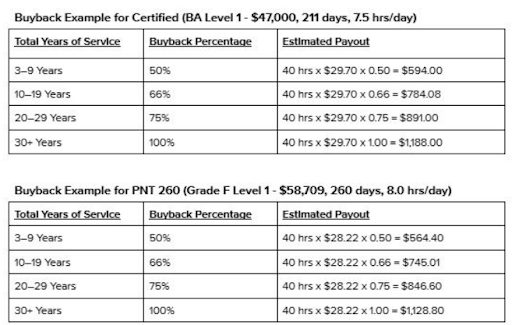
The program, which would allow employees to sell back up to 40 hours of unused paid time off depending on their years of service, has sparked interest among staff.
The district did not previously offer buyouts, though it has a payout policy for certified employees hired before 1992. This policy allowed employees to sell back PTO upon retirement or separation, but only a handful of employees were still eligible for the program, prompting the change.
The plan is tiered based on time working for the district, with buyback percentages at 50% for employees with up to nine years of service, increasing to 66% for 10–19 years, 75% for 20–29 years, and 100% for those with 30 years or more. Eligible employees must leave at least 240 hours in their PTO bank.
In a recent update, the district moved the payout date for hours to December, in order to ensure that staff receive their payouts during a non-pay week.
The district has sent out multiple reminders to eligible employees to ensure they meet the Sept. 30 deadline to submit buyback requests.
Chief Human Resources Officer Kathleen Sheppe told the governing board that 154 of 330 eligible employees have submitted requests to opt into the program.
Classified employees — staff who provide support services such as clerical work, custodial duties, or food service and do not hold teaching or administrative credentials — are not eligible for the buyback program. Sheppe said that was because they have not expressed interest in changing their current payout policy, though she noted it could be reconsidered in a future year. SUSD substitutes are also ineligible.
Board members also received updates on the district’s family support programs and facilities projects, including the Family Resource Center and the Parents as Teachers program.
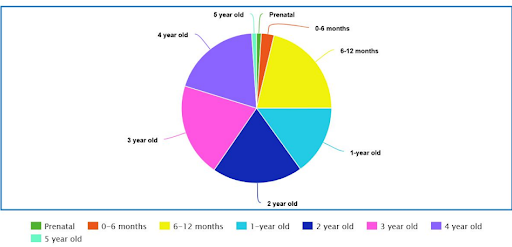
The program offers free services to families with children from the prenatal stage through kindergarten. Funding comes from grants and a 90-cent tax on cigarette packs, according to program coordinator Becky Ridge, who said Parents as Teachers currently has 199 enrolled families.
The program’s main goals are to equip enrolled 4-year-olds with kindergarten-ready skills and to provide developmental, hearing, and vision screenings for younger children, intervening when delays are identified. Ridge reported 81 developmental delay referrals last year, with language delays being the most common.
“The heart of our program is our home visitations,” Ridge said, explaining that the monthly home visits to each enrolled family allow staff to observe the development of children in their home setting and identify gaps in their developmental skills.
The visits also give staff the opportunity to help connect parents with resources such as healthcare coverage and certifications.
Ridge said the Parents as Teachers program conducted 2,167 home visits last year, about 5% of which were virtual. The program also held 19 community events, including a zoo visit and a story time at the community center, and connected families with material resources through organizations such as the United Way.
The Family Resource Center opened in August 2024 and is meant to provide in-person and online parent education classes and support to families. The center enrolled 132 new families since last year and will offer a total of 60 classes in October, according to Ridge.
“Our most popular and best-attended classes are our parent-child classes, where the parents come in and actually engage with their child,” Ridge said.
Superintendent Jose Gastelum expressed his support for both programs, talking about their impact.
“When we’ve attended the events … (participants) make it a point to stop me and stop others and say how proud they are to be a part of the program and that the experience they’re having is definitely a good one,” Gastelum said.
The governing board also unanimously approved raising the job-order contract limit to $1.5 million to replace the cooling towers in Summit View High School’s HVAC system.
Summit View has been experiencing HVAC problems due to significant leaks in both of its 100-ton cooling towers. The towers are considered beyond repair, given the number of systems and components that need to be replaced.
Chief Operations Officer Abel Morado noted that the system has not yet failed, but said it’s on its last legs. The estimated replacement cost is around $1 million, which matches the current job-order contract limit.
Morado said the district is asking the governing board to raise the limit to $1.5 million in case costs exceed the current cap or unexpected expenses arise. Funding would come from the district’s additional assistance allocation if the school facilities division does not provide it.
However, the school facilities board has already exceeded its $200 million allocation for the year, making it unclear whether the funds will be approved, even though the project likely meets the criteria.
Desert View High School experienced a similar HVAC failure, requiring the district to bring in a tractor-trailer as a temporary backup system.
Morado said the district plans to begin installing the new system at Summit View during the school year, using a temporary system to provide air conditioning rather than waiting until summer break. He added that the new system is expected to serve the school for the next 15 to 25 years.
After the governing board voted to extend the job-order contract limit, Gastelum told Governing Board President Beki Quintero that the current limit is outdated.
“At some point, we do have to revisit that policy,” Gastelum said. “It hasn’t been changed for years, and with the prices of things now, we probably need to look at upping that at some point.”
Ian Stash is a journalism major at the University of Arizona and Tucson Spotlight intern. Contact him at istash@arizona.edu.
Tucson Spotlight is a community-based newsroom that provides paid opportunities for students and rising journalists in Southern Arizona. Please consider supporting our work with a tax-deductible donation.