Rising traffic fatalities drive RTA safety discussion
Pima County leaders discussed transportation safety, RTA Next and rising traffic fatalities during a Jan. 29 Regional Transportation Authority meeting.
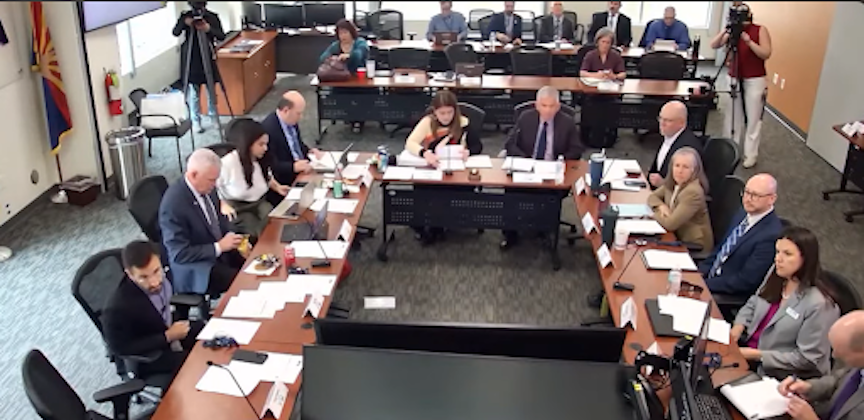
Facing a decade-long rise in traffic fatalities, regional leaders gathered Jan. 29 to address transportation safety in Pima County, with renewed emphasis on protecting pedestrians and cyclists through coordinated, data-driven solutions.
The Regional Transportation Authority is a voter-approved, countywide transportation funding program that plans, builds and finances major road, transit and safety projects across Pima County. Funded primarily through a half-cent sales tax, the RTA coordinates projects among local governments to improve mobility, reduce congestion and enhance safety for drivers, cyclists and pedestrians.
The discussion comes as voters prepare to decide the next 20 years of the region’s transportation plan in a March election on RTA Next, while leaders simultaneously confront a sustained rise in traffic fatalities that has elevated safety and equity as urgent countywide priorities.
Tucson Mayor and Regional Transportation Authority board Chair Regina Romero requested the meeting to discuss bicycle and pedestrian safety, with Pima Association of Governments Transportation Planning Director Jeanette DeRenne walking board members through the “Five Es” used to address traffic safety in Pima County:
- Enforcement of rules and regulations
- Education and spreading awareness about threats to safety
- Emergency response and improvement to response times
- Evaluation of plans and programs for all projects
- Engineering and implementation of physical safety infrastructure, such as guardrails, separate bike lanes and surveillance technology
PAG serves as the region’s metropolitan planning organization and provides the data, analysis and coordination that guide how RTA-funded transportation projects are prioritized and implemented across Pima County.
“We're aware that transportation safety is a multifaceted topic, and in order to be effective, safety considerations need to include a range of possible solutions,” DeRenne said.
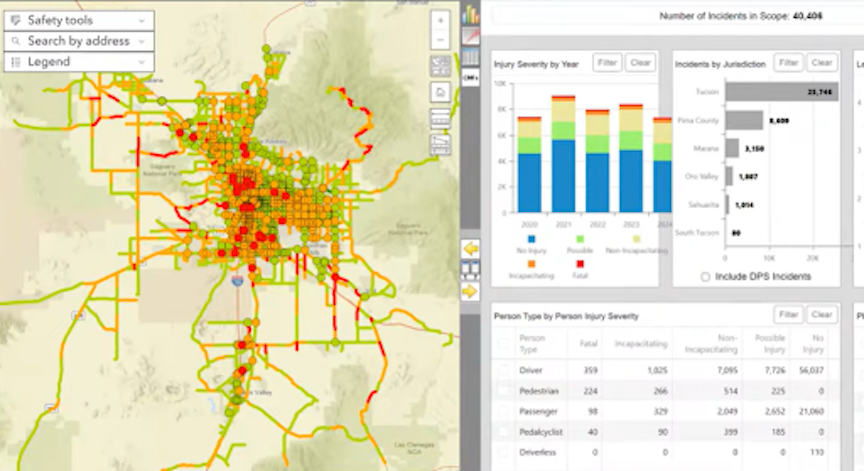
PAG established the Safety Explorer as a centralized hub for regional crash and emergency response data, combining records from the Arizona Department of Transportation with Tucson-funded initiatives and crowdsourced cellphone data. The tool tracks detailed crash information, including the number and type of incidents, severity, location, direction of travel, vehicle type and profile data for individuals involved.
PAG has also completed 75 road safety assessments since 2011, including independent safety reviews of corridors, intersections and designs.
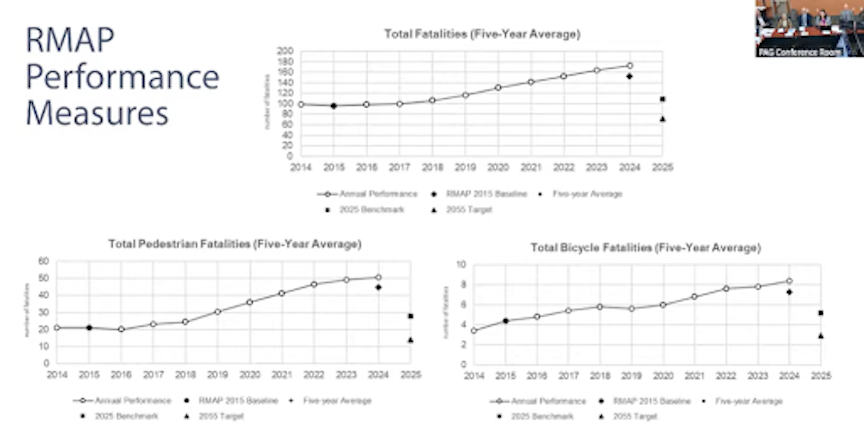
But the county is “trending in the wrong direction” with regard to safety, DeRenne said, with data showing 10 consecutive years of increases in car, bike and pedestrian accident fatalities.
To counter the trend, DeRenne pointed to the previously approved Regional Active Transportation Plan, expanded data analysis through tools such as the Safety Explorer and a more collaborative approach to funding. She said PAG’s data-driven strategy has the potential to make a meaningful impact on improving transportation safety.
Romero said she and the Tucson City Council have been working hard to address road safety, but she believes it is a regional problem and wants to add a sixth “E” to the list for equity between roads.
“Not all roads are created equal within our region,” Romero said. “There are certain areas that are much more dangerous for pedestrians than cyclists, even including cars. We’ve just got to work on a strategy where we're not duplicating the work, but bringing it all together.”
The city of Tucson has updated its transportation master plan, MoveTucson, to help prioritize investments for the most vulnerable users, efforts that have fed into submissions for RTA Next.
Tucson and PAG have received $30 million from the federal Highway Safety Improvement Program for projects such as narrowing travel lanes to control vehicle speeds. Officials also reported $850 million in capital investment projects planned over the next five years, including $550 million in collaboration with the RTA.
The city has also pursued strategies such as converting traffic signals on major corridors to adaptive signal control, a change officials said has resulted in a 60% reduction in red-light violations along those routes.
“We are hopeful that in the coming years these investments will start reversing these unfortunate trends,” said Andy Bemis of the city’s Transportation and Mobility Department. “We also know that engineering solutions alone won't solve the problem. We can't forget about the need for enforcement and the need for education.”
Vanessa Cascio, executive director of Living Streets Alliance, criticized the original RTA plan, saying road fatalities increased by 243% during its lifespan due to what she described as a prioritization of speed over safety. She said streets designed for speed and vehicle dominance are “inherently dangerous” and urged the board to focus on targeted safety investments rather than maximizing vehicle throughput at any cost.
“For the last few years, I worked nationally on evidence-based road street design, from local street design to federal legislation and I’ve seen how MPOs can move the needle, but only when safety is treated as a system, not a checklist,” Cascio said.
The board also discussed future high-speed rail development in Arizona and the broader region. Alvaro Madreal Montesa, head of the unit of economy, information and rail regulation with Mexico’s Secretariat of Infrastructure, Communications and Transportation, presented Mexican President Claudia Sheinbaum’s plan to invest in high-speed rail, including a line connecting Mexico City to the U.S.-Mexico border near Nogales. The project could also expand Arizona’s access to Mexico’s interior through improved cross-border rail connections.
Romero said cultivating tourism opportunities between the two nations is a priority, adding that she wants the rail line to serve as a catalyst for cross-border travel and economic exchange.
“Mexico is our number one trading partner,” Romero said. “We see the investment of Mexican companies in Tucson and in southern Arizona. And then, of course, the tourism piece, but just to make sure that the rail will have capacity for both passenger and tourism, but also for freight and economic development opportunities.”
Pima County District 2 Supervisor Matt Heinz said he wants the state to adopt a mirror plan that would connect with Mexico’s railway, expressing hope that he would one day be able to board a train in Tucson and get off in Mexico City.
“I drove to Mexico City one time, and I’ll never do that again,” said Tohono O’odham Nation Chairman Verlon Jose.
The board also heard a presentation from the Arizona Department of Transportation on the Arizona State Rail Plan, which outlines a proposed roughly 160-mile passenger rail corridor connecting the Tucson and Phoenix metropolitan areas based on data and recommendations from a 2016 passenger rail study.
Phase one of the program was approved in June 2025, with the second phase — project planning — currently under review by the Federal Railroad Administration.
Ian Stash is a journalism major at the University of Arizona and Tucson Spotlight intern. Contact him at istash@arizona.edu.
Tucson Spotlight is a community-based newsroom that provides paid opportunities for students and rising journalists in Southern Arizona. Please consider supporting our work with a tax-deductible donation.