AZ Corporation Commission hopeful takes aim at TEP
Johnathon Hill, a Democrat running for the Arizona Corporation Commission, says his science background will let him challenge utility rate hikes and data center deals.
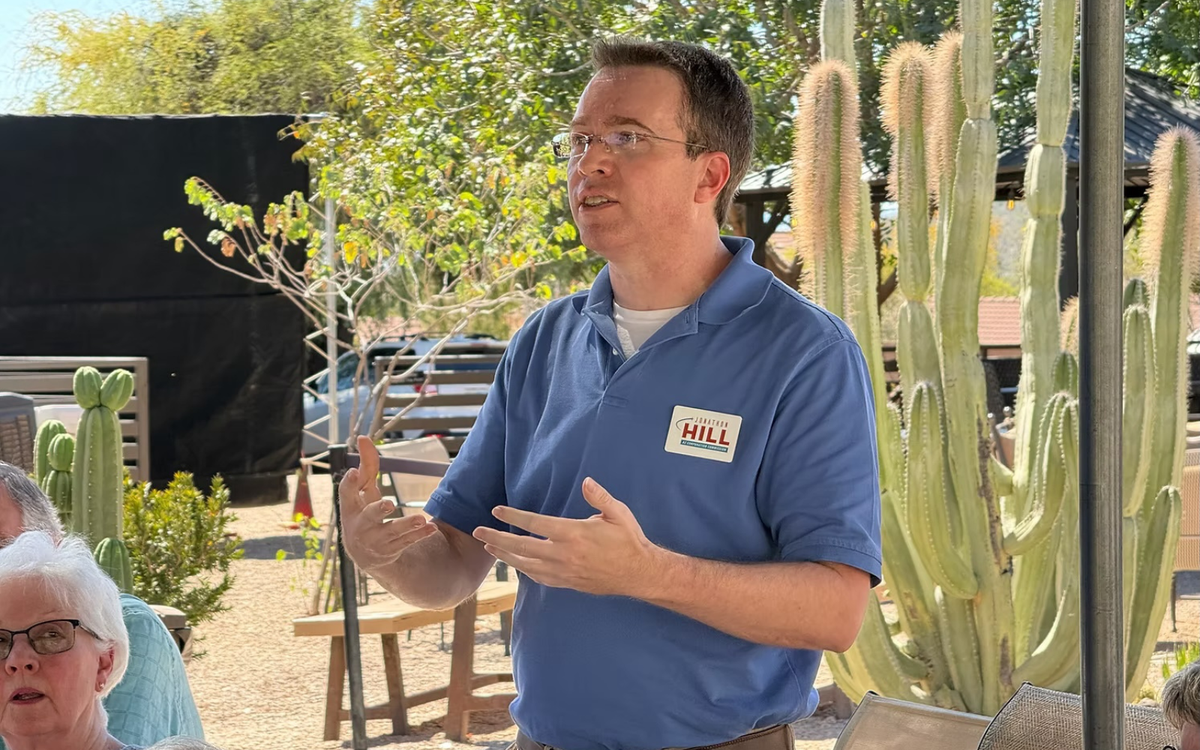
Johnathon Hill wants to turn the Arizona Corporation Commission back into a watchdog instead of what he calls a rubber stamp for utility companies, and he's betting his science background can get him there.
Hill, a Democrat, is a scientist, engineer and a self-described proud Arizonan. His campaign website promises he'll lower utility bills, protect water, limit data centers and restore transparency to the commission.
The corporation commission has been under public scrutiny since the current commission approved energy rate hikes and the "Project Blue" data center.
The five-member commission regulates the state's private utility companies, setting rates for electricity, gas, water and wastewater service. It also oversees business incorporation, securities and railroad and pipeline safety.
Commissioners serve staggered four-year terms, elected statewide, and are capped at two consecutive terms. Two seats are on the Nov. 3 ballot, both currently held by Republicans: incumbent Kevin Thompson, who won his primary, and Chairman Nick Myers, who lost his primary to state Rep. Ralph Heap.
Hill is campaigning alongside Clara Pratte with the two Democrats running as a joint ticket for the commission's two open seats. They face Thompson, Heap and Green Party write-in Mike Cease in the general election.
Rene Lopez, Lea Marquez Peterson and Rachel Walden, all Republicans elected in 2024, hold the three seats not up this year.
Your membership pays emerging journalists to cover Southern Arizona the way it deserves.

Hill said his master's degree in aerospace engineering and doctorate in geological sciences, both from Arizona State University, give him the knowledge to ask tough, technical questions when utility companies request rate increases.
"The corporation commission used to be an independent watchdog, but now it's become a lap dog for utility interests," Hill told Tucson Spotlight. "The commission has a responsibility to closely scrutinize rate cases, demand transparency from utilities, and work for the people of Arizona."
Hill said that if elected, he'll replace the current system of formula-based rate adjustments with a rigorous process. He also wants to restore full public hearings and ensure robust community input before any rate increase is considered.
"I will never approve a rate increase that merely lines the pockets of a utility company's investors," Hill said. "People cannot keep paying for corporate greed. While over 161,000 Arizona families are behind on their utility bills, utility companies are making record profits, and the Corporation Commission is letting it happen by approving outrageous rate increases."
Attorney General Kris Mayes, a former commission member, noted that a smaller rate hike, closer to 3%, would still have worked without penalty to the energy corporations.
Along with power, water is one of the most important necessities for people living in the Arizona desert. The commission also has regulatory authority over Arizona's private and investor-owned water and wastewater companies.
"The current commissioners have allowed too many of these companies to fall behind on maintenance and create rate shocks when they suddenly need to fund new infrastructure," Hill said. "It is possible to update infrastructure to better conserve water without passing exorbitant costs onto consumers, but the current commissioners don't seem to be acting in the best interests of Arizona residents. I will be proactive in working with Arizona's water companies to ensure the best service and affordability possible."

While power and water are issues that tend to overlap, one issue that touches both is the proposed "Project Blue" data center.
Analysis of the impact of data centers is ongoing, but there's evidence to suggest that construction and operation requires large amounts of energy and water. Beyond that, residents who live near the centers often complain about the noise.
There's new evidence that these large-scale computer systems also generate large amounts of waste heat, which gets vented from these facilities through water or air circulation. The result is rising temperatures for communities near the megastructures.
Those concerns are part of why Hill has singled out the deal Tucson Electric Power struck for the project.
"The corporation commission must stop giving data centers secret, sweetheart deals, like the controversial agreement made behind closed doors with Tucson Electric Power for Project Blue," Hill said. "I strongly believe that data centers and other large corporate users should pay for the full cost of the infrastructure they require. Arizona residents and small businesses should not subsidize private development."
Hill is running under Arizona's Clean Elections system, which provides public campaign funding in exchange for forgoing private and corporate contributions.
His campaign has raised $174,655 in public funds and spent $166,802, leaving about $7,854 on hand, according to state campaign finance records.
Quentin Agnello is a University of Arizona alum and freelance journalist in Tucson. Contact him at qsagnello@gmail.com.
Tucson Spotlight is a community-based newsroom that provides paid opportunities for students and rising journalists in Southern Arizona. Please consider supporting our work with a tax-deductible donation.